There are many ethical questions propelling Vancouver-based writer-director Ann Marie Fleming’s new film Can I Get A Witness?, described as a sci-fi thriller set in the near future starring acclaimed Canadian-born actress Sandra Oh.
But by far the plot’s biggest ask — beyond whether society could reset itself to an agrarian milieu in exchange for world peace, equality, and environmental stability — is whether people would willingly sacrifice themselves at age 50 to make it all work.
In Can I Get a Witness?, people do just that, thus ensuring all life on the planet is serene and without real or existential peril. Alas, it’s also without electricity, cars, iPhones, and unlimited water consumption, as decreed by Fleming’s fascinating fictional Universal Constitution of Human Rights and Responsibilities.
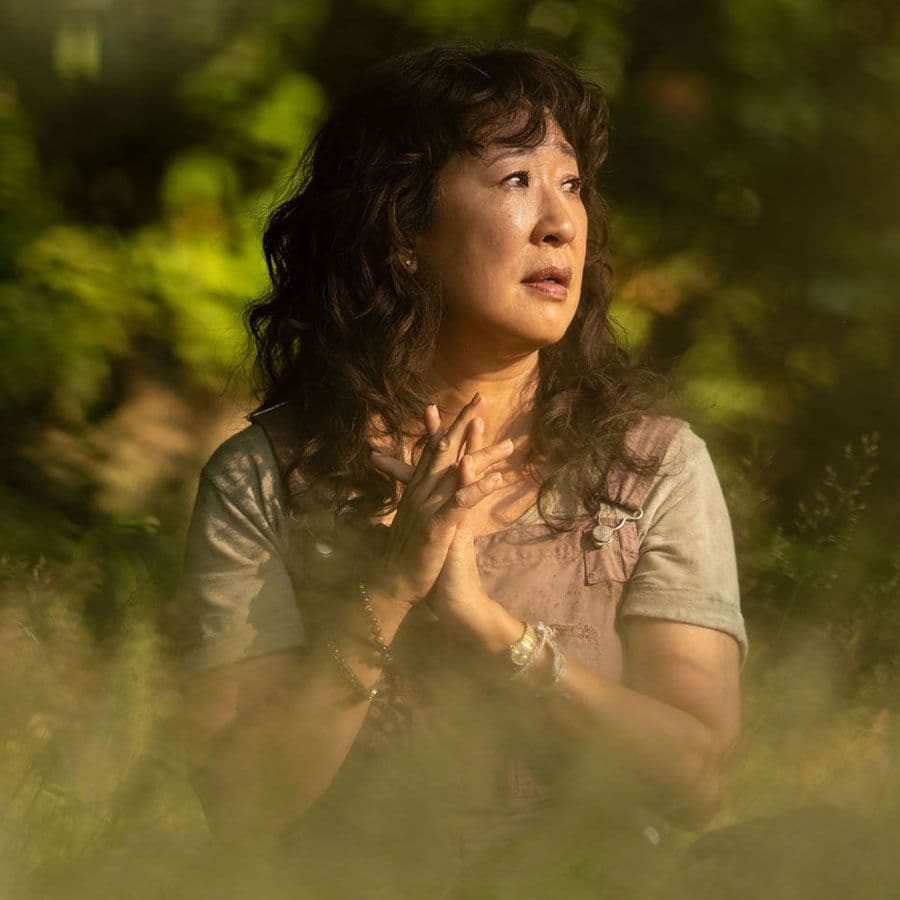
Oh, 53, plays Ellie, mother to 16-year-old Kiah (Keira Jang). Like all in their orbit, the pair live a simple, spare life, repurposing clothing and growing their own food. But things are about to change. As Ellie approaches her expiry date, artistic Kiah is set to become a Documenter – a teenage recruit chronicling with pencil and paper the “End of Life” rituals of those in their 50th year (the witness of the film’s title). It’s emotionally fraught and psychologically exhausting work.
For all its provocative themes, Can I Get a Witness? – which opens March 14 in Toronto, Vancouver, and Montreal and elsewhere throughout the spring – is visually sumptuous, elevated both by its gorgeously fertile Powell River, B.C. setting and by random animation sprouting from Kiah’s imagination and sketchbook.
Zoomer recently talked to Fleming, 62, and an under-the-weather Oh, 53, via Zoom from Vancouver and Los Angeles respectively, about their quietly absorbing film – the pair’s latest collaboration after 2016’s award-winning animated feature, Window Horses.
KIM HUGHES: In the press materials for the film, the question of ‘Why age 50’ is answered with ‘Because it hurts.’ Can you elaborate?
SANDRA OH: I think maybe because we are used to age 65 being some random number where that’s an accepted time to step out of society. But 50 – I think for younger people who have parents in their 50s and for those of us straddling 50 – we know it is an extremely vital time with a lot to give. It felt like a number that hurt. It was a number many people would feel was a great, great, painful sacrifice.
ANN MARIE FLEMING: This is a fable and a thought experiment. It started off farcical. It’s supposed to be extreme. You’re not supposed to believe that this is a suggestion or a solution. So many things have happened since I first wrote this script back in the early 2000s that make it seem like our real world in so many ways. People think they have achieved certain goals. They’ve had families, careers, travels, love, and life, and at 50 you’re still striving.
The death thing in the film came around 2011 when people were talking about raising CPP from 65 to 67, when you’re supposed to retire and have pensions and social assistance. There is a certain world of assumptions that we have grown up with that is crumbling. So, I wanted to point a finger to that, to our system, and how at our 50s you’re still a contributor more than a consumer. If you look around the world, 50 is still a median age [of death] for some countries. And it wasn’t that long ago that that was true for this country. History is short.
SO: Also, it’s the time where you are really taking death seriously, really contemplating it, and all the actors are then called to think about their own mortality.

KH: That said, the perspective of the film is Kiah’s, who is 16, more than the characters reaching age 50. Why was that?
AMF: It is absolutely from the point of view of this teenage girl, and all the responsibilities that are being foisted on her. This started off as climate change action film and death was a metaphor. But the world has changed and it becomes more and more a tender exploration of death. I went to my first funeral when I was six months old. Death has been a big part of my life and my work and what I think about every day. So Kiah, in some ways, is partly me. She is mixed race; she lives in a room that looks a lot like the room where I sat doing my drawings and writing my poems.
Here we have these young generations who are living with anticipatory grief. Those of us who are older are maybe thinking of the grief of losing the ones we love and maybe losing our own lives. But for the young, they don’t know if they want to have kids anymore. They are looking at everything dying. Real-world dying and the dying of our planet … these are really the big questions that our very small and gentle film is trying to tackle in a very human way.
KH: Sandra, what was the hardest thing to get right with this role?
SO: [Long pause] It was to try and have Ellie parent in a way where I could show up in the best way. The way that Ellie is trying to balance and give, almost in a condensed way, her entire job as mother in this last couple of days on Earth. To not frighten her child, to prepare her child, and to be there for her child to express whatever she needs to go through.
AMF: If I can add, in the hustle and bustle that is a film set, to be able to carve the space to have those super-quiet, super-intimate, super-contemplative moments … scenes where Sandra was just sitting, nobody breathed or made a sound. It broke my heart to watch. The quietness of those scenes being shot … everyone on set was listening to you breathe.
SO: I’ll take that as my answer!

KH: Can I Get a Witness? struck me, almost, as a more altruistic take on the concept explored by the 1976 film Logan’s Run. Am I off-base here?
AMF: It’s a political satire. But it’s the opposite of Logan’s Run where people end their lives at 30 because they’re promised a present, promised a new life. It’s a selfish act. With this film, you sacrifice yourself for the greater good, for future generations, for others. And you don’t get anything but this beautiful precious life, and now it’s time to pass it on.
SO: I think just the idea that someone would do something for the greater good is a daring question to pose at this point. I think a lot of people would even be offended by that idea. What is being revealed in how you orient yourself to that question?
KH: Could either of you make such a sacrifice?
AMF: My editor, Justin Li – who is a young man himself – has a very young daughter. And he answered that question. He said, ‘I would do anything for my daughter.’

KH: What are your highest hopes for the film?
SO: Two-fold. For it to reach as wide an audience as possible and for it to keep going. People discover films not just at release. I am hoping the relevance of the film continues and it remains a conversation starter.
AMF: And I would love it if it started conversations between people with very different cultural, political, and demographic views. It’s not just a film for me. It’s an action and a conversation I’m having all the time. And I think other people want to have it, too.
Can I Get A Witness? opens in theatres in Toronto, Vancouver, and Montreal on March 14; on March 21 in Ottawa, Calgary, Saskatoon, Waterloo, Guelph and Kingston; and then in further Canadian cities throughout the spring.
RELATED:
Oh, Sandra! The Canadian Award-Winning Actor Lands Time Magazine Cover
Oscars Fashion: 17 of Our Favourite Looks, From Angela Bassett to Sandra Oh and Cate Blanchett