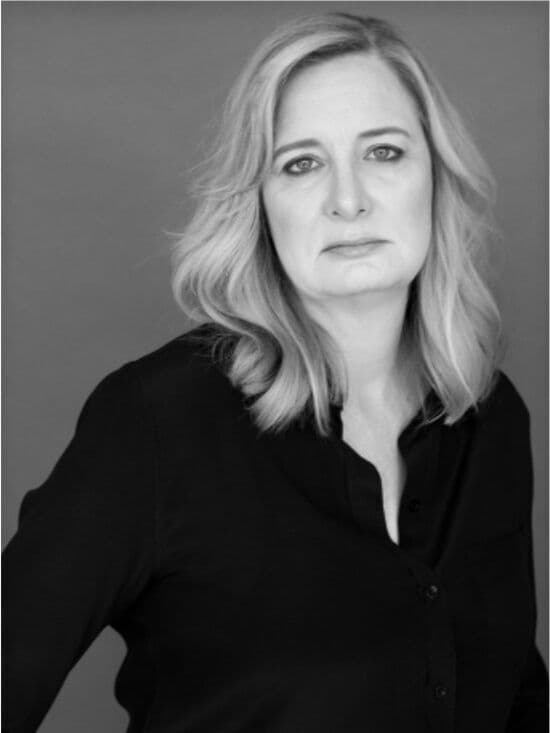
“It’s quite common for women’s hair to thin over time, especially during menopause,” says Dr. Kristy Bailey, who pointed me to the study. Bailey is medical director and founder of the Hair Transplant Centre in Toronto. “Unfortunately, this can significantly impact a woman’s self-confidence because hair is so closely tied to identity. Too many women suffer in silence because of the stigma of hair loss, but there are many options available to restore hair density at any stage.”
The first person to notice, and often the first person you discuss hair change with, is your hairdresser. Luis Pacheco is the founder of society favourite Medulla & Co. in Yorkville, Toronto. “Things can change from one visit to the next,” he says. “When you start to see brittleness, less density, that means hair loss. It no longer performs the same way.” Grey hair, of course, has a different texture: “It is coarser and weaker, more susceptible to breakage, which compounds the problem.”
It helps to have a long-term relationship with your clients, Pacheco says, to have sensitive conversations. The first line of defence is proper scalp maintenance. “We have been told the less we wash our hair the better, when in this case it is quite contrary,” he says. “The goal in hair loss is to prevent product buildup.” He points out that your scalp is a continuation of the skin on your face: “You wash that to deal with daily breakouts, inflammation and clogged pores.” He created the TO112 Shampoo Brush, “that fits in the palm of your hand and has these bristles made out of recycled bamboo. You pour shampoo on the brush and exfoliate, cleansing deep and also stimulating blood flow to the follicle.” He suggests pairing that with his TO112 Biotin Shampoo, made with growth factor and caffeine to repair and stimulate weak and thinning hair. As for conditioner, he says that should strictly be applied to ends. “Leave your conditioner on long enough to penetrate the follicle or the treatment just sits on the surface getting limper and oilier by the day.” Heat protection is also critical, he says, citing Oribe Royal Blowout as a favourite product.
If your hair is thinning, you need to re-evaluate your priorities, including how often to highlight your hair. “Changing the shade to work with your skin tone can help camouflage ‘see-through’ areas,” says Pacheco. “Colour can add the illusion of volume. If your scalp is lighter, go for a lighter shade, so the contrast is not as obvious. Similarly, those with darker skin should shy away from lighter tones.” Work with the optical illusion.
As for cutting techniques and length, “I find that some women become attached to having long hair because they are already dealing with the insecurity of hair loss, but often bobs and chin length will look thicker and healthier,” Pacheco says, while noting it is a case-by-case process to work out the best overall proportions with a client.
It is important to consult a doctor to look at possible vitamin and iron deficiencies that can affect hair and skin health, or thyroid issues. For over-the-counter products, Pacheco swears by Viviscal, a supplement our experts nearly unanimously recommend.
If hair loss becomes a bigger problem than over-the-counter products and hair stylist wizardry can overcome, Dr. Bailey recommends one of three treatments: Red light therapy, PRP, and FUE hair transplantation.
“The ideal candidate for red light therapy is someone with minimal hair thinning,” says Bailey. The Theradome Laser Helmet is an FDA-approved at-home treatment that uses low-laser light technology to stimulate follicle and tissue repair, reverse hair miniaturization, and promote growth. There’s zero downtime or pain, and patients can begin to see results after three months. The helmet costs approximately $1,600.
We’ve reported on various uses for PRP (platelet-rich plasma) and PRF (platelet-rich fibrin). They are important tools in the hair loss battle. “They are novel techniques where we extract growth factors from the blood’s plasma,” says Bailey, “and inject them back into the hair to stimulate the cells responsible for growth.” It works best, she says, for people with genetic or hormone-related thinning and a mild amount of scalp showing. It is considered minimally invasive; treatments are usually administered over six sessions spaced four weeks apart, costing around $1,000 to $4,000.
For people with truly significant hair loss, the top-of-the-line treatment is FUE (follicular unit extraction). “It’s a one-day procedure to permanently thicken hair, and unlike traditional hair transplant methods, FUE is minimally invasive,” Bailey explains. “We extract individual hair follicles directly from the patient’s thicker scalp sections and apply them to thinning areas using a precise micro-punch tool.” This method leaves no linear scars, is less painful, and is resistant to hormones that cause hair loss. The downtime is one week, and the cost ranges from $10,000 to $16,000.
The main thing to remember is that there are indeed options for all stages and severities of hair loss. And with slightly more than half of the female population over 50 struggling with the same issue, you are also not alone.
Always asking questions,
—Leanne Delap