Adventures Shared, From the Himalayas to Champagne Seas
These one-of-a-kind travel experiences are sure to inspire your next journey.
By Zoomer|May 15, 2024
SHARE
Spa: I Became One With the Cosmos
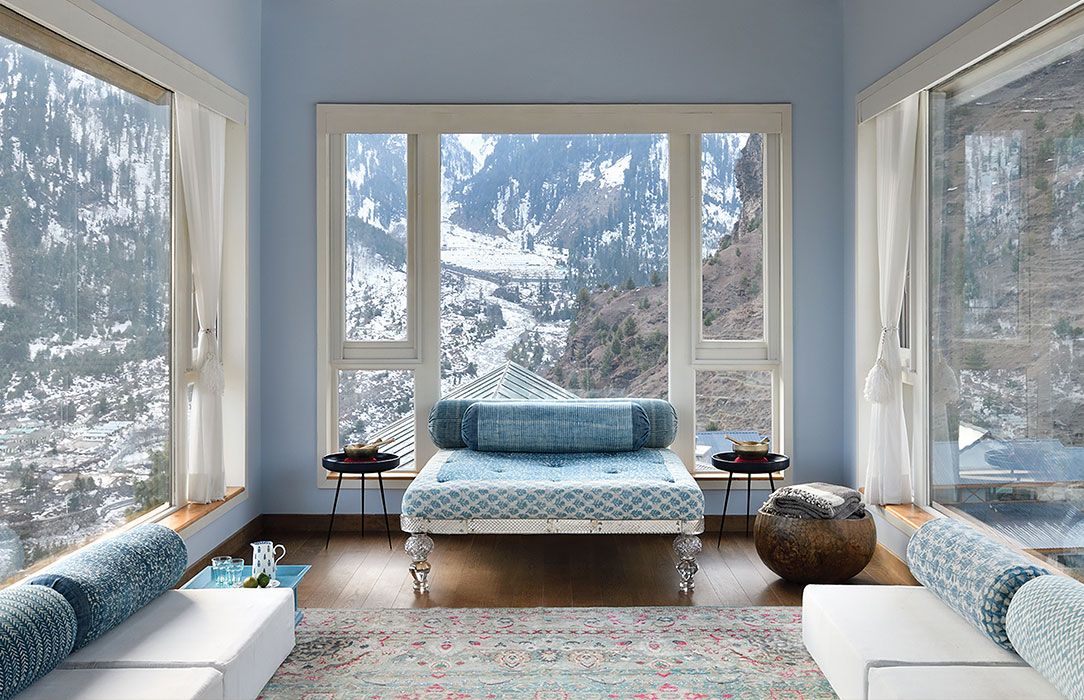
To visit Sitara Himalaya is to answer the call of your soul. On the way to the valleys of Lahaul and Spit in northern India, surrounded by Buddhist monasteries, this new 10-bedroom retreat is built where, it is believed, the great Indian sage Rishi Ved Vyas meditated for 12 years before inscribing the eternal cosmic wisdom into the four Vedas. I could feel the magic as soon as I arrived. Located at an altitude of 8,200 feet (2,500 m) and surrounded by epic mountain and glacier views, this tucked-away sanctuary is an extension of the private retreat of Anita Lal, the founder of India’s coveted lifestyle brand, Good Earth. Decorated with a touch of the divine – Tibetan rugs, sacred ornaments, hand-painted murals of hummingbirds and the earthy smell of juniper berry incense – and guided by the Vedic philosophy that everything in the universe is interconnected, it invites guests to drop, relax, reflect and elevate. The “Svasthi” dedicated well-being area offers a scented plunge pool, sauna and steam, yoga practised in harmony with the breath and body treatments that combine sound bowl healing with ancient Marma massage techniques. Both physical and emotional release are to be expected – I wept away some tensions. The glass-roofed Skylight room is a highlight. Lie back and watch the Milky Way while listening to the hum of the earth. Cosmic indeed. There is something humbling and comforting about connecting to that feeling of something bigger than ourselves. Here is a place to do just that. Food is refined traditional comfort; the vibe that of a genteel house party. Days are spent walking, reading, in conversation or in contemplation. Candlelit evenings pass by with storytelling, traditional singing and dancing – both guests and staff contributing. Come bedtime, find two little bottles of essential oils on your pillow. One, “Clarify,” clears your head, the other, with Kashmiri lavender, aids “Deep Sleep.” No wonder I left feeling so rejuvenated. This is the secret India you have been longing for. –Daisy Finer
To book Sitara Himalaya contact greavesindia.co.uk. Take a domestic flight from Chandigarh or Delhi to Kullu-Manali Airport. From there, it is a 90-minute drive. The property is closed in January and February and there is a minimum three-night stay.
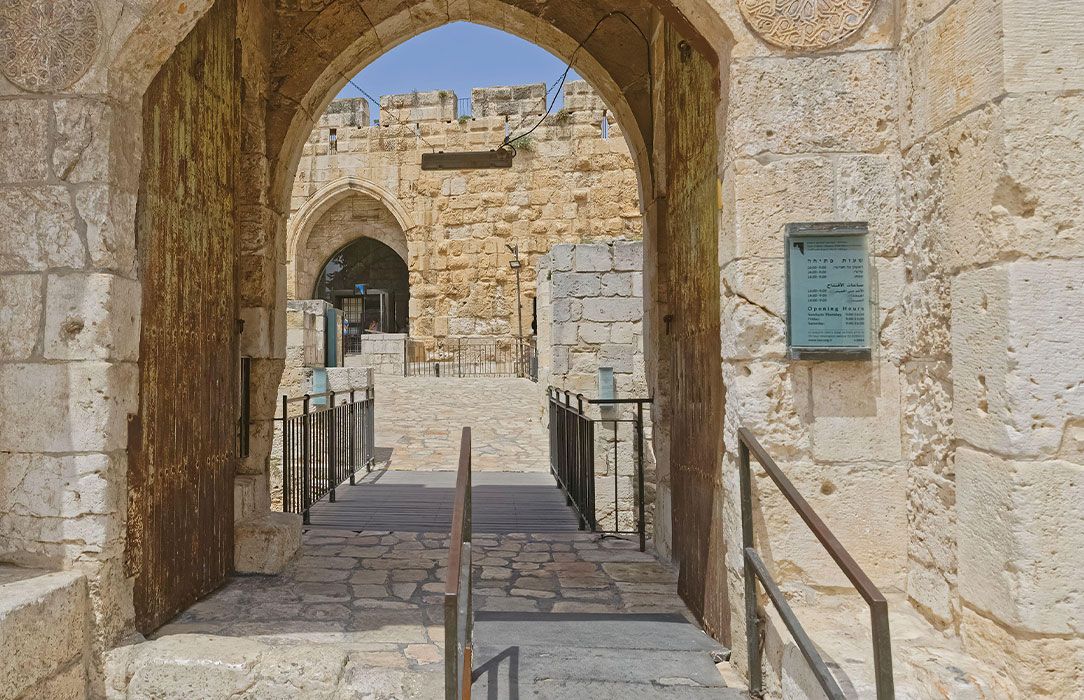
The entrance to the Tower of David in Jerusalem. Photo: Tower of David Entrance
Accessible: I Toured Jerusalem in My Wheelchair
With its winding, cobblestone streets and ancient monuments, Jerusalem seems like the opposite of accessible. Yet, thanks to the advocacy of Yuval Wagner a former Israeli air force pilot who, after being paralyzed by a helicopter crash, started Access Israel to promote accessibility throughout Israel, I was able to visit almost all of Jerusalem’s historic sites from my chair.
At the Tower of David – originally built in the second century BC to protect the city – a series of stone pavers and ramps meant I could enjoy this magnificent citadel without much difficulty. Once inside the Old City walls, I wheeled along the metre-wide path of smoothed paving stones on Via Dolorosa – believed to be the path Jesus walked to his crucifixion – to the Church of the Holy Sepulchre, which contains two of the most important sites in all of Christianity: Calvary, where Jesus was crucified, and Jesus’ tomb. At the Aedicula, a shrine built around the tomb, the Greek Orthodox priests (who have been guarding the church since the 12th century) ushered me to the front of the very long line. When I arrived at the tomb, with the assistance of two of the priests, I could just squeeze my wheelchair through: touching the marble slab that seals it is a moment that will remain with me for the rest of my life. –Fred J Maahs Jr.
Maahs is the Founder and CEO of the accessible travel and tourism consulting company, Maahs Travels, that can create global travel experiences for people with disabilties (maahstravels.com). He toured Israel with Eli Meiri of Israel4All.com, a tourism company for people with disabilities and special needs.
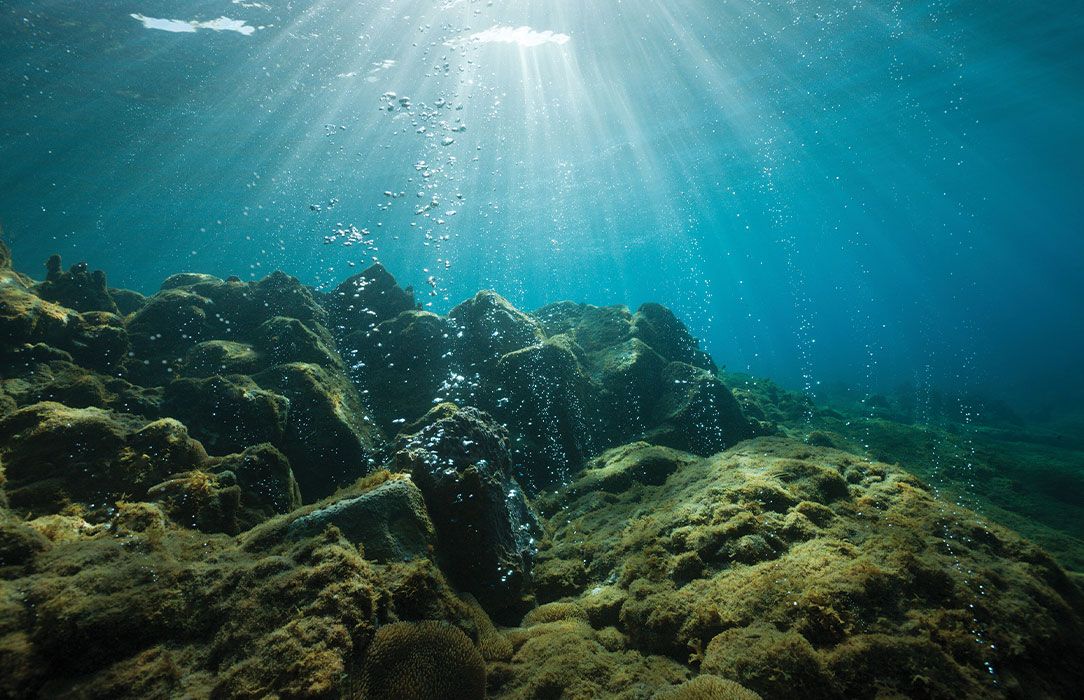
Photo: Volcanic air bubbles in the the Champagne reef, Dominica.
Sustainable: I Swam in Champagne in Dominica
Thirty years ago, I jumped off a boat’s platform for my first shallow dive with my future husband, holding hands on the way down. And what did we see? Poseidon himself, it seemed, was blowing bubbles from underneath the seabed. They danced between slanted sunbeams that pierced the water from above. Time stopped. We telepathically toasted to our future, suspended in this giant, light-infused, champagne bowl of a volcanic crater in Soufrière Bay, on the southwest coast near Pointe Michel, Dominica.
Chasing bubbles alongside a school of squid, we were captivated by the vents where undersea thermal springs seeped through, colliding with cold seawater to make “champagne” from released carbon dioxide. In our happy place, we dug our fingers into the heated sand around monochromatic, gold-hued mounds of coral known as Champagne Reef.
Today, Dominica, known as the Nature Island, continues to offer visitors this and other unparalleled experiences, thanks to its rugged mountainous topography, which fends off large-scale development, and inspires an appreciation for the precious gift they steward. –Marie-Elena John Smith
There are no direct flights from Canada to Dominica. Instead book a connecting flight to Douglas-Charles airport (DOM) on LIAT or InterCaribbean. Antigua, Barbados, Puerto Rico, St. Vincent and St. Lucia are some of the islands they fly through.
40s
›Inspiration: Kate Hudson and Danny Fujikawa
When Kate Hudson’s not here with her musician beau, she’s probably at A-listers’ favourite glow-inducing spa, We Care.
›Stay & Play: Juice fast with the A-Listers
Book in to We Care, the liquids-only wellness retreat where Hollywood elites go to drop a few crucial pounds for the red carpet.
›Festival Tip: Splurge on a VIP Pass
With access to air-conditioned restrooms, shaded seating areas, plus specialty food and drink, this is worth every penny.
50s
›Inspiration: Pharrell Williams
He’s created tennis gear for Adidas so rap star and Louis Vuitton menswear designer Pharrell Williams might easily pop into the BNP Paribas Open.
›Stay & Play: Match Point
Every March tennis fans head to the desert for one of the world’s top tournaments, the BNP Paribas Open. Expect LA-inspired dining (there’s
a Nobu!).
›Festival Tip: Later Is Better
Choose the second weekend – it’s less crowded, the bands have warmed up and are ready to rock.
60s
›Inspiration: Rande Gerber and Cindy Crawford
Cindy took up golf during lockdown, so now she and hubby Rande can take in some tunes and then go to the greens.
›Stay & Play: Swinging Sixties
With 350 days of sunshine, golf here is glorious, with endless choices of where to play – there are 63 courses within 20 miles of Palm Desert.
›Festival Tip: Show Up Early(ish)
While the millenials nurse their hangovers and drift in sometime after 1 p.m., you can be enjoying a prime stage-viewing spot in the 12 to 2 p.m. time slot.
70s
›Inspiration: Debbie Harry
At 77 when she took to the stage this year, Blondie’s Harry was one of Coachella’s oldest ever performers. Known for her love of art (she was part of Andy Warhol’s inner circle) she probably soaks in the art and architecture scene in Palm Springs.
›Stay & Play: Modern Love
Book with the Modern Tour to get inside Frey House II, famously built around a boulder, as well as numerous private homes in this mid-century-modern mecca.
›Festival Tip: Ditch The Car
It can take hours to exit the parking lot – jump on the shuttle instead. The traffic flow is designed so shuttles don’t get stuck.
80s
›Inspiration: Clint Eastwood
Passionate about music, Eastwood is an accomplished pianist and composer.
A Coachella devotee, he was last spotted at the festival with Bradley Cooper and Suki Waterhousein 2015 at age 85.
›Stay & Play: Great Heights
For spectacular views without the hike take the aerial tramway – 2,500 feet up into the San Jacinto Mountains.
›Festival Tip: Hydrate
Drink water even when you’re not thirsty. You’ll feel spry as you step over the prone bodies of exhausted youths lying passed out on the grass.
A version this article appeared in the Feb/March 2024 issue with the headline ‘Snowbirds, Flock to Texas.'
Everything old is new again
On the three-hour drive to Houston, our final destination, we stop for lunch in the beer garden of Saint Arnold Brewing Company (my dad’s favourite local craft beer). Talk turns to how we’re finally getting around to visiting 1960s outsider artist landmark The Orange Show, an idiosyncratic maze-like architectural installation in Houston’s East End, and its folk-art sibling, the Beer Can House, a mid-century bungalow entirely covered in deconstructed beer cans. They’re a nexus for the creative community that unwittingly attests to its breadth. By peppering the curator with questions (I come by my profession honestly), my parents unearth the fact that one of the original preservation committee donors in the 1980s was legendary Houston art doyenne Dominique de Menil, founder of the world-famous Menil Collection and nearby Rothko Chapel.
Along with the Museum of Fine Arts, the Renzo Piano-designed Menil – with its modern and contemporary collection of nearly 20,000 works, including artists Clyfford Still, Barnett Newman and Robert Rauschenberg – is my go-to in Houston’s walkable Museum District.
The view from POST Skylawn, a five-acre rooftop park and farm above Houston’s arts complex. Photo: COURTESY POST HOUSTON
Houston is a sprawling city of distinct neighbourhoods that can feel overwhelming to navigate. Staying downtown overnight has encouraged us to explore the less obvious facets: it’s given us time to sample local institution Phoenicia Foods, a gourmet international food marketplace (their Armenian string cheese is addictive), see Graffiti Park in East Downtown (EaDo), and dine farther afield at
several of the many hidden gems be-loved by residents of this ethnically diverse, minority-majority city, like Rado MKT.
Rado is the new moniker of the Eldorado Ballroom, a segregation-era entertainment hub once at the heart of Houston’s Black community in the Third Ward. Through revitalization initiatives, the 1939 streamlined modern site has been redeveloped to include an art gallery, café, music venue, community event spaces and retail shop. The driving vision behind the revamped complex is James Beard-nominated chef Chris Williams, of the acclaimed southern-style Museum District restaurant Lucille’s.
The bistro-style menu here also reflects his culturally conscious food ethos (“where culinary meets community”) with oxtail smash burger and a poblano pimento grilled cheese served with a side of gumbo, rather than traditional tomato soup, for dipping.
While my parents head back to freshen up (and, I later learn, enjoy an aperitivo at the hotel’s rooftop bar) before the Houston Symphony, I pop over to POST Houston, another buzzy multi-use arts and culture complex. Housed in the former U.S. Post Office headquarters, from the outside it’s a drab and bunker-like compound, but inside, the three connected buildings open up to enormous glass skylights. Light pours into each atrium and the neon-lit food hall inspired by Japanese night markets. Soaring crisscrossing and spiral staircases lead up to a two-hectare rooftop
park – free and open to the public – that has spectacular views of downtown. I leave regretting that I’m still too full from lunch to sample any of the indie vendors.
It’s not just our appetites that are appreciative of these new discoveries. We’re all wowed by the adaptive reuse projects that are spurring a dynamic new cultural landscape in Houston. This crystallizes on our final day as I venture underground into the Cistern, Houston’s former drinking water reservoir, while my parents explore the sur-rounding Buffalo Bayou Park. Built in 1926, the subterranean facility has been repurposed into a magnificent public space. The Saturday morning sound-healing meditation session is popular; we quietly shuffle into the spooky darkness and stretch out on the concrete walkway for the stirring 40-minute experience of chimes, singing bowls and bells that reverberate throughout the cavernous space.
Afterward, when my parents join me, we take turns launching echoes into the 16-second delay across the invisible expanse. There’s a shallow pool of water at the bottom of the 8,000-square-metre (87,500-square-foot) reservoir. It’s so glassy-still that any light shone across it illuminates the hundreds of cement columns and creates an optical illusion of infinity. On our drive home (after a pit stop to show them POST Houston and grab lunch, naturally), the car is uncharacteristically quiet. It could be the Cistern’s hushed and awe-inspiring experience. Or that we all find ourselves wishing our time together were infinite, too.