There are few filmmakers as prolific – and varied in the subjects they cover – as Barry Avrich. Consider that since 2020 alone, the 62-year-old Montreal native has released documentaries about dictatorship in Turkey (Reversal of Fortune: Turkey’s Unraveling Democracy, 2020), comedian Howie Mandel (Howie Mandel: But, Enough About Me, 2020), jazz great Oscar Peterson (Oscar Peterson: Black + White, 2020), Canadian con artist Albert Rosenberg (The Talented Mr. Rosenberg, 2022), former Supreme Court of Canada justice and Holocaust survivor Rosalie Abella (Without Precedent: The Supreme Life of Rosalie Abella, 2023) and famed chef Sash Simpson (Born Hungry, 2024). And those followed on the heels of documentaries like Prosecuting Evil (2018), about Ben Ferencz – the last surviving Nuremberg prosecutor – and David Foster: Off the Record (2019), a star-studded look at the life and work of the legendary Canadian producer.
You’d think, with a workflow like that, there wouldn’t be time to stop and look back at any given subject. But that’s exactly what happened with another documentary that the filmmaker released in 2020.
Made You Look: A True Story About Fake Art chronicled what’s been called “the largest art fraud in American history” – one that eventually took down New York’s prestigious 165-year-old Knoedler Gallery. It centered around Glafira Rosales and Carlos Bergantiños Diaz, a couple who, beginning in 2000, employed street artist Pei-Shen Qian to create works they claimed were painted by acclaimed expressionists like Mark Rothko and Jackson Pollock. They then sold the fake art to the Knoedler Gallery for upwards of US$80 million over the course of the ensuing decade. Once discovered, the scandal led to the downfall of both the Knoedler Gallery in 2011 and its once esteemed director, Ann Freedman, who’d sold the fake artworks to collectors.
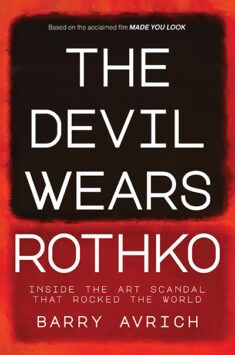
Now, Avrich is revisiting the subject of the Knoedler Gallery, its scandalous downfall and the colourful cast of characters involved in his new book The Devil Wears Rothko: Inside The Art Scandal that Rocked the World.
“I didn’t even think about doing a book,” Avrich said during a recent call with Zoomer. Instead, he noted that when Made You Look premiered on Netflix and CBC in 2020, “a group from Hollywood optioned the doc to make it into a Succession-style miniseries.” After a year of working through that process, the project fell through. But that wasn’t the end. Avrich says that “I just got so excited about the pitches and the stories and what this could be” that his agent suggested that he take his wealth of knowledge and write a book about it.
The resulting tome, The Devil Wears Rothko, recounts the scandal with new information, interviews and updates on the major players, as well as the continued fallout of the fraud and why the art world still hasn’t learned its lesson from this cautionary tale. It also discusses the pervasiveness of forgeries in the art world, such as how one former director of The Metropolitan Museum of Art (the MET) noted that up to 40 per cent of that institution’s collection could be fakes.
In his interview with Zoomer, Avrich discussed the book, new discoveries he made about the players in the scandal and why this story hasn’t made him cynical about strolling through an art gallery today.
MIKE CRISOLAGO: Perhaps it’s no surprise, given your extensive work on this story in film and now print, but this book reads like it’s written by someone who is genuinely enthusiastic and excited to discuss this subject.
BARRY AVRICH: Well, Mike, it’s a great point in that, again, I don’t profess to be a writer. I’m a storyteller. Is there someone that could have written a better book, or a better version of this? Perhaps. But I write the way I speak and the way I tell stories, whether it’s in person or in film. And that is with excitement and passion – specifically because this is a world that just keeps on giving. It’s a world of art fraud and art crime that just keeps on giving. Not only has no one learned from this story, nor will they learn from this book how to do due diligence when they’re collecting – because people who buy art just have to have it no matter what and they’re happy to overlook what might be an ocean of red flags. In this particular case, this Hollywood dream cast of players was so delicious that it was just exciting for me to delve in.
MC: What challenges did you encounter writing the book as opposed to when you made the documentary?
BA: The challenge was continuing to delve in and pull the Band-Aid off and pick at the scab. But so many people were still so angry. And yet, one of the discoveries and people that came forward in the book that was so much fun was the lawyer for Glafira Rosales and Carlos Bergantiños, [who] had just retired. And he called me and he said, “I hear you’re doing a book. I’d love to talk to you.” He would not go on the record for the film because Glafira Rosales was still dealing with many legal issues, even when we were filming. And so he was amazing because he took me into the headspace of Carlos Bergantiños and Glafira Rosales – whom I called the Bonnie and Clyde of the story – and also revealed certain things about their daughter.
MC: What did you learn about their daughter?
BA: I knew they had a daughter and that she had worked as an intern at galleries in New York and she’d worked at the Knoedler Gallery herself. And here’s a bit of an exclusive – while I was writing the book I got an email from a woman saying, “I understand you’re doing a book. I have this great story, and I think it would make another documentary.” And she had had this horrendous experience with the daughter in several real estate deals and just went on and on about this. And so I ended up doing this deep dive on the daughter and realized the daughter has opened and closed various art galleries around North America and was selling Basquiats and Warhols herself. Are they real? Are they not? Where’d they come from? And given what her mother went through sitting in jail and her father who … fled to Spain, that was amazing.
MC: You mention in the book that some forgers see themselves as sort of Robin Hood figures, fighting back against the one percenters of the art world. What’s your take on that perspective?
BA: I don’t look at it as a Robin Hood situation. There are those that think that this is a victimless crime in that if you’re a billionaire or a millionaire, and you got ripped off, well too bad. If you were stupid enough to overlook certain issues and red flags, so be it. I mean, the FBI in the United States, and those that I spoke to who are in law enforcement, really do not care. And they said this on the record – do not care about the rich being conned. What they care about is wire fraud. And that ultimately is what sunk Glafira Rosales … And again, too, the reality is that this is a world that remains unregulated – how prices are determined, Mike, and how this world is governed is the Wild West.
MC: Having made the documentary and now written the book, why do you think the idea of art forgers and fraud is so fascinating to audiences?
BA: I’m a documentary filmmaker and in my meetings and pitches with streamers and broadcasters, true crime is the hottest thing ever. That’s what they’re asking for. And I think people live vicariously through those who commit crime because they would never do it. It’s delicious to think about “What would you do” … People just love looking through the lens of something from a safe distance. They always have.
MC: Some of the most fascinating elements of this whole story come via people like the former director of the MET, who said that up to 40 per cent of their collection could be fakes. Or the idea that galleries exhibit art stolen by Nazis without acknowledging that provenance. How does that change your perspective when you walk into your favourite art gallery or museum, knowing that the works could fall into those categories?
BA: So I just got back from Paris and went to see the Hockney exhibit and there’s hundreds of pieces in the collection. Is it possible [that some were fake]? Even the artists themselves and their families have been fooled. So do I walk through a gallery today or an art show with cynicism? No … I won’t walk through a gallery or an art show or a museum with cynicism because I can be in love with a fake just as much as I can a real painting. Who’s dictating that? Provenance and documents. That’s why I always say: buy with your eyes and not your ears. And also buy it because it makes you feel something. Not because you want to trade it, not because of its value, not because you think people will think you’re important because you hung it in your home. It should be because you love it.
MC: With that in mind, what steps would you advise people take before buying artwork?
BA: It’s up to the buyer to do the digging. The first question that you ask is, “Are you in love with the painting and are you buying it because you love it?” And if the answer is yes, then the next step is saying to the gallery, “Tell me about this piece. Did it come directly from the artist’s studio? Are there any pictures of the artist painting it? Who owned it before? What’s the history?” And if a gallery’s not prepared to share that, then walk away … At the same time, I don’t want people to be afraid of buying art and be disillusioned by the art world. I wanted to explain how this happened and what you should be aware of and what you should ask. But don’t dismiss the entire world of art over this. It’s the same for some people who don’t understand cryptocurrency. They would never go near it. I never want people to feel the same way about the art world.
The Devil Wears Rothko: Inside The Art Scandal that Rocked the World is available now.