
In times of economic downturns, like the one we’re suffering through now, one of the first things companies do is jettison their older workers. Yes, it’s scary out there for 50-something Canadians whose careers hang in the balance sheet. They’re being downsized or passed over for promotions not because their skills have eroded but because they’ve reached a certain age – and compensation level – that renders them expendable.
Those of us who are in danger of hitting this grey ceiling (or wall, perhaps) can take solace from a new book by Canadian corporate consultant Dan Pontefract, which carries the hopeful title The Future of Work is Grey: The Untapped Value of Age in the Workforce (May 2026, Page Two Books).
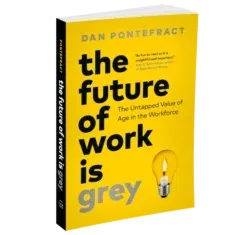
Pontefract, 55, a workplace leadership and cultural strategist, builds a business case showing how companies that blindly downsize older workers do so at their own peril. He unveils a new term – “age debt” – which he describes as the hidden costs organizations accumulate by ignoring new demographic and longevity realities, and undervaluing the knowledge of seasoned employees.
His solution to combatting age debt? The “experience dividend,” where the contributions of older workers become valued as longer-term investments, and where they’re not seen exclusively as burdensome liabilities. Ultimately, companies that create an environment where older workers relay their knowledge and skills to younger generations will see a dramatic improvement in the bottom line.
Born in Hamilton, Ont., Pontefract’s career path has been anything but typical. He started studying pre-med at McGill University before shifting into the then-burgeoning field of technology. In the mid-’90s, he moved to Vancouver where he landed a job teaching tech at the British Columbia Institute of Technology. Once again, he pivoted, moving from education into a tech startup. Since then, he served as a senior executive at German-based business database company SAP before becoming Chief Learning Officer at B.C.-based telecommunications company Telus. Along the way, he authored six books on corporate management and launched a successful public-speaking career while still finding time to help corporations around the world build a winning – and profitable – culture.
View this post on Instagram
Zoomer caught up with Pontefract in March in Victoria, B.C., where he lives with his wife, Denise Lamarche, and their three children.
Peter Muggeridge: How did your personal experience with ageism spark your decision to write this book?
Dan Pontefract: There were actually two incidents. A few years ago, I received an email from a speaker’s bureau I had been with for a long time, saying, “Hey Dan, thanks for your service. But the market is skewing differently and we’re refreshing our roster.” I had just turned 50 and when I pressed the founder about their decision … well, it became clear that my age definitely played a role. The other incident happened when I was 26 and had just started out at BCIT. I was going into the faculty washroom and an older gentleman stopped me, saying, “Son, this washroom is only for staff and faculty.” I showed him my company lanyard and he replied, “It’s a shame we’re hiring people so young.” So those two incidents were a microcosm of the problem of ageism in the workplace: how young people are not getting hired or are viewed as lacking wisdom, and then on the flip side, “It’s time to kick the old dude to the curb.”
PM: You structured the book like a record album, with Sides A and B, and you sprinkle music references throughout. Why did this theme appeal to you?
DP: I’m just a huge music fan. When Denise and I host parties, I’m that guy playing music from all over the world across all age spectrums and genres. When I was younger, I actually auditioned to be a MuchMusic VJ – I was terrible! But in terms of the book’s theme, I think there are a lot of leadership books out there that just aren’t fun. People deserve a little bit of fun while they’re reading something important and critically sensitive. I actually asked my publisher if they could print the book in the shape of a record. They said, “No, it will roll off the shelves.” So we ended up with the album concept.
PM: You propose rebranding the traditional descriptions of younger, middle-aged and older workers into “rocks, rivers and rubies.” Can you explain these terms and why you feel they will help ease intergenerational friction in the workplace?
DP: So many generational associations are deleterious, like #OKBoomer, or Gen Xers are still crying about Nirvana, or Millennials always order avocado toast, or Gen Z was raised on Roblox. These are just memes and tropes, but they find their way into organizations. So my new terms are “rivers” (people who are in their early careers and still establishing themselves), “rocks” (mid-career and hardening their skills to become more crystallized) and “rubies” (fully crystallized gems – their knowledge and expertise are oozing, and they just know how to get things done).
PM: Besides eradicating generational terms, you don’t have much time for the whole linear work cycle.
DP: I want to take a match, if not a blowtorch, to the career-ladder metaphor: the only way to get paid more is to go up the ladder; the only way to get more responsibility is to go up the ladder. Maybe some people want to stay put. Why do they have to keep going up the ladder? And maybe some people want to phase out. I call it the “career canvas.” Look at the British Columbia Lottery Corporation. They have instituted a program that helps older workers who want to phase out toward retirement. So, over a two- or three-year period at the end of your career, you can mentor up-and-coming workers for whatever your role might be. If the employee agrees, the boss agrees, the leader agrees and HR agrees, it can be a wonderful way to phase out – the person still contributes, but maybe not full-time.
PM: So the whole idea of retiring at a set age is a thing of the past?
DP: Right, retirement is no longer a fixed finish line. It can come in your 40s or your 70s. Zurich Insurance has created this career platform called My Journey. It helps the company retain the knowledge of experienced workers by offering them flexible working arrangements – say, three days a week going forward. And they also offer job sharing, where you split your work 50-50 with another person. And they offer alternatives for those who don’t want to fully retire. If a person says, “Hey, I’d like to take my retirement but continue working on a contract basis,” they can allow [the employee] to boomerang in, or boomerang out.
PM: Technological advances have put a lot of older workers on edge, fearing that their skills will be made redundant. What’s your take on AI?
DP: There are certainly practical ways that AI is helping. But it’s a sort of blindness for senior leadership teams to think that AI can replace people at the top of the wisdom curve – let’s have a debate about that. But, more importantly, there’s the tacit knowledge that employees can only attain in the friction-fuelled situations, where it’s sandpapery and gritty and you learn from people above you by being in meetings or taking on the slop work. This hardens you, and that builds up your repertoire of wisdom over time. If we take that out and try to replace it with AI, I’m worried that younger folks won’t learn those hardened skills that they need, and their companies need.
PM: Are you optimistic that your message about the importance of retaining experienced workers is getting out? What is it going to take to get companies to wake up?
DP: I think it will come to certain industries by necessity. I was not shocked when our federal industry minister recently came out and said, “We have to do something about mining. Because no one’s going into mining. The average age of miners is 53 – what are we going to do?” And I’m like, yes, but we’ve seen this happening for years because of the demographic disruption. So then you see Manulife, Sun Life and RBC putting out their reports that say a labour apocalypse is upon us. Heads up, people!
PM: In the meantime, what’s an older worker to do?
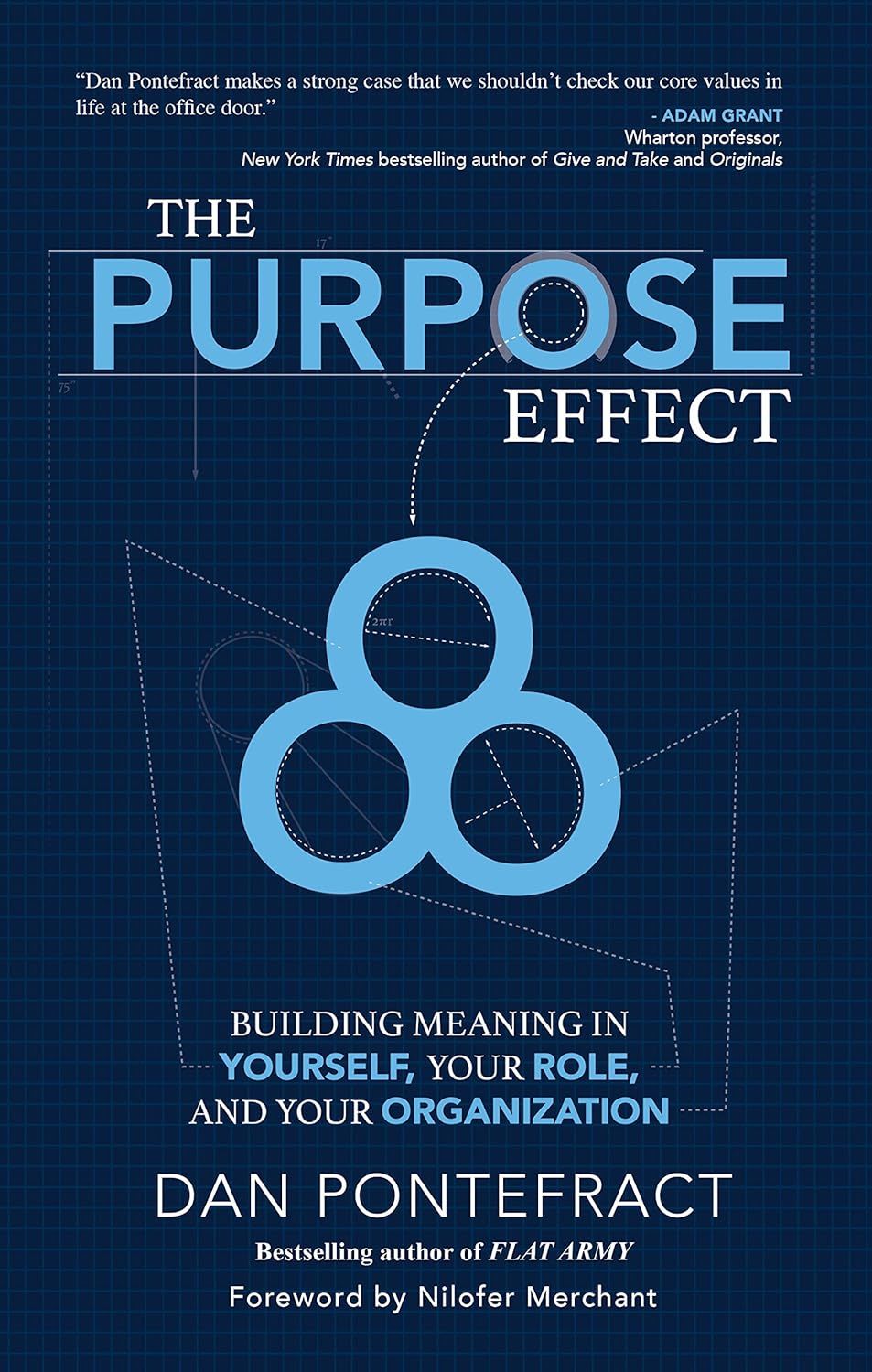
DP: So one of my books is called The Purpose Effect. I truly believe that everyone has their own sense of purpose and what they believe in, whether it’s your intellect or your passions – what is it that you want to be doing? You need to follow that. And if your organization is unwilling to listen and allow you to do that, you’ll have to sculpt a different type of job or career. You really have to own your next path, your next journey – whatever your age. You might have to pitch yourself to more progressive organizations. Otherwise, you’ll have to think of setting yourself up for gigs and contracts.
PM: So what’s next on Dan Pontefract’s career canvas?
DP: I’m writing a new book (planned for an Oct. 2027 release) called Culture at the Core. In it, I will look at the “four Ds” – direct, deliver, develop and dignify – of leading a high-performing team. And it uses the “river, rock and ruby” model and how companies can keep the seesaw demands of each group balanced. A leader who looks at the 18- or 88-year-old employee is going to have to think about those four Ds. And, as I’m turning 55 this year, I’m going to be consulting with some new partners about my concept that the future of work is grey. It’s something I’m going to hang my hat on.
(This interview has been condensed for space and clarity.)