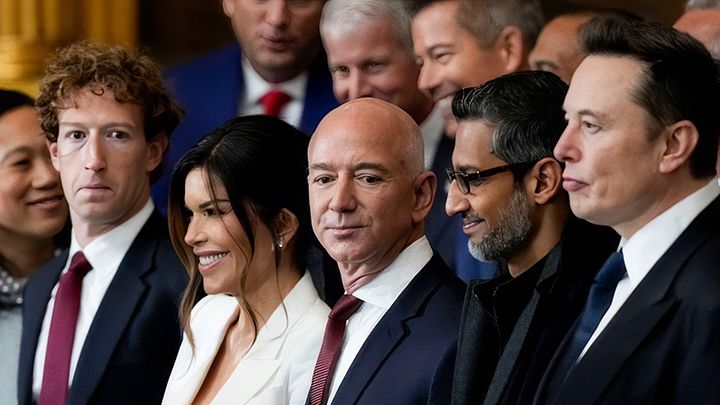
Brace yourself. Just as we’re trying to wrap our heads around the prospect of the AI robots exterminating the human race, their Big Bro overlords are about to invade the big screen in a new crop of movies that promises to set your hair on fire while making your blood run cold. They are brainy thrillers and biopics that take dead aim at the super dudes who own more of our lives than any nation state – Facebook czar Mark Zuckerberg, SpaceX rocketman Elon Musk, and Open AI emperor Sam Altman. These men are not just household names. To quote the horror trope, they are inside the house. And now as Hollywood brings their larger-than-life avatars to the screen in a pack of Oscar-pedigree films, the Bond-like villainy of a Dr. Evil bent on world domination takes on a chilling reality.
And as if Anthropic is aligning the stars, Yura Borisov, Madison’s co-star in Anora as the Russian gangster with a heart of gold, resurfaces in Artificial as Ilya Sutskever, the Israeli-Canadian computer scientist who co-founded Open AI with Sam Altman. Directed by Luca Guadagnino (Challengers), Artificial puts a satirical spin on the rise of AI, with Andrew Garfield starring as Altman – quite the status update for the British actor after suffering through The Social Network as Zuckerberg’s betrayed friend, Facebook co-founder Eduardo Saverin. The film begins in 2003 with a eureka moment in Canada, where the young Ilya walks into the University of Toronto classroom of British-Canadian scientist Geoffrey Hinton (Mark Rylance) and promptly blows his mind by solving a hitherto unsolvable math equation. (AI’s origin story is thick with the fingerprints of Canadians, even if they later found the Frankenstein monster too hot to handle. And Hinton, who is considered the godfather of AI, has acknowledged its dangers with the most dire warnings.) Set for a late December release, Artificial drew breathless reviews at its recent New York Film Festival premiere. Variety called it “a sprawling, enthralling docudrama meticulously true to history . . . a dawn-of-a-new-world story, a backstabbing corporate business story, and a horror movie, in which AI emerges from the lab as a sinister serpent.” And Vanity Fair reported that Garfield portrays Altman as a “mesmerically amoral” Pinocchio. As he “bends the truth to suit his whims, it isn’t his nose that grows – it’s his net worth.”
Then there is Musk, a pure documentary that has no need for satire in conjuring horror. Created by Oscar-winning director Alex Gibney (Enron: The Smartest Guys in the Room, Taxi to the Dark Side), this deep dive into Musk’s mind uses his own words and an avalanche of facts to paint an epic, eviscerating portrait of the world’s richest man. Opening in Toronto theatres on Oct. 17, it’s even longer than The Odyssey, with a running time of four hours, including an intermission. I saw it at the Toronto International Film Festival and wasn’t bored for a second. While Musk’s length will make it tough to find movie screens, it will soon be streaming on HBO. We hope. Now that the cable channel has been absorbed by the Skydance merger of Warner Bros and Paramount, there is speculation that Skydance CEO David Ellison –whose father, Larry Elison has been a major backer of Musk’s Tesla and X ventures – may block it.
It’s hardly a surprise that Hollywood has come to view the cabal of tech oligarchs as natural enemies. Long before AI was a thing, its movies raised the spectre of a machine intelligence outpacing humanity, from the velvet-voiced Hal in 2001: A Space Odyssey to the enslaving simulation of The Matrix. Now the zeitgeist is as overheated as a DeLorean time machine. And as the streaming giants erode theatrical cinema, and major movie studios are swallowed whole by Big Tech, AI’s grand masters have rapidly become typecast as the new villains of choice.
In light of the current panic about AI morphing into an existential threat on a par with the atom bomb, the controversy over Facebook’s algorithms in The Social Reckoning is almost quaint. It seems like ancient history though it erupted only five years ago – and triggered escalating lawsuits that culminated in an $18 billion settlement agreed to last summer by Meta (Facebook and Instagram’s parent company) over the harm their platforms have done to children. But Sorkin’s film is not a cautionary tale out to make us afraid of the future. It’s a blithely entertaining period drama that magnifies a historic scandal while basking in the cloak-and-dagger intrigue of its revelation. This is an honestly old-fashioned picture – a slow-burn newspaper thriller in the sleuthing tradition of All the President’s Men (1976), Zodiac (2007) and Spotlight (2016). In romancing the kind of granular investigative reporting that is the pride of “legacy” print media, it requires a screenwriter who can lift facts off the page with dialogue that plays like action. And Sorkin is the prime maestro of that craft.
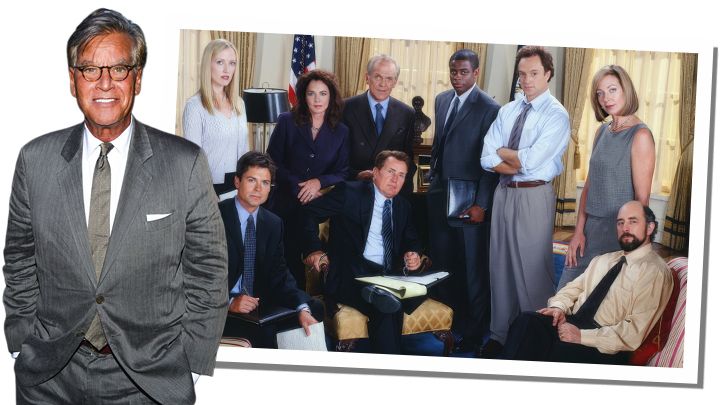
Ever since he turned the White House into a model home of liberal democracy with The West Wing, Sorkin has shown a knack for taking us deep into the weeds while making us comfortably stimulated at every turn. As The West Wing ushered in the millennium, its seven-year run served up a vicarious fantasy, a Hollywood mirage of the Oval Office that foreshadowed Obama’s real-life Camelot, which dawned two years after the series finale in 2006. As Sorkin went on to write actual Hollywood movies, his most powerful work dramatized true stories of American gamesmanship. Whether bushwacking the backrooms of politics (Charlie Wilson’s War) or sports (Moneyball) or poker (Molly’s Game), he cut through the bracken of detail with a scalpel wit and head-snapping dialogue. His characters were sharper and more colorful than they had any business to be in the real world.
Sorkin’s screenplays routinely violate the under-observed rule that good film writing, like good film editing, should be invisible, working its magic without calling attention to itself. But it’s worth bearing in mind that Sorkin started out as a playwright, plying a medium where theatricality is the whole point. His script for A Few Good Men (1992) – with its blistering courtroom scene of Jack Nicholson levelling his crocodile eyes at Tom Cruise and saying, “You can’t handle the truth” – was based on a play he had written over a decade earlier. Like a maximalist David Mamet, who also tacks fluidly between stage and screen, Sorkin can turn a passage of dialogue into an action scene on a dime, with a rhythm and cadence as kinetic as gunfire. It’s an old-school skill, like working as a blacksmith or hammering out a scoop on a typewriter in a newsroom.
The Social Network (2010) is Sorkin’s most successful movie, if measured by its three Oscar wins. The stealth direction of David Fincher, who coolly elides the obvious, kept the on-the-nose theatricality of Sorkin’s dialogue firmly in check. And its narrative was decidedly downbeat. Unlike The Social Reckoning, it lacks the redemptive arc of a Hollywood movie. It’s like the opposite of The Graduate, as the tale of a dork who reinvents plastics but doesn’t get the girl. He doesn’t even get himself. In the final shot of the film, the lawyer played by Rashida Jones quietly informs him, “You’re not an asshole, Mark. You’re just trying so hard to be one.” Well, practice makes perfect. In The Social Reckoning, Zuckerberg has matured into Meta Man, who speaks robot and wears his body like a silicon suit of armour. He is not just amoral, he’s a-human, a facsimile of himself, like one the pod replicants in Invasion of the Body Snatchers.
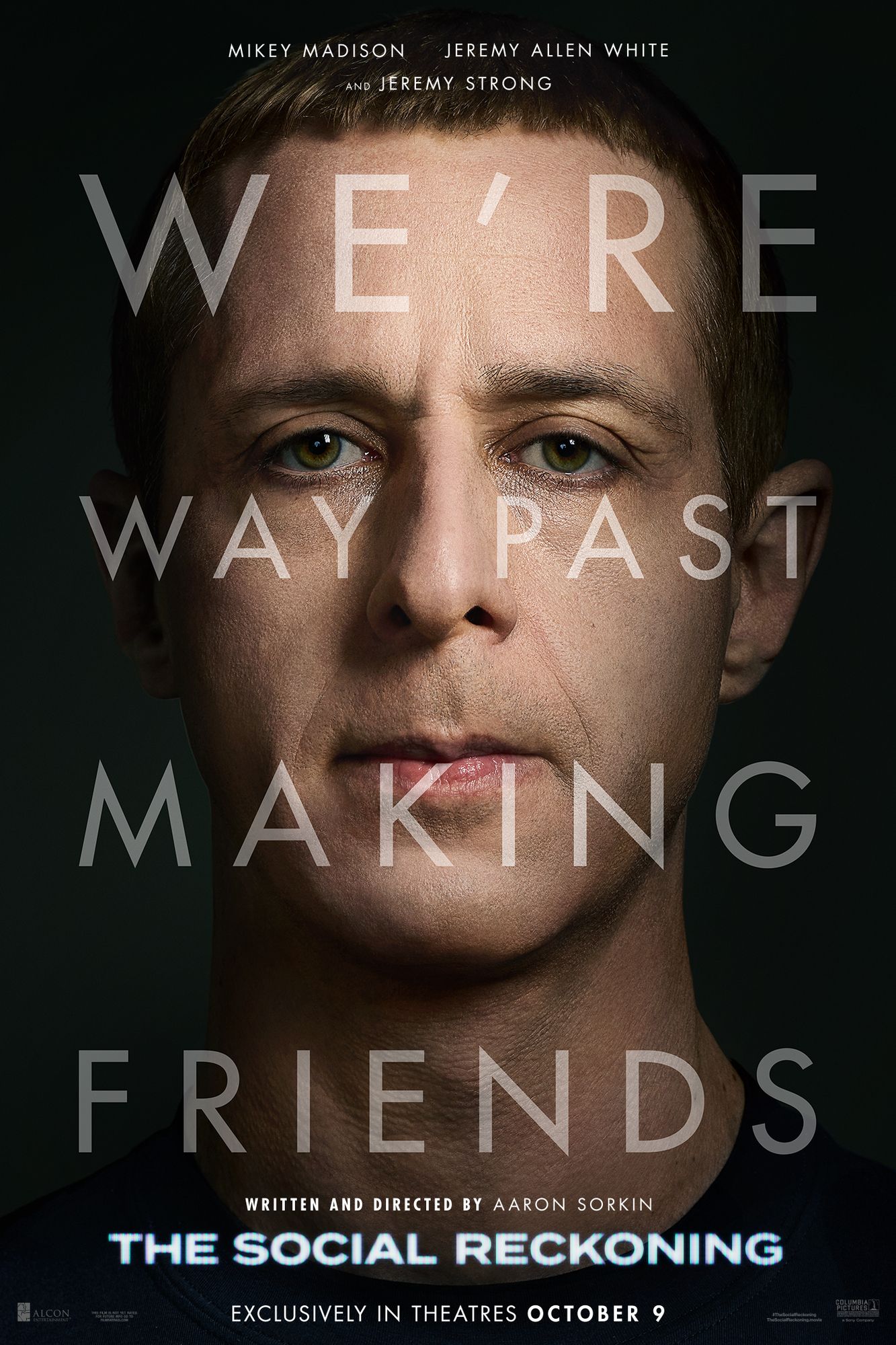
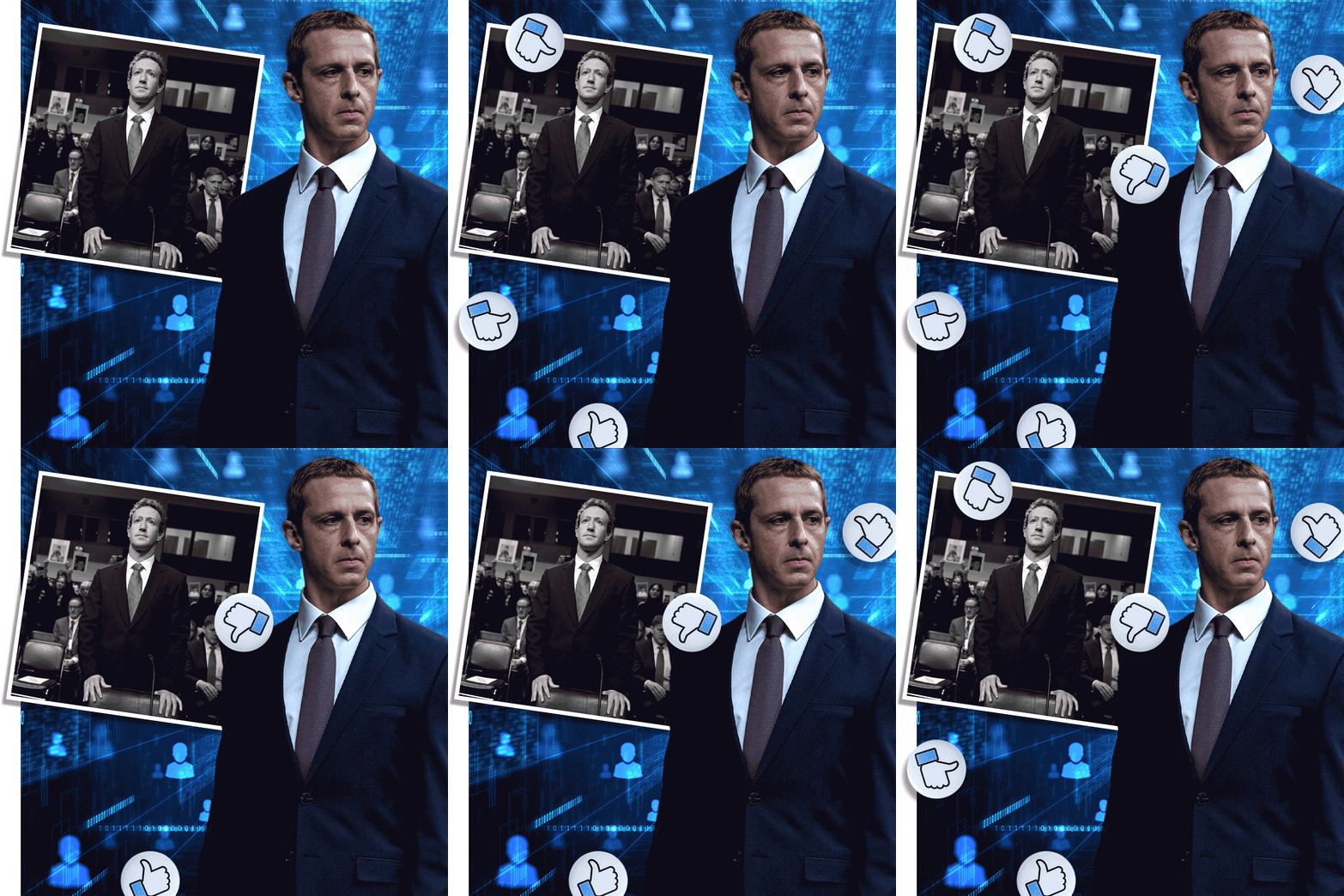
And in most of Zuckerberg’s scenes, he literally plays himself, in a Star Chamber round of rehearsals for congressional hearings staged by a crisis PR strategist (Wunmi Mosaku, the Oscar-nominated Hoodoo healer in Sinners). As Zuck is grilled by a hand-picked cast of adversaries – in particular, an ex-colleague portrayed with excoriating zeal by comedian Bill Burr – she fights a losing battle to make him appear faintly human. Stiff as a board, Zuck 2.0 is a bad actor, in every sense of the word. Which gives Jeremy Strong a lot to chew on in a feat of meta acting that welds caricature with an eerie realism. Playing psychopaths doesn’t seem like much of a stretch for Strong, but as a method actor, he did his homework to an obsessive degree. “I amassed what amounted to a longitudinal record of Zuckerberg’s evolution from every scrap of available source material for the decade spanning from 2010 to 2020,” he boasts in the film’s press notes, citing books, speeches and “every interview, talk, personal post, panel, summit, and written text.” His conclusion: “Mark is a besieged, embattled wartime CEO having to make incredibly complex frontline decisions with unprecedented consequences for civilization. He is between a Gibraltar and a hard place.”

For all his titanic efforts, Strong’s tour de force serves as a sideshow in The Social Reckoning. The main event is the more nuanced relationship between Jeff and Frances, which unfolds as a platonic meet-cute romance between Old and New Media. Jeff faces a steep learning curve as a tech-illiterate political reporter who can’t navigate a Google map. Meanwhile, Frances, newly hired by Facebook as part of its so-called Civic Integrity Team, is struggling to reconcile her passion for Facebook’s core mission as democratic town square with its covert role in nurturing toxic speech. As this odd couple struggles to find common ground, their investigation hinges on the cover-up of an alarming statistic, that 64 per cent of people who joined extremists groups on Facebook were introduced to them by its algorithm. And that an internal ranking system called MSI (Meaningful Social Interactions) skewed the platform’s algorithm to prioritize resharing of posts, which resulted in favoring the most lurid, sensational and inflammatory speech.
In scripting the chemistry between the old-school male journalist and the young female whistleblower, Sorkin’s bias is transparent. He even drops in references to Woodward and Bernstein and the case of the Zodiac Killer as Jeff schools Frances on journalism history. There are some awkward moments. In one contortionist tangle of dialogue, when Frances berates Jeff for “mansplaining,” he replies, without missing a beat: “Speaking on behalf of all men, we’ve heard that feedback and come to the conclusion it’s something that women say when we’re losing an argument.” Ouch. Sorkin may be shooting for a post-millennial blast of Spencer Tracy/Katharine Hepburn fireworks, but as he doubles down on mansplaining, he lays a heavy hand on the scale. That said, White and Madison achieve a playful balance as they settle into a groove. She’s a gas. And after seeing White writhe through his tormented-genius roles as the sullen chef in the Bear and the angsty Boss in Springsteen: Deliver Me from Nowhere, it’s almost as thrilling to see him relax into the role of a confident man on a mission with his cobalt-blue eyes wide open – the kind of hero Robert Redford or Paul Newman would have played back in the day.
Sorkin’s screenplay could have benefited from the leavening discipline of David Fincher. But Fincher is not just in a different league, he’s playing a different game, and any comparison between their filmmaking styles seems as unfair as comparing chess to checkers. But in the film’s final act, as Sorkin drives the story home with a dynamic sequence that thrusts its narrative threads into the fire of American politics, he redeems himself as a director who can turn hard news into inspiring spectacle.
But the final reckoning of the movie is a fleeting triumph. Haugen’s release of the Facebook Files, initially published by Horwitz in The Wall Street Journal, unearthed a cache of 22,000 internal documents that revealed the company was all too aware of the negative impacts its platform was having on everything from teen mental health to viral misinformation. But in the end, their coup is a pyrrhic victory. Unlike Woodward and Bernstein, Horwitz and Haugen didn’t overturn a corrupt regime. They gave it a flesh wound. The ultimate target proved to be invincible. As the film notes in a sobering postscript, a vast number of Americans still get their news from Facebook, and last year Meta simply eliminated its fact-checking program. Now, as the AI monster threatens to go rogue, it would require a Hollywood leap of faith to imagine a newspaper, or a movie, stopping it in its tracks. But for two hours or four, a movie can allow us to dream of changing the world.