Home Base: Boise, Idaho
Author’s Take: “Maybe this novel is my middle-aged book: a story of trying to rein in my own restlessness, accept the beauty of what I already have, and welcome my own insignificance in the face of the vastness of the cosmos.”
Favourite Line: “The owl gazes down at Seymour; the wind ruffles the feathers of his face; in the whirlpool of his attention spins an understanding as old as time.”
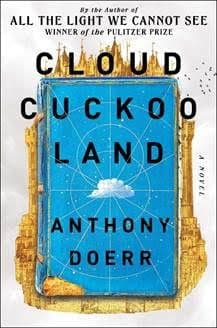
Review: There’s a reason it took Doerr seven years to write Cloud Cuckoo Land, which is also the name of the story within his story. The U.S. author, who won the 2015 Pulitzer Prize for his last book, All The Light We Cannot See, invents a 2,400-year-old novel by Antonius Diogenes, a real Greek author of speculative fiction, and then spins that story across time and space, from Constantinople (now Istanbul) in the 1400s to a spaceship 65 years in the future.
In the first pages of the book, it is 2020 and octogenarian Zeno is directing a children’s play in the fictional town of Lakeport, Idaho, based on his translation of the ancient Cloud Cuckoo Land story. Then 17-year-old Seymour enters the building, where Zeno and the children are rehearsing, with a homemade bomb in his backpack and a gun in his pocket. Before we find out why Seymour is bent on destruction, Doerr goes back 600 centuries to Anna, a seven-year-old orphan in Constantinople who sells old books she steals from an abandoned library to make money, and then jumps to Omeir, a baby born around the same time with a cleft palate in Bulgaria, where the villagers believe the boy is cursed. The other character, Konstance, 10, is aboard The Argos spaceship bound for BetaOph2, which the passengers will colonize because Earth is too polluted.
If it sounds complicated, it is. But in Doerr’s masterful hands, the story about a foolish shepherd named Aethon, who is searching for a utopia in the sky, is just one part of this masterpiece. The novel speaks to the power of stories to transport us from the present to imaginary realms where we are so immersed that we enter the author’s alternate reality. It distracts poor, unfortunate children like Anna and Omeir from their miserable lives and takes them to a magical place where witches extract sunbeams from melons, roads are paved with jewels and tortoises carry stacks of honey cakes on their backs. For Konstance on the spaceship, it is a riddle to be solved that helps gain her freedom. For Zeno, it is about self-actualization and the power to embrace his authentic self.
The book is also an ode to libraries and books, to owls and the environment, and how the modern world is eradicating both in different ways. Doerr has said there isn’t a moral to the story, because he’d rather ask questions and let readers come to their own conclusions. For me, the revelatory moment happened when Konstance and the children on The Argos learn they are the “bridge generation,” and grow up knowing they will die before they reach their destination. They are content because they have been indoctrinated to believe their children will live to colonize a futuristic utopia in the sky and save the human race from extinction.
The idea that each generation stands on the shoulders of the other struck me, since most of us think of our grannies and grandpas as distant relatives who lived in a time of great deprivation, with no airplanes or Wi-fi or smartphones. The fact that we feel so divorced from our most recent ancestors – our great-great-grandparents and the great-great-greats – is almost as sad as the way each generation views its modern time-saving inventions as an improvement on the previous versions, as consumerism gallops on, unabated.
We are all interconnected, Doerr says in this book, and the same goes for humans, owls and ancient myths. It would be wise to honour those relationships. – K.H.