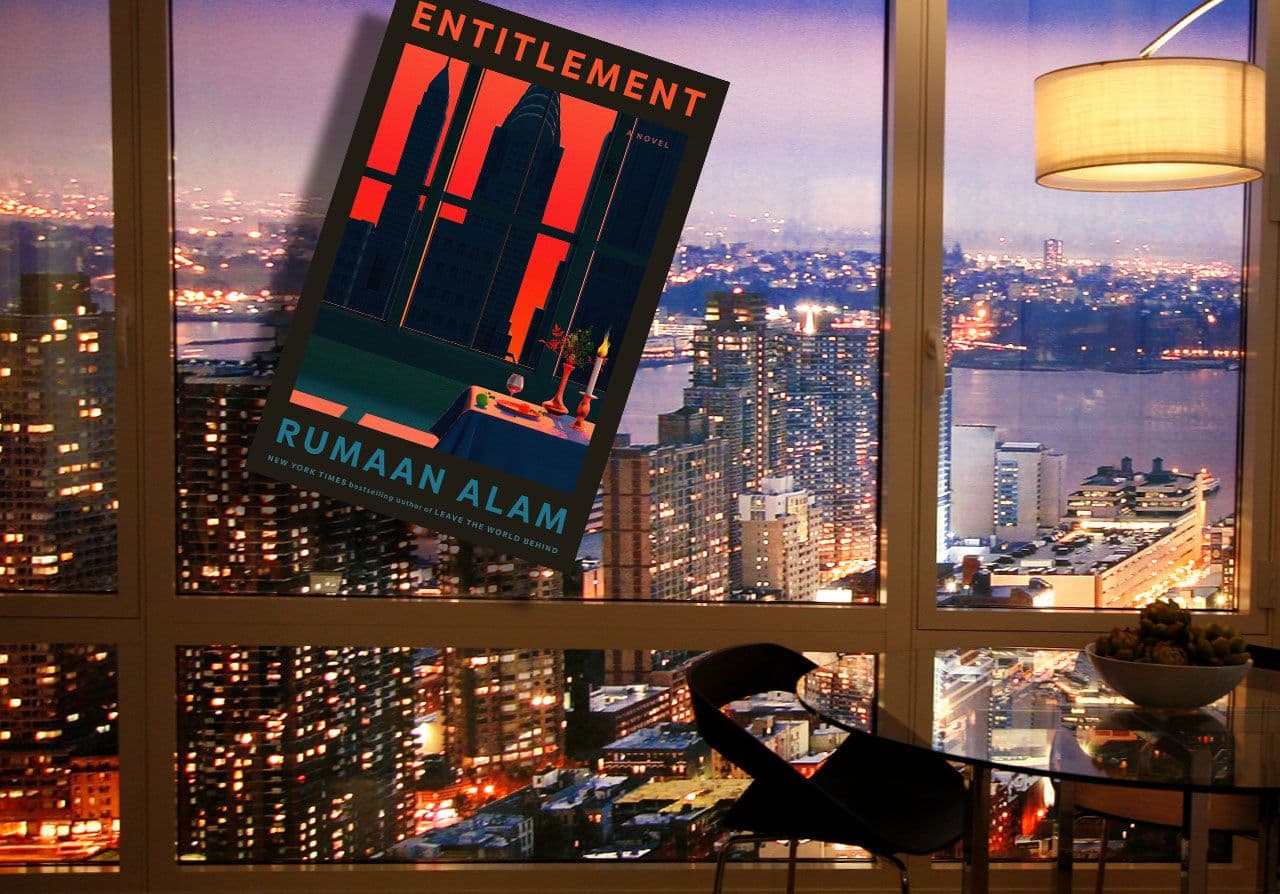
Readers familiar with Rumaan Alam’s last book, Leave the World Behind, know he’s interested in the fault lines that run through contemporary society. Class and race differences figured prominently in that novel, about a bougie white family that holes up in a sumptuous vacation rental in the Hamptons while a mysterious apocalyptic event unfolds. When the Black owners of the house turn up, seeking refuge too, prejudice and mistrust make things even more precarious.
Released during the COVID-19 pandemic, and adapted for Netflix with a cast that included Julia Roberts, Mahershala Ali and Kevin Bacon, Leave the World Behind became a breakout hit for Alam. It was his third novel, written at home in late-night spurts after his husband and two young sons had gone to bed. Thanks to its success, Alam now works office hours – in an actual office – and says life as a parent helped him become a more efficient writer. (He wrote a first, “terrible,” draft of Leave the World Behind in an astonishing six weeks.) “You unlock unheard-of levels of efficiency when you’re negotiating with a two-year-old,” says the Brooklyn-based author, who grew up in Washington, D.C., and resisted his Bangladeshi immigrant parents’ entreaties to choose a more financially promising profession.

His new novel, Entitlement, mines racial differences again, but targets a new issue: wealth and who has a right to it. Brooke Orr is a Black 30-something who wants to make a difference in the world. Her employer, Asher Jaffee, is a white octogenarian billionaire who has created a charitable foundation to give away his vast business fortune. Financially, Brooke doesn’t need much – she has a decent apartment in Manhattan and an employer who treats her to $200 lunches – but, as she bonds with Asher and experiences the benefits of infinite wealth, she starts to believe she deserves a slice.
“Good God, this apartment,” Brooke thinks when she sees Asher’s Central Park-facing pied-à-terre. “Rooms in every direction, a sense of space all around them; beyond those, the unending sky…. Did Asher know how special it was? He did. She knew it. And he was telling her that such a life was hers, too.”
In a recent interview with Zoomer, Alam discussed money, the expectations it imposes, and his penchant for endings that leave readers thinking – and talking.

Carol Toller: You’ve described the inspiration for Leave the World Behind as a vacation house you rented that made you think about domestic novels and the idea of subverting the notion of quiet lives existing in them. What was the impetus for Entitlement?
Rumaan Alam: It’s actually hard for me to remember, which is surprising because I remember the beginning of the previous book with such specificity. But at some point in 2021, I was very interested in the idea of non-profits, and I found myself at a pool party where there was a woman I knew who worked as a non-profit consultant. I remember saying to her, ‘tell me everything about your job.’ She was so surprised – it’s not the kind of job, I think, where people say that to you. We talked for 45 minutes, standing in the swimming pool.
CT: What got you thinking about non-profits, money and wealth?
RA: Something was churning inside my brain. The idea of a non-profit was there. The idea of the billionaire was there, and the idea of having an intimate relationship with somebody who possessed so much money and yet you’re unable to ask for any.
Money interests me because there’s this weird propriety about it. There are people who have so much of it, and yet there’s some line we draw when it comes to talking about it. Like, if you were friends with Bill Gates, you would never say to him, ‘Hey Bill, it’d be nice if you paid for my kid to go to college, because for my family that’s a hardship.’ Even though, to him, it wouldn’t cost anything. Somehow money exists outside the logic of the co-operative, outside the social norm, and that interested me.
CT: Brooke and Asher are about 50 years apart, and yet they become close. Why the age gap?
RA: The intergenerational aspect was of such interest to me. When you’re in your 20s, maybe even 30s, there’s some abstraction with respect to age – your peers’ parents seem unrelated to your experience. And then you cross some line and you realize, ‘Oh, that old lady on the corner is actually just like me.’ You understand that somebody who is much older than you could actually be a friend. They could have some interesting perspectives on what’s happening in your life.
And I wanted to toy with readers’ expectations that the book would be about a violation of sexual propriety – that it would be a #MeToo book. I hoped that the reader would expect that, but that the book would frustrate those expectations.
CT: These two novels crackle with nervous energy. From the very first page of Entitlement, where we learn that a mysterious man is pricking women on the New York subway with a hypodermic needle, the reader knows they’re entering an uncomfortable world. Is that how you experience life?
RA: I don’t think that’s my everyday experience of reality, happily, but on balance it’s not a bad aspiration for a novel that’s trying to describe these times. Also I find myself drawn to books that destabilize me – that kind of shift under your feet, where you can’t quite get comfortable. It’s a pleasure that’s not so far from the pleasure people find in watching a horror movie. You’re ceding control. It’s like, I’m going to tell you a story but also make you feel a little weird.
CT: But it isn’t all discomfort. In Entitlement, Brooke and Asher both seem to find clarity or even transcendence through art – paintings by Monet and Helen Frankenthaler and the music of Mozart.
RA: Art is a system where monetary value doesn’t really pertain, even though it does. The reader understands that the Monet in the book is worth millions, but that there may be some other function at work that resists the system of value. Mozart is a better example, because Mozart’s music is not monetizable. It’s something that we as a society, as humanity, agree is a pinnacle of human achievement. But it can’t really be bought or sold.
CT: Let’s talk about endings, because wow. The ending of Leave the World Behind still has the internet chattering, and the conclusion of this novel is just as likely to generate debate. Do you typically have endings in mind from the outset?
RA: No, I don’t. In this book, by the 11th draft, I identified how the ending would go – I wanted it to end on the word “free,” because free is such an interesting word. It means there’s no price attached, but it also means liberty. And I wanted to build to a point where there’s both clarity and a sense of frustration, where the book has answered most of your questions, but the literal answer to what happens to Brooke at the end is something I can’t answer, and that’s kind of funny. You can answer that question as a reader, but I can’t.
CT: But you must have an ending in your own mind, at least?
RA: I don’t think I do. I’m not privy to some secret about the book, because that suggests I’m kind of laughing at you as a reader. I don’t want to do that.
We don’t have [the artist] Helen Frankthaler here anymore, but even when we did, would she have been able to tell us what we’re looking at when we look at one of her paintings? Or would she have said, Oh, that’s not my job. My job is to make things and your job is to complete it.
This interview has been edited and condensed for length and clarity.