

Pop culture figures don’t come more polarizing than Yoko Ono. Some 60 years after she scrambled brains – including John Lennon’s – from New York to London with fearlessly outlandish music, films, art installations and performances, the Tokyo-born multimedia artist remains something of a peculiar punchline.
As recently as December 2023, pop star Taylor Swift was accused of abetting the losing streak of the NFL’s Kansas City Chiefs by “Yoko Ono-ing” or sexually distracting the team’s tight end, her beau Travis Kelce – as Ono purportedly did with Lennon. It wasn’t the first time that harsh analogy had been levelled.
Even a new biography acknowledges that most Beatles lore casts Ono as “a caricature, a curiosity, or even a villain – an inscrutable seductress, a manipulating con artist and a caterwauling fraud who hypnotized Lennon and broke up the greatest band in history.”
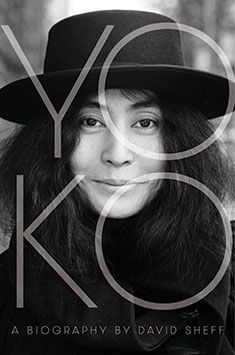
But David Sheff, author of the just-published Yoko, goes on to decisively upend that perception. He chronicles how “the world’s most hated woman,” as he terms her, was in fact a towering original who never stopped creating but whose output was consistently appraised through a profusely racist and sexist lens.
Speaking to Zoomer from his home in Northern California in his first-ever interview about his book, Sheff confirms his ambition was to correct historical wrongs – he asserts, most strikingly, that Ono extended the Beatles’ run – while emphasizing her influence on the avant-garde, as well as on modern peace activism.
Written with the assent of son Sean Ono Lennon – who greenlit interviews with intimates in the family’s orbit, including Yoko’s younger brother Keisuke and her former classmates at Sarah Lawrence College in New York – Yoko also draws deeply on Sheff’s decades-long friendship with the artist.
The connection was forged when Sheff – author of 2008’s Beautiful Boy, which chronicled his son’s drug addiction and was adapted into a 2018 film starring Steve Carell and Timothée Chalamet – spent three immersive weeks in the fall of 1980 with John and Yoko for a Playboy magazine profile.
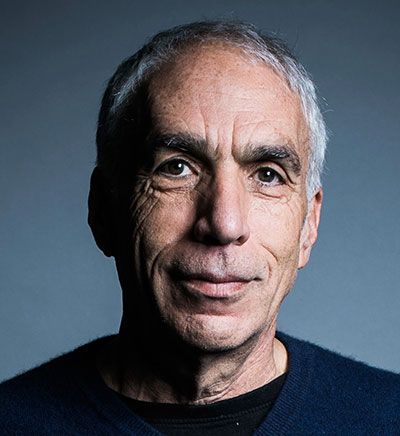
It would be their last major interview together before Lennon’s murder that December. The widow and author kept in touch, and eventually travelled together to Russia and Japan. In 2002, Ono hosted Sheff’s son Nic at her upstate New York farm during part of his recovery. Sheff writes that he and Ono communicated for a decade after that through bicoastal, in-person visits and phone calls but then “slowly drifted apart.”
Now 92, Ono did not directly participate in the book; Sheff doesn’t know if she has read it. “It was made clear to me that she was not doing any more interviews and was living this very different life,” he says, noting that Ono has been absent from the spotlight since 2017 when she alluded to an unspecified illness. “It would have been fabulous to go back and clarify things with her. But that just didn’t happen.” Still, if anyone has the frame of reference to document Yoko Ono’s kaleidoscopic life, it’s Sheff.
Zoomer: What makes Yoko Ono such a complicated person, and historically so hard to love?
DAVID SHEFF: The racism and sexism she endured cannot be overstated. Sean Ono Lennon has asked if the attacks would have happened had she been some blond. The answer is probably no. John was not immune to it, either. Imagine is the best example. He wrote that song in collaboration with Yoko. He told me himself in 1980 that the concept was based on her book Grapefruit, which is all about using our minds to create a different reality. But John failed to give her credit because, as he said, she was “the wife.” Had it been Harry Nilsson or David Bowie, it would have been listed as a co-write from the beginning.
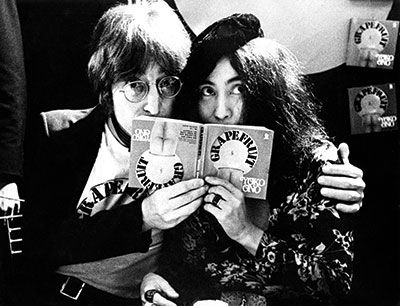
Yoko also didn’t make it easy for people. She was very open as far as her art and music were concerned, but she was not forthcoming about her personal life. So many times I heard, “What did John see in Yoko?” She had a very difficult childhood, raised during wartime in Japan. She had what was described to me not as a “love-hate” relationship but a “hate-hate” relationship with her mother, Isoko [heir to a Japanese banking fortune], who told her not to smile in public because it was overly ingratiating.
She was broken and depressed in many ways and that came through in her personality. [Sheff details multiple suicide attempts during her teens and one prior to the 1963 birth of her daughter, Kyoko, for which she was briefly institutionalized.] Yoko was not this exuberant pop star. Plus, she was in the world of the Beatles, four guys who were larger than life.
Z: Contrary to popular belief, you maintain Yoko kept the Beatles together long enough to create Abbey Road and Let It Be despite the resentment her presence at those sessions stirred in the other three members.
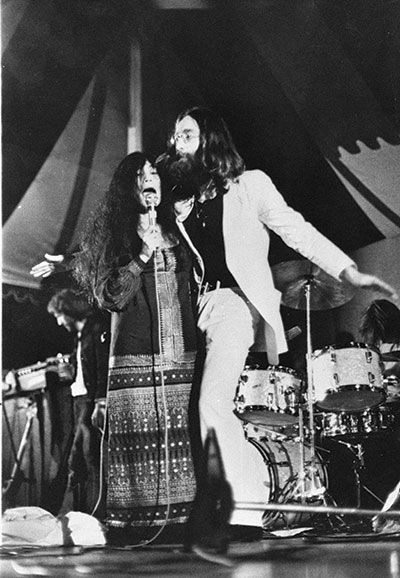
DS: Yes. All Beatles ephemera subscribes to this idea that she injected herself into, and disrupted, this holy foursome. But John was miserable during that period, overwhelmed by being in the Beatles, the pressure to churn out hits. He already had a foot out the door and without Yoko literally holding his hand in those sessions, he may have had the other foot out the door. Obviously, there is no way to know for sure. But John attributed his ability to cope to Yoko’s support – something a good friend of theirs, the musician Klaus Voormann, confirmed. Yoko unleashed John, especially as a performer. She
saved him as an artist and as a person.
Z: Dozens of very influential people, like David Byrne, Laurie Anderson and David Geffen – as well as Yoko’s largely unacknowledged, post-Lennon boyfriend of nearly 20 years, the artist Sam Havadtoy – really stepped up to rave about her.
DS: People were thrilled to talk about her because the feeling was she had not gotten her due. I sensed from many people that it was almost a duty to set the record straight.
Z: But two notables opted out: Paul McCartney and Ringo Starr.
DS: I tried. Through their publicists I got relatively polite nos.
Z: Yoko’s children Sean and Kyoko cooperated with the book. But Julian Lennon, John’s son with first wife Cynthia, seemed less involved.
DS: He did answer a few of my questions but only by email. He is writing a biography, and I was told he was contractually prohibited from talking to others. Julian ended up suing Yoko over his father’s will but that was only a small part of their relationship. Yoko was very supportive when Julian started making and showing his own work and Julian often stayed at The Dakota when he was in New York. I know that’s true because I encountered him there personally.
Z: Do you aspire to sway people’s attitudes about Yoko Ono?
DS: Yes. If this book does anything, it will elevate her, so people see her in a new light and understand she wasn’t just an appendage, she didn’t break up the Beatles, and she was this incredible creative force. She was a pioneer but was largely dismissed after she got together with John because she was viewed as this pop figure.
But her work is so inspiring and beautiful, ethereal and important. She saw things differently and was able to communicate that in her art and music. The reason John made the Double Fantasy and Milk and Honey albums – and the reason he did that big Playboy interview with me – was to show the world what he saw in Yoko. John maintained that her music was as important as the Beatles’ music.
Z: You have some Hollywood connections via Beautiful Boy, a title inspired by Lennon’s song about Sean. How would you feel about adapting Yoko into a biopic?
DS: Fabulous. Her story is so rich and unexpected. She is a part of history, but other than the clichéd story and the vilification, people really don’t get why
she is extraordinary.
Z: Also amusingly self-aware. You write that after Donald Trump was first elected in 2016, the 83-year-old Ono tweeted: “Dear Friends, I would like to share this message with you as my response to @realDonaldTrump. Love Yoko.” It was a 19-second audio clip of her screaming.
DS: Ha! Yes.


