If you ever wondered why Emma Donoghue’s name is seemingly everywhere – on novels, children’s books, movie screenplays and even theatre marquees – it’s because the Irish-Canadian writer has a pragmatic view of her profession. “I really like to have a lot of projects to work on because they’re always falling through,” Donoghue, 55, tells Zoomer. “Not that much in fiction, but certainly with film projects – and the theatre is always up and down. So it’s kind of like the way that I was the eighth child in my Catholic family: the parents can be a little bit more mellow because they’re like, “Oh well, surely one of them will bring home the bacon.”
A couple of Donoghue’s “children” are hard at work right now. She recently released the bestselling historical novel The Paris Express, about an infamous 1895 train derailment. And while her last play, a Broadway version of Room – Donoghue’s internationally acclaimed novel and Oscar-winning film – fell through before opening day, she’s back in the playhouse with a new work, The Wind Coming Over the Sea, which she wrote for this year’s Blyth, Ont., summer theatre festival (running until Aug. 12). The story follows an Irish couple, Henry and Jane Johnson, during the 19th-century potato famine, as they make their way to Canada – albeit separately. “It might seem like fairly traditional subject matter, the immigrant history in Canada,” says the writer, “but immigration is so much in the news these days that it gives a show – even about the 1840s – a really timely edge.”
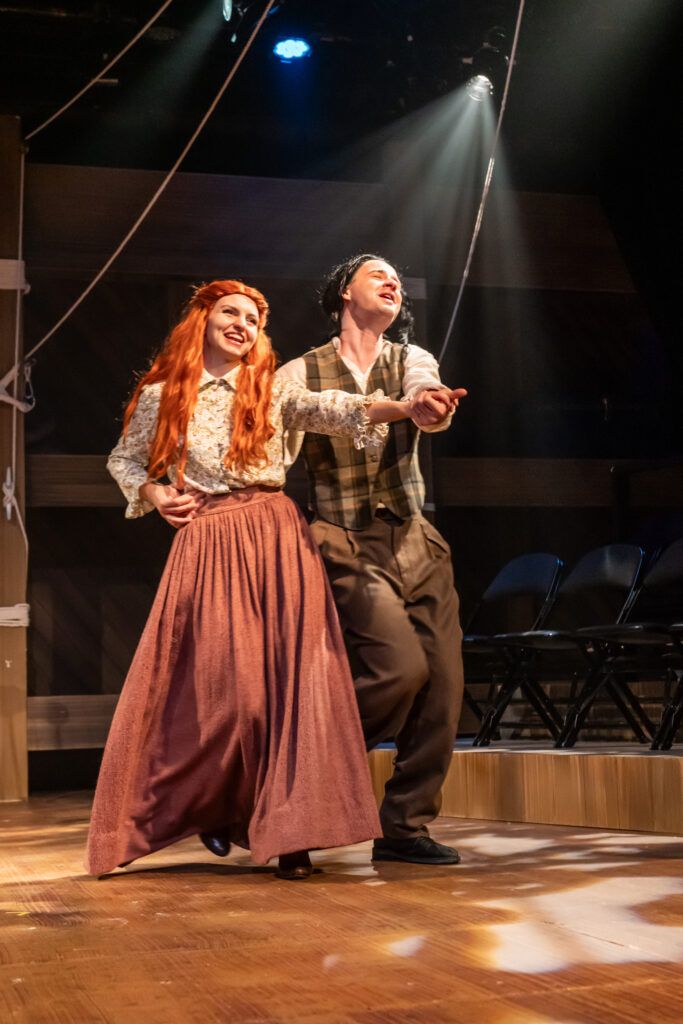
Donoghue, who lives in London, Ont., with her partner, women’s studies professor Chris Roulston, and their two children, Finn and Una, talks to Zoomer about her fascination with the real-life Johnsons, whose historic letters were the basis of the play.
Zoomer: Congrats Emma on The Wind Coming Over the Sea. What aspect of this theatre show excites you the most?
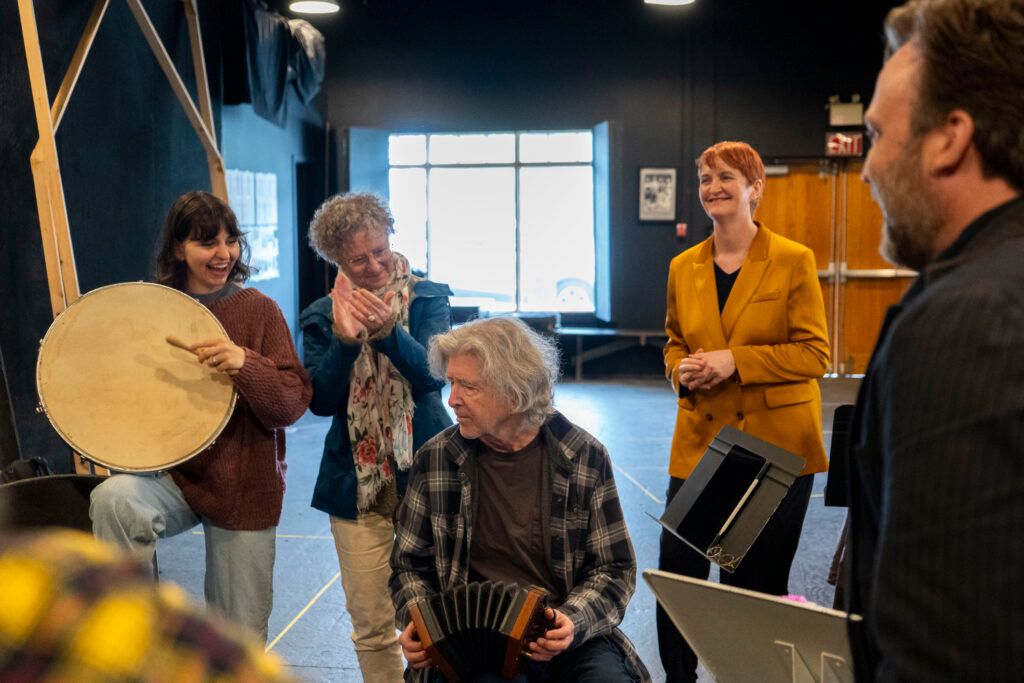
Emma Donoghue: Well, I suppose it’s always exciting to have a new show – and this is my first real musical. The play adaptation of Room had some songs in it, but it was the director who added them. And I loved them, but it wasn’t really my idea, and they were used just as internal monologues for the mother character. Whereas, in this play, I was the one who chose all the songs from the corpus of British and Irish traditional music. And I’m really using them to tell the story of this particular couple. So it feels like much more of a real musical.
B: For those who haven’t experienced the Blyth Festival, can you tell us what makes it so special?
ED: Working with Blyth Festival, it’s a dream. When I saw my first show at Blyth about 25 years ago, I was dumbstruck to realize that this tiny town in the middle of Ontario had some of the best theatre in Canada. So the idea of doing a new show with Blyth is just chef’s kiss.
Z: What is the town like?
ED: It is so utterly charming. When I was there for rehearsals, I needed something to celebrate a high school graduation, and I was able to get a chocolate owl wearing a mortar board. They’ve got these delightful specialist goods available, but it’s still a very real, rural town. For instance, in our show, there are key scenes of knitting that help to tell the story. There is a blanket in the Strathroy Caradoc Museum [near Donoghue’s home in London, Ont.] that was knitted by the real-life Jane Johnson. So, of course, we had to have the character knitting that blanket on stage. And I remember in a very early production meeting someone said, “How do we get this kind of specialist knitting with an apricot leaf pattern?” And somebody else says, “This is Blyth, we’ll find someone! We have such strong community ties.” So it’s a theatre that’s really supported by its community. It’s been there so long, more than 50 years, and yet has managed to keep this cutting-edge commitment to quality. It’s never dumbed things down for the summer theatre trade. It’s not a bit like other summer theatres. It does pretty much all new Canadian plays, and that’s so unlikely to find in a rural community. I don’t know anything like it in any country, actually.
Z: You’ve already written about the Johnsons, what is it about their lives that keeps you coming back to them?
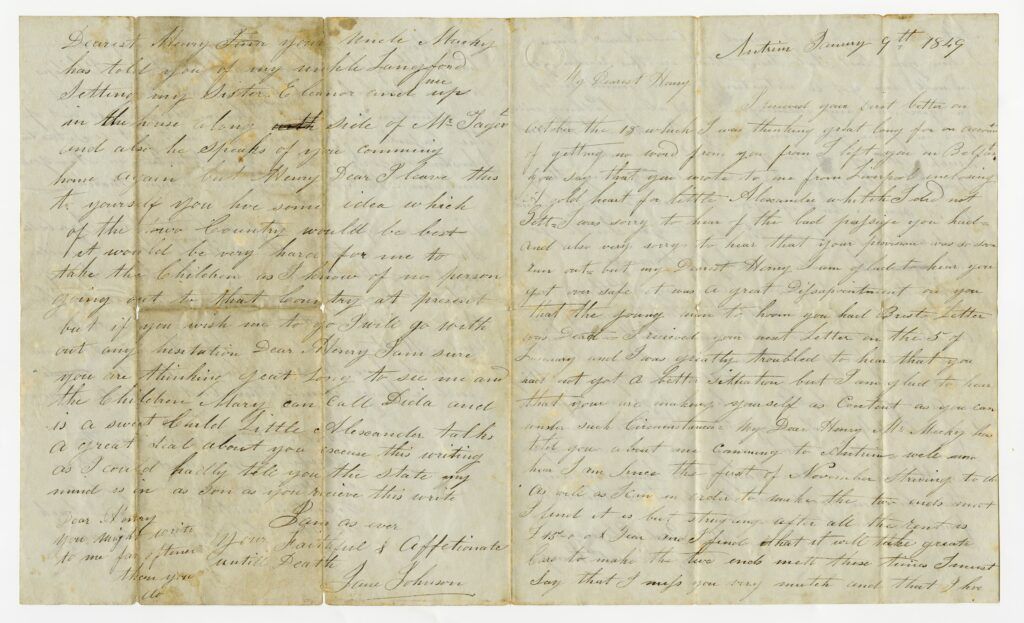
ED: I came across the Johnsons’ letters in a footnote to a book about the famine. Theirs is a very poignant story. There are really just seven key letters between the two of them, which were carried around and exchanged and returned. And those seven letters tell a very strong and powerful story of love and family and risk and loss. But it is also the fact that they are very eloquently written. These were fairly well-educated people from Presbyterian shopkeeper families, and they wrote with a kind of blunt, pragmatic quality. They hardly ever talk politics, rather after Henry emigrates, he writes, “How much is wheat this year?” or “Bring the gun” or “I am 14 pounds heavier than when I came here.” In a way they were emigrating for calories, they wanted their kids to live. They wanted some chance to try, like all immigrants do. But they also make these extraordinarily articulate emotional statements, too. The very first letter is from when Henry is in jail for his debts in Ireland before he leaves for Canada. And he writes to his wife, “I mean to be what I have not yet been, a good husband for you, a husband you deserve.” So they were emotionally articulate as well as concrete and pragmatic. And so, yes, those statements about love and time and being together – I think that’s what keeps bringing me back.
Z: And now the immigration theme is so prevalent.
ED: I think it’s odd that ever since we started talking about this show, immigration has become much more political and much more timely. The question of letting new people into a country is in the headlines every day, along with the hostility to immigrants, images of thousands at the border and the terror of ICE raids [in the U.S.] – and Canada defining itself by contrast as this richly multicultural country.
Z: Of course you also emigrated to Canada. But your experience in 1998 would have been much different than the Johnsons or even with those coming today.
ED: Yes, obviously, I’m not drawing a very close parallel with the Johnsons. By 1840 standards, you know, my story is a fairy tale. I came for love and that love has lasted. But I think the Johnsons’ story is a fairly representative immigration story in that it’s true that once you make it to Canada everything’s not perfect. Henry went first and he’s writing home to Jane saying, “Come on, I have a feeling it’s gonna be better here.” But then he writes, “It’s not better here yet, I can’t find a job, and the prices are really high. But I think it’ll be better if you come and help me.” It’s never simply that the new place is better than the old place. When people leave, they often have some sadness and regret. I felt a mixture of sadness and happiness, there are things that I like in Ireland, there are things I like in Canada. So it’s always a mixed feeling and frankly, that’s very good for a writer. I think writers should always have to keep ourselves, slightly, as an outsider to the culture, noticing the little differences and so on.
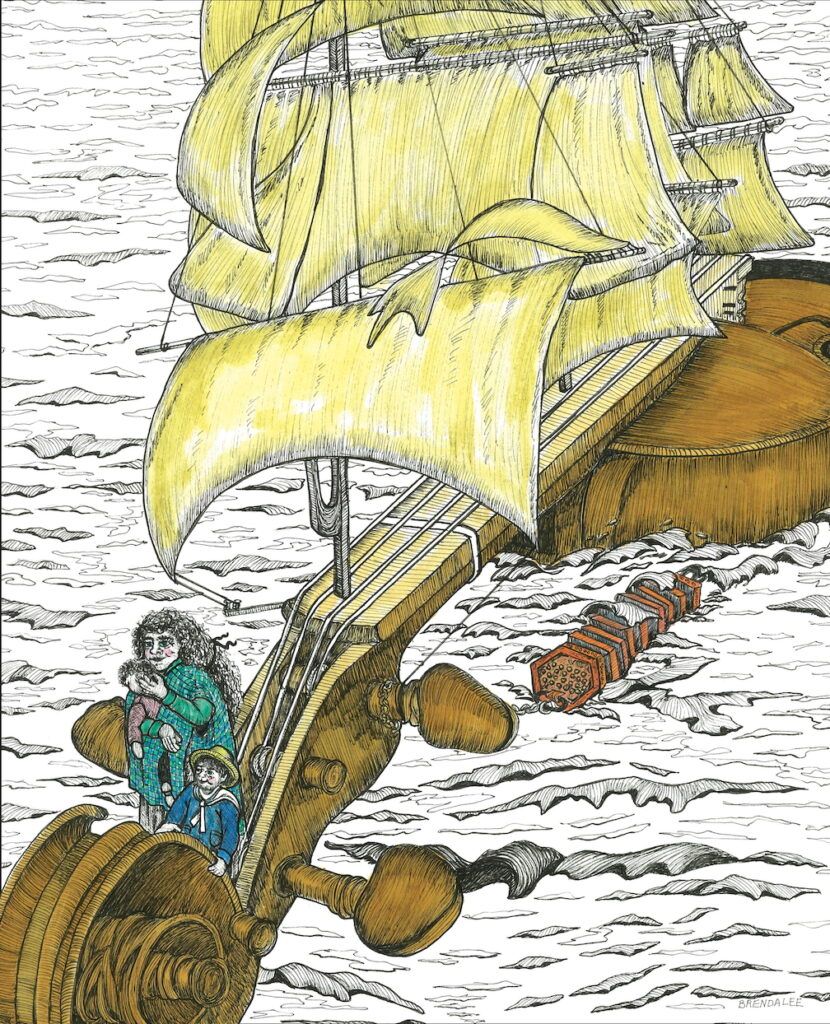
Z: The Johnsons wanted to raise their children in Canada, which is what you did. Is it what you expected it to be? Is it very different than if you had raised them in Ireland?
ED: Ireland came much later to the idea of same-sex families than Canada and, even now, it doesn’t give them all the same rights. Having our kids here, and knowing from day one that they would be completely secure in their legal relationship with both of us – that they didn’t risk losing either of us with a breakup or death – that was lovely. They are able to have plenty of friends who have two mothers or two fathers, and we didn’t have to think too much about it. Whereas, we’ve gone to live in France several times, and I remember one particular place where we stayed, we were the only gay couple in the village. So I have to say, raising our kids in southwestern Ontario as a same-sex couple has felt like a best-case scenario. And certainly, as soon as the kids arrived it felt like that was the moment I put down my roots.
Z: You’ve given credit to your daughter, Una, for contributing to this new play.
ED: She’s about to go to Sheridan College to study musical theatre, and she’s been focused on a career in that area for years. With her I’ve seen many musicals and we’ve analyzed them afterwards, saying which songs seem unnecessary or if the act break seems slightly in the wrong place. So it’s become a delightful mutual hobby. I might not have thought to make this show a musical if it wasn’t for Una, and she was very helpful reading through and saying things like, “Oh, that’s a bit too close to the last song or it would feel odd to have a heartbreaking song there.” So yeah, it’s very helpful to have the performance perspective – and special to be able to work on that together.