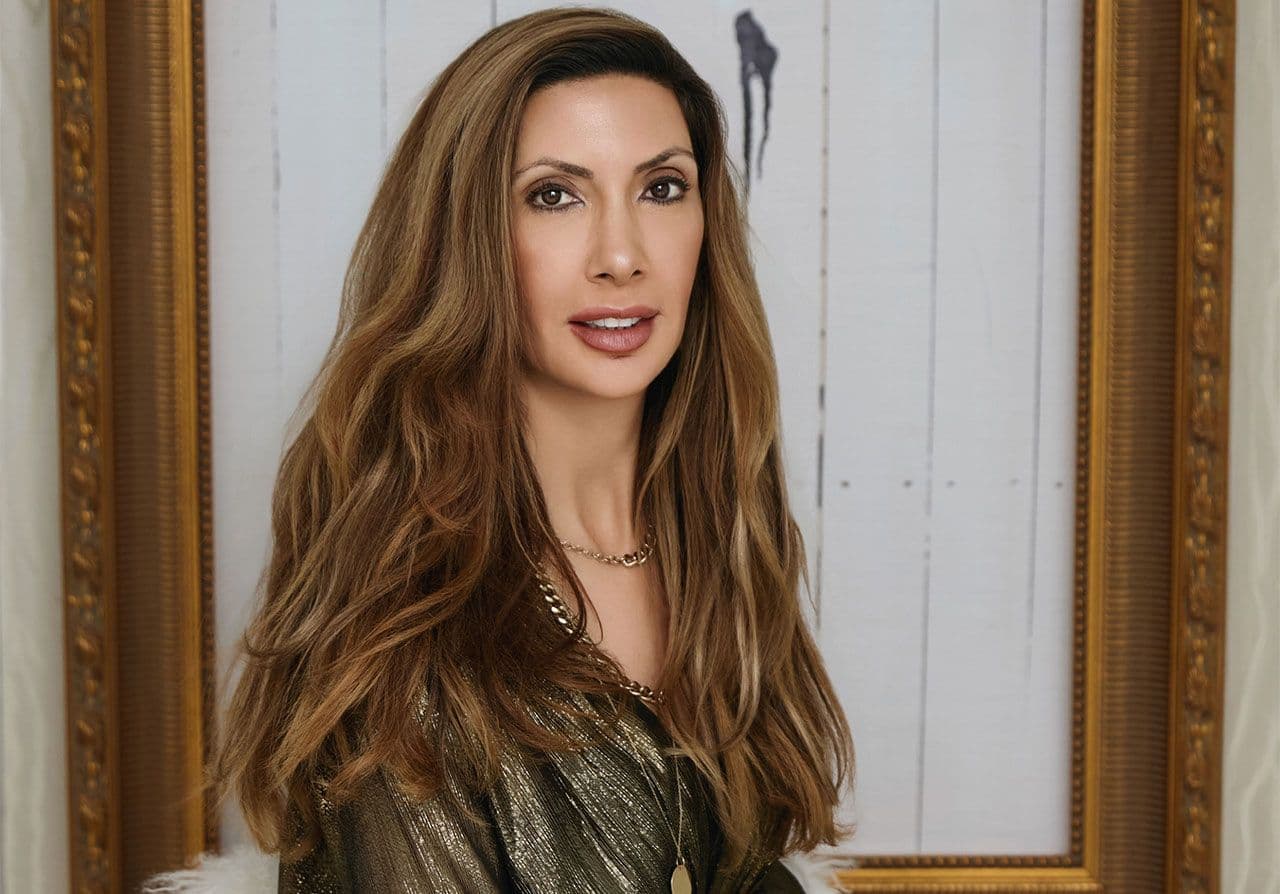
As a child, books had a powerful influence on Rana Florida’s life, and as an adult, one in particular altered her future – she met her husband, renowned urban studies theorist Richard Florida, when she asked him to sign a copy of his 2002 bestseller, The Rise of the Creative Class. They married in 2006 and moved from Washington, D.C., to Canada in 2007, after he was hired by the University of Toronto, where he is a professor of economic analysis and policy.
The glamorous, always amiable author and marketing guru with an MBA juggles many roles: mother of two young girls, indispensable member of the Toronto society set and CEO of the Creative Class Group, a boutique advising company where she manages new business development, global operations and marketing for clients such as Meta, BMW, Converse and Cirque du Soleil.
She’s also authored three books herself: Creative Entertaining; Simply Jordanian, a collection of Middle eastern recipes; and Upgrade: Taking Your Work Life from Ordinary to Extraordinary, for which she interviewed more than 30 leaders in their fields, from tennis player Andre Agassi to starchitect Zaha Hadid. Books have clearly been a constant for Rana, so she walked us through some of her favourites.
What’s the best book you’ve read this year?
The Anxious Generation by psychologist and New York University professor Jonathan Haidt. I’m already freaking out about our seven and eight-year-old daughters wanting cellphones; as kids, we spent all day riding our bikes on our own. Our biggest worry was the “white kidnapper van” and being home for dinner by 5 p.m. Outdoor play, nature and physical activity are what kids need. We didn’t have devices until our 20s, by which time our confidence and morals were almost fully formed. The thought of a young girl on social media is terrifying – the social comparisons, the mental health issues, depression and anxiety.
When our girls get together with their older friends, they’re all glued to their devices, unable to connect, play or have a conversation. This book is a great read, and I’m trying to make a social pact with other moms to not cave into giving their kids cellphones at least until the age of 15, which still feels too young!
What book can’t you wait to dive into?
After a four-hour delay at Pearson [International Airport in Toronto], I bought Adam Grant’s Think Again. I’m fascinated by how people think and how to open others’ minds; it’s a major issue in our society right now. It’s so polarized that family ties and longtime friendships are ending over political or social views. So, how do we get people to rethink and unlearn? The book invites us to let go of views that aren’t serving us well, and to value mental flexibility, something I think the U.S. and Canada need now more than ever.
I’m also intrigued by why some companies fail and others flourish. When we first moved to Canada, we met Mike Lazaridis, CEO of Blackberry. I was celebrity-stricken as I was obsessed with my Blackberry and didn’t want to trade it for Apple’s iPhone due to the keyboard. According to Grant, Mike’s genius was shrouded by his overconfidence and pride in his successful invention, which prevented him from seeing that the competition would quickly put the $70-billion company out of business in just a few short years.
What’s your favourite book of all time?
The Rise of the Creative Class by Richard Florida. Getting the book signed at [former Michigan] Governor Jennifer Granholm’s “Cool Cities” conference is how I first met my husband. When he asked me who he should sign it to, I brazenly replied, “Your future wife!” And the rest is history.
What books completely changed your perspective?
Growing up with immigrant parents in a tight-knit village in very suburban Michigan, there were a handful of books that changed my life. On the Road by Jack Kerouac – its messages of freedom and self-discovery – inspired my teenage years and unleashed my spirit for adventure. Also, its portrayal of a restless search for identity and belonging really resonated with me and my yearning for personal discovery and exploration. Henry and June by Anaïs Nin and Tropic of Cancer by Henry Miller, which also challenged societal norms, opened me up to a whole new world. The open dialogue and sexual themes sparked my rebellious streak.
And lastly, of course, J.D. Salinger’s The Catcher in the Rye, as I was slightly obsessed with cool boy Holden Caulfield. I was fascinated by his disdain for phoniness and his quest for genuine human connections. I adored his rebellious nature, as at the time I too was questioning the boundaries of my conformity and independence. I devoured these books, which were a whole world away from my traditional upbringing.
In high school, my sisters and friends and I worked at Café Jardin, a restaurant in the upscale [Troy, MI] mall, the Somerset Collection, where there was a Doubleday Books next door. A sweet elderly lady used to let me pick free books in exchange for a pint of fresh crab pasta. For some reason, she had to tear off the front cover, but I was ecstatic to bring home a new free book every week!
If you could have dinner with any author, living or dead, who would it be?
I loved Barbara Kingsolver’s The Poisonwood Bible and had to travel to Africa after I read it. I distinctly remember that – as she wrote – when you land in Africa, you can smell the earth and the dirt as it wasn’t as sanitized as in the U.S. It was the best trip of my life. Some of the local villagers even offered my parents 10 cows and two goats for my hand in marriage! She also wrote a children’s book about nature with her daughter, something I have been trying to do with our two little ones. She said it was her hardest book to write; she tried three times.