This is Part One in an ongoing series examining the moral and ethical dilemmas of judging the mental capacity of elderly Canadians, who are developing dementia in record numbers. With $1 trillion in wealth to pass on to heirs, baby boomer children are launching legal fights over their cognitive abilities that are clogging courts, draining estates and sawing branches off family trees. Part One was nominated for a 2025 National Magazine Award for Investigative Reporting.
In Part Two, “Perfect Prey,” a new breed of unscrupulous suitors is swindling elderly, well-to-do Canadians out of their fortunes. It’s called predatory marriage, and there’s never been a better time for romantic fraudsters to hunt. Part Two was also nominated for a 2025 National Magazine Award, this time in the Long Form Feature Writing category.
Visit our Big Issue hub, featuring stories, videos and more focussed on the topic of guardianship and judging the mental capacity of elderly Canadians.
We’d like to hear from you. Email your stories to capacity@zoomermag.com.
The Palichuks were a happy family, once upon a time.When Steve and Nina Palichuk were building their dream home on two green acres in Acton, Ont., in the late 1960s, Linda Palichuk remembers how she and her younger sister, Susan Palichuk, camped on the property before the house was finished, roasting hot dogs and marshmallows over a bonfire. Their father eventually put in a trout-stocked pond, where they fished and swam in the summers and skated in winters.
The memories are bittersweet now. In 2016, Steve Palichuk died suddenly in his Acton home at 85, and the family ties have since unravelled.
Both parents’ wills and spoken wishes were for their estate to be split equally between their two children. But, in the fall of 2020, Linda, who is assistant manager of the Royal Botanical Gardens gift shop in Burlington, Ont., learned she had been completely cut out of her mother’s will and would not have power of attorney. Instead, Susan, a former florist, would be responsible for her mother’s personal care and property, and inherit everything.
“I was shocked,” Linda says in one of several interviews conducted over the last 10 months. “I was heartbroken and very sad to realize that I had lost my mother to Susan’s constant manipulation.”
Linda felt sure Susan had turned their mother against her, and Nina, who was then 89 and “forgetting to take her medication, eat, bathe and change her clothing,” did not have the fortitude to resist her. In December 2020, Linda filed a lawsuit with the Ontario Superior Court of Justice alleging her sister wielded “undue influence” over Nina. She also made a legal bid to become her mother’s guardian, and challenged the sudden radical changes Nina had made to her will and powers of attorney, on the basis she was mentally incapable of making them.
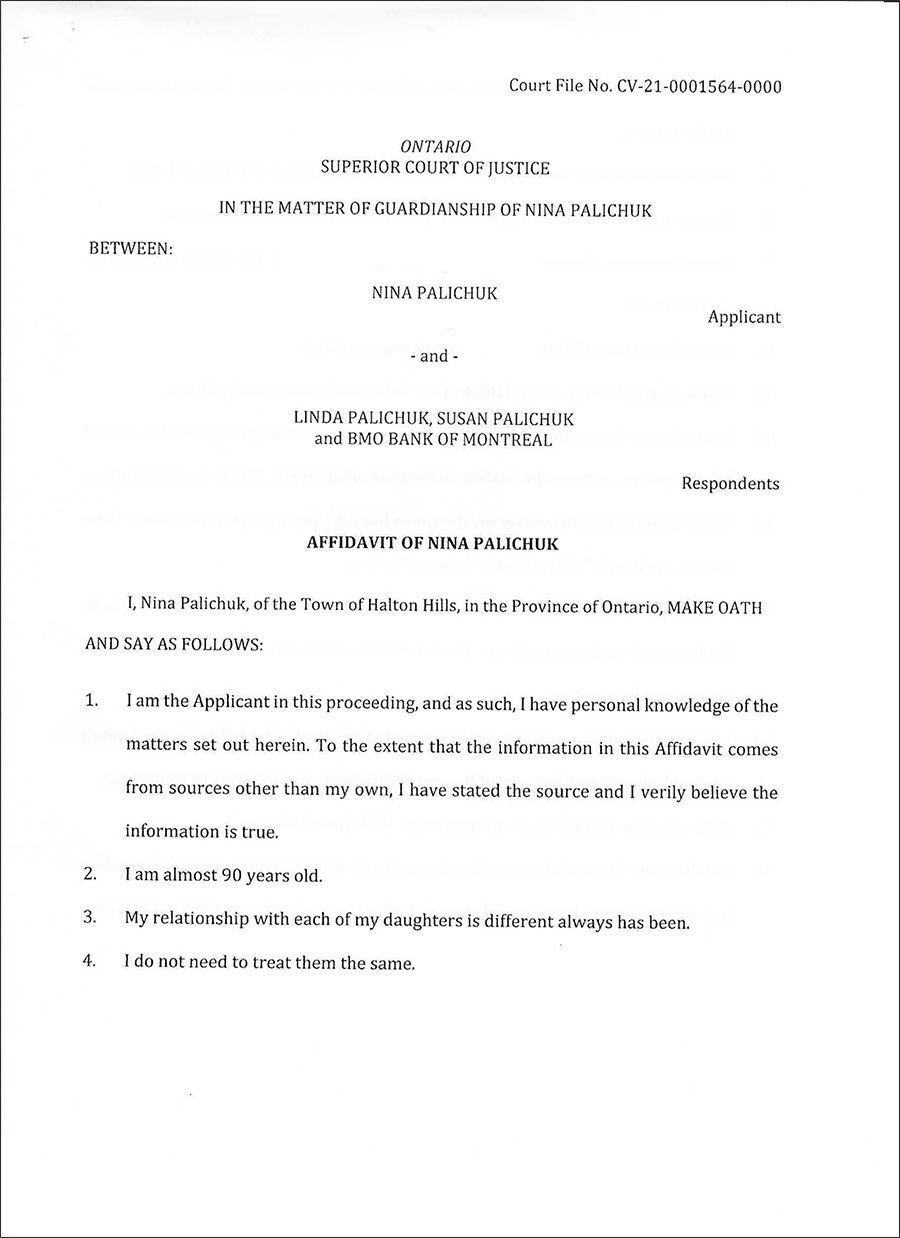
As Nina would later tell the court, the guardianship bid felt like “Linda kicking her in the teeth,” and, with the help of Susan – who alleges it was her older sister who tried to control and bully their mother – Nina launched a legal offensive of her own.
There’s a rising tide of bitter family feuds hitting courts across the country, as elderly Canadians live longer than ever, with dementia cases rising to record levels among them and more wealth to leave their heirs than any generation before them. Baby boomers are in the midst of inheriting an estimated $1 trillion from their elders, and the historic wealth transfer is unleashing a torrent of pain – emotional and financial – as children sue parents, parents sue children and siblings sue each other. The legal odysseys are clogging the courts, draining estates, ripping families apart and often leaving the elderly without some loved ones around them in the last years of their lives.
As a judge would one day write about the Palichuk family: “I consider this case to be a tragedy.”
Most of the legal wrangling hinges on the question of capacity: whether elderly people have the mental ability to manage their care and finances, and – crucially – who should control their lives and money if they don’t. The diminished capacity of aging celebrities, for instance, has erupted in epic court battles. After actor Nichelle Nichols, who played Lt. Uhura on Star Trek, developed dementia, she was the centre of a three-way conservatorship dispute between her son, her former manager and a producer friend before she died in 2022 at 89. L’Oréal heiress Liliane Bettencourt’s daughter questioned her mother’s mental capacity for years before a judge agreed in 2011 that France’s richest woman needed a guardian. Four years earlier, her daughter filed a criminal complaint alleging Bettencourt was incapable of resisting the influence of her much-younger confidante, a society photographer she willingly gave hundreds of millions of dollars over three decades. Medical experts later concluded she’d been suffering from Alzheimer’s since 2006, and her protégé was convicted of “abuse of weakness” in 2015. Bettencourt, who died in 2017 at age 94, spent the last years of her life under the guardianship of her daughter and grandsons.
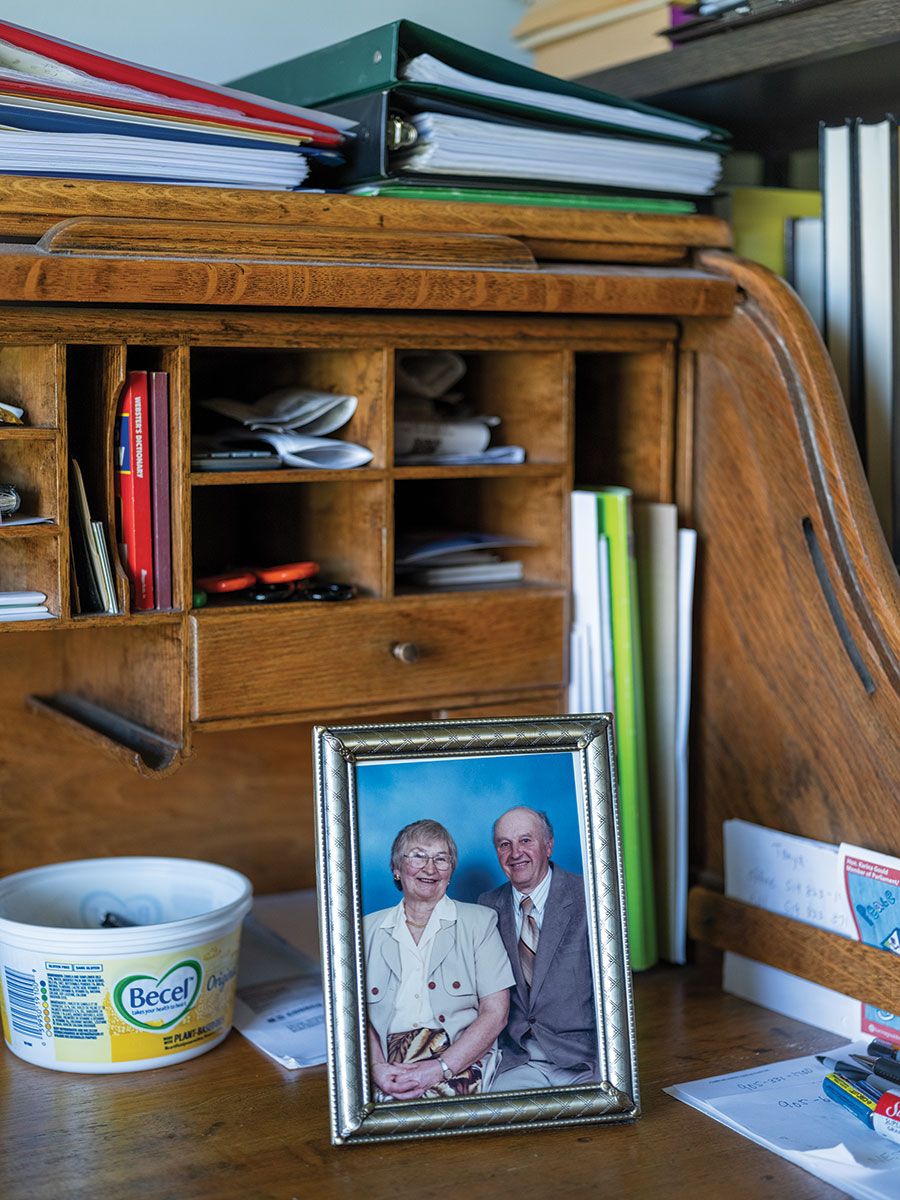
Nasty, protracted rows are no longer the exclusive purview of the rich and famous. When modest houses can fetch more than seven figures in today’s real estate market, even small estates can trigger big fights as everyone vies for a piece of the inheritance pie.
“I refer to this as the perfect medical-legal storm,” says Dr. Kenneth Shulman, a geriatric psychiatrist at Sunnybrook Health Sciences Centre in Toronto, and one of the country’s leading experts on capacity. “A rapidly growing elderly population, with a high prevalence of cognitive disorders, is about to make the greatest transfer of wealth in history to a younger generation of increasingly complex families under greater economic stress.”
The perfect storm, meanwhile, is crashing into an imperfect system. How we judge capacity is a minefield: There’s no standard way to define it, no objective way to measure it and too few experts properly trained to assess it. Yet, as demand surges, assessing capacity is growing into a lucrative industry and it operates with a remarkable lack of oversight, given an individual’s very freedom rides on it.
Most assessors are health care professionals who evaluate capacity on the side, and business is booming, not just among feuding families, but with bankers, lawyers, realtors or any professional who has a vested interest in ensuring a client is mentally fit to make or change a will, sign a contract or give a gift. Provincial governments train and certify some assessors (but not all of them), who have a narrow mandate to determine whether someone has the capacity to look after their personal care and property in case the state has to step in as guardian if an incapable person has no one else to act on their behalf. Certified assessors, who charge about $250 an hour, are not public employees, but they are subject to government review.
In 2018, however, Ontario’s auditor general discovered extensive problems with government-certified assessors, many of whom continue to do evaluations “despite repeated concerns” about poor performance, including several cases of capable people who were judged incapable. Meanwhile, in 2019, a Toronto judge found alarming evidence certified assessors can be manipulated by whichever side picks up the tab.
“Capacity assessments were not designed, nor were they ever contemplated, to be used as weapons in high conflict litigation,” Ontario Superior Court Justice Michael Penny lamented in his ruling on a bitter family dispute. But a review of recent court cases in Ontario and beyond makes it clear that, increasingly, they are, while the elderly are often caught in the crossfire of families fighting over their fates and fortunes.
Old Law, New Times
Back in 1870, when psychiatric hospitals were called lunatic asylums and “general insanity” passed for a diagnosis, the contested will of a wealthy English bachelor set the legal bar for capacity. It still holds today in Canada, where English common law was adopted in 1759 after General James Wolfe defeated French commander Louis-Joseph de Montcalm on the Plains of Abraham and the country fell under British rule. John Banks had originally willed his large estate with 15 cottages in England’s Lake District to his sister, but, after she died, Banks made a new will leaving everything to her daughter. When Banks died, a nephew challenged the validity of the second will, arguing his uncle – who suffered from seizures, delusions and paranoia – was mentally impaired. But a progressive judge ruled a mental disorder does not necessarily impact all functions of the mind. With evidence that Banks had carefully managed his business affairs and his money before his death, the judge found Banks had the capacity to draft a new will because he understood the relevant facts needed to make it and appreciated the foreseeable consequences of changing it.
More than 150 years later, those two components – an understanding of the facts and an appreciation of consequences – still form the basis of assessments used to determine if individuals are capable of making their own decisions. What it means is impossible to overstate. In the eyes of the law, being capable entitles you to decide everything from how you live to whom you love.
The crux of the problem is it’s a judgment call between preserving a person’s autonomy and protecting them from bad decisions. No blood test or imaging scan will provide a straight answer, and often there is no straight answer. Assessing if someone is capable or incapable depends entirely on the question: Capable of what?
“You can’t generalize about capacity. That’s an important principle,” says Shulman. “It’s decision specific, situation specific and time specific.”
Making a will, giving a gift or choosing a power of attorney are all tasks that may require different levels of capacity, and sometimes, Shulman says, the same task may demand a different degree of capacity depending on the situation. “Making a will is very different for one person who has a huge estate with multiple corporations and blended families fighting with each other, than for someone who has a simple will that’s giving all their assets to their two loving children.”
Lawyers hire Shulman – who has been involved in a “few hundred capacity cases” – for his expertise in “retrospective assessments,” which help the courts determine if a person, living or dead, was mentally capable when they made a past decision.
One of the most common grounds for contesting a will is the allegation that a person was not of sound mind when they signed it. Two disinherited grandchildren of New York real estate mogul Leona Helmsley, for instance, successfully argued their grandmother was mentally unfit when she decided to leave a US$12-million trust fund to her toy Maltese terrier in 2005.
Sibling Rivalry
The Palichuk sisters were never close, not even when they were kids. “Growing up, Susan would always get upset or jealous if my parents did anything for me,” Linda says. “She would physically fight with me, and my mom tended to defend her and say, ‘Oh, she’s only playing, she’s just roughhousing.’” In her court affidavit, Nina described her daughters as being “as different as night and day.”
Whatever animosity bubbled beneath the surface, it didn’t fully erupt until their father died. Susan, who was divorced with three adult children and no job, left her house in Georgetown, Ont., empty and moved in with Nina.
In July 2016, five months after her husband’s death, Nina, a former nurse and bookkeeper, visited her lawyer, Margaret Chapman, to update her will. She named Linda, who was then 62, and Susan, then 60, equal beneficiaries and gave them joint powers of attorney over her personal care and property. But, by 2017, Linda says Susan was “unable or unwilling” to take care of the family home. Weeds grew waist high, the lawn went unmowed and whenever Linda tried to speak to her sister about their mother’s living conditions, “Susan was indifferent to the situation.”
Even before their father died, Linda says her mother found upkeep on the Acton house was too much and wanted to move into a retirement home. So, after her dad’s death, Linda started taking her mother to tour residences in the area, about 60 kilometres northwest of Toronto. When she dropped Nina back at home, “My mom would be really, really upset and say, ‘Your sister doesn’t want you to come into the house.’”
By 2018, Linda could only see her mom if she took her out, and when they’d return, Nina was often reluctant to go in. “She said Susan would be angry about our outing … she used to sit in the car and watch me do some yard work.”
Susan declined twice to be interviewed, saying she preferred to leave the painful experience behind her, and Nina said she would think about it, but eventually decided against it. Their side of the story is reconstructed from public court documents. Susan told the court she never stopped Linda from entering the Acton house while their mother lived there. Linda, however, says she wasn’t able to go inside until Susan was hospitalized for surgery in September 2019.
“I was shocked and appalled at what I saw. There were mouse droppings and garbage everywhere. Susan had obviously been hoarding and sleeping on the floor in the living room area. … I don’t know how they were able to take a shower or a bath. They were using the bathtub for storage.”
Photographs submitted to the court show overstuffed bags, boxes and sundry items jamming the main floor, and a kitchen obscured by counters blanketed in cans, coffee mugs and silk flowers. A judge would later say the pictures showed “squalid conditions.”
As Linda took in the state of the family home, “my mother started to cry. She said, ‘Oh, Susan’s going to be so, so upset you came in the house. Promise me you won’t tell her that you came in the house.’ Susan had told my mother that [if she let me in] she would leave and never come back, and that my mom would never see her again. Susan had created a situation so that she was doing everything for my mother, and so now my mother felt that she needed Susan or she wouldn’t survive.”
In court statements, Susan denied telling her mother she would leave for good if Nina let Linda in the house.
To Linda’s great relief, her mom moved into a newly built Georgetown retirement residence in November 2019 and Linda began to prepare the home for sale. Linda believed that’s what her mother wanted, and what her mother’s financial adviser said she needed to do to cover her retirement-home costs. Linda hired lawn services and landscapers to clear the overgrown garden, but says Susan was unable to find Nina’s chequebook to pay the $3,000 bill or their mother’s moving expenses, so she paid with money from the joint account she shared with her husband, Peter Wignall. Susan would tell the court Linda never asked for Nina’s chequebook.
The following year, after the COVID-19 pandemic broke out, Linda noticed her mom “had started to lose her spark” under the lockdowns, so she brought Nina to her house in Burlington, Ont., for a few weeks in June 2020. That’s when Linda and Peter, a retired firefighter, noticed Nina was neglecting herself. After her mom went back to the retirement home, staff emailed Linda to recommend more services for Nina after finding food rotting in her mother’s suite. In a document filed with the court, the home said she’d stopped doing her laundry and needed frequent reminders to go to the dining hall to eat. Linda started to wonder then about the mental state of her mother.
“Until you experience the aging of the brain, you don’t know how it affects people. There’s decline, but it’s not a straight line,” Linda says. “Mom could be forgetful, and sometimes her behaviour was really concerning; other times, it was good.”
Signs of Dementia
According to the Canadian Institute for Health Information, about one in every four people over the age of 85 will develop dementia; it’s as prevalent as heart failure. The Alzheimer’s Society of Canada estimates there will be more than 500 new cases a day by 2030, and nearly 1.7 million people living with dementia by 2050. Yet, as with capacity itself, dementia’s effects on the mind can be tricky to gauge.
“Many people with dementia, even severe dementia, retain their social graces,” says Shulman. “So, if you don’t challenge directly someone’s cognition and you just have a chat about the weather, they seem very nice and very pleasant and well put together, and they’re not acting in a strange way – until you ask them what day of the week it is, or ‘Do you know what year it is? Do you know how much money you have?’”
The 1870 Banks case is still influential, because it shows judging capacity is not a black and white matter. “You could be mentally ill and still capable,” says Shulman. “So, you cannot assume that a diagnosis of dementia or Alzheimer’s means you are not capable. The truth is, you can suffer from them and potentially still be capable.”
Helen Ward, a leading estates lawyer in Edmonton, recalls a case where a widowed mother disinherited her only child. “This poor woman was suffering from some delusions about her lovely daughter, whom she had come to see as a bad actor. … She was in the early to middle stages of Alzheimer’s at that time, but she presented, socially, very, very, very well. She presented as intact and that’s terrifying to a lawyer, that someone is going to come in, they’re going to make rational sense and how do we know that what we’re being told isn’t true?”
After the elderly woman died, Ward’s client was able to prove she’d had a good relationship with her mother, and a retrospective assessment found the mother had Alzheimer’s. “It became a bit of a detective story,” says Ward, “a matter of recognizing cracks starting to show in the veneer.”
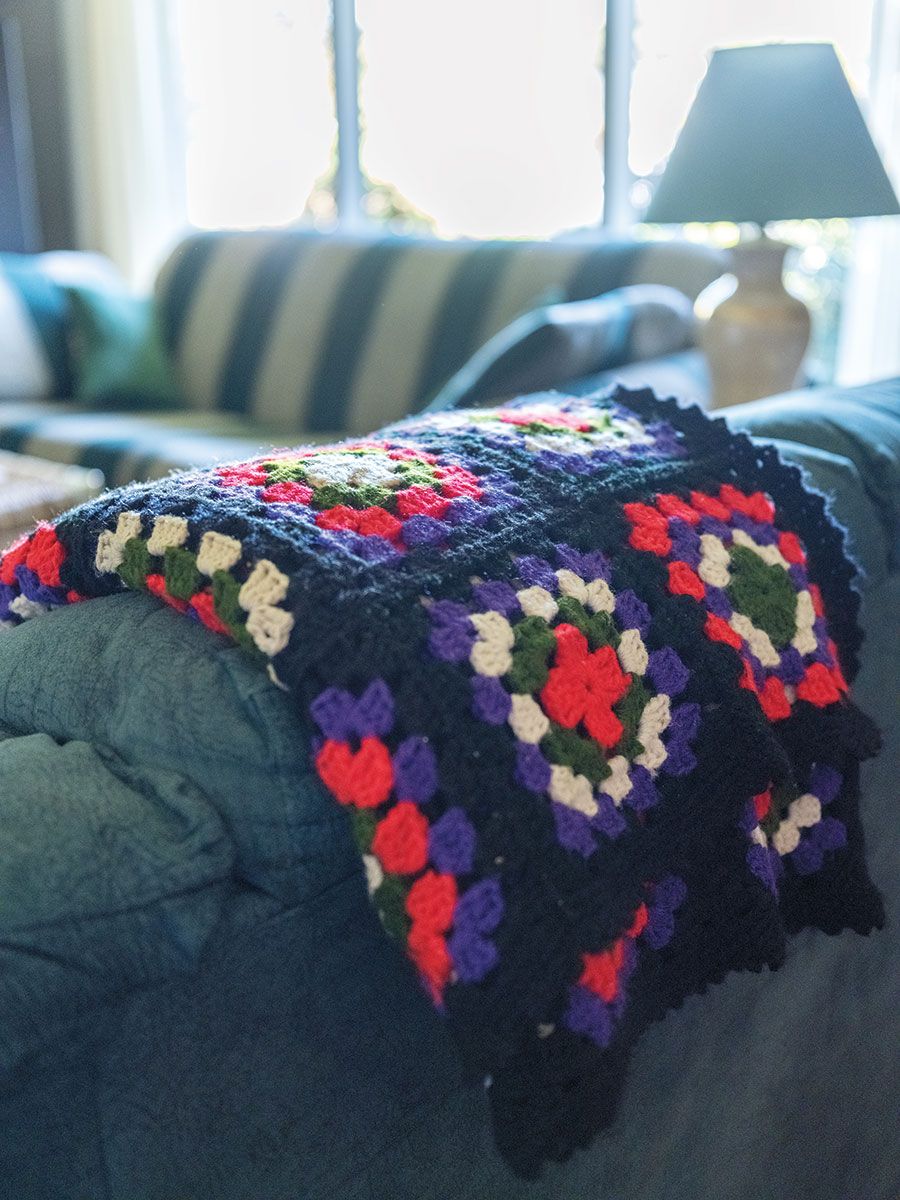
Sadly, Shulman says one of dementia’s hallmark symptoms, even in some cases of mild cognitive impairment, is a sudden mistrust of people close to you. It can range from doubt and suspicion to overt delusions that a family member is stealing from you. “Usually, it’s the daughter-in-law who is accused of the stealing, in my experience.”
Shulman stresses capacity assessments not only involve evaluating someone’s understanding and appreciation of information needed to make a decision, but also whether they are able to communicate the reasons for making it.
“One of the things we try to teach around capacity is to look for the red flags – one is great age itself. If someone is 90 years old and says, ‘I want to change my will,’ that’s a signal you better pay attention and do a very careful assessment – especially if they’ve made a very significant departure from the pattern they previously held, like treating [their] children equally.”
She Said, She Said
In August 2020, Linda hired a junk removal company to clear out the Acton home and arranged for a property appraisal. Neither one happened. When Linda went to the house to label items to be removed, Susan wouldn’t let her in. “She started pushing me – pushing, like when we were kids. … [Susan] said that she deserved everything. You know, I had a job, I had a husband, I didn’t need anything and she had a hard life.”
By then, each sister believed the other was misusing their mother’s money. In the court record, Susan alleged Linda wrote cheques on their mother’s accounts and took money from Nina’s night table. Linda says she did find about $2,000 cash in there, which she counted with her mom and deposited in Nina’s account. Linda, meanwhile, alleged Susan was regularly withdrawing more than $1,000 from Nina’s accounts and using their mother’s credit card as her own, which Susan denied in court statements.
Susan did say she took her mother to the bank, where Nina decided to empty a joint account she shared with Linda and transfer the money into a new joint account with Susan. But, after Linda spoke with her mother, Nina transferred the money back. In August 2020, Nina tried to have Linda’s signing authority removed from her investment account, but the bank explained it wouldn’t be possible without Linda’s consent. After the bank informed Linda of Nina’s request, Linda tried to talk to her about it at the retirement home. But Linda says Susan put Nina in the car and refused to let them speak privately. Instead, Linda says the three of them drove to a nearby park, where her younger sister told her she was too controlling. “When I asked my mom how she felt, mom looked at Susan and Susan would answer.”
Based on the court record, Susan’s perspective was Linda had not been close to their mother, and had not gone on day trips or spent time with their parents, as she had. She said Linda wanted to sell the Acton house, not her mom, and her sister had spent money on landscaping work “contrary to her mother’s wishes.” In Susan’s sworn affidavit, she said Linda’s attempt to control their mother and her money “has and continues to cause my Mother undue stress, anxiety and upset.”
Linda agrees her sister spent more time with her parents, because she had a day job and Susan was unemployed. She also points out her mother often talked about wanting to sell the house and was excited when she heard Susan’s estranged eldest child was interested in buying it.
As the two sisters argued in the park, Linda says her mother “started to cry and stated that she wished she was dead.” After that meeting, Nina refused to speak with Linda. “I knew something was terribly wrong.”
That September, Linda’s daughter Katherine Wignall came home from Calgary, Alta., and discovered why Nina cut off communication. On a visit with her grandmother, Nina said Linda and Peter were writing cheques to themselves on her account, and they could go to jail for it. In a letter to the court, Wignall said she told her grandmother to call the police if she really believed it was true, but Nina seemed less certain the more they discussed it. Wignall also wrote about running into Susan outside the retirement home, who “told me my mother and father were stealing from my grandmother.” When Wignall advised her aunt to tell the police, “Susan then became very quiet.”
Neither Wignall nor Linda knew Nina had already changed her will and powers of attorney. As Linda would later find out, Susan initially took their mother to see Nina’s lawyer, Margaret Chapman, but she wouldn’t make the changes. Chapman did not respond to repeated requests for an interview, but Linda says the lawyer “did not feel it was right” and told her “there were lawyers who would probably do it willingly. And that is what happened.”
A few days before Wignall’s visit, Susan took Nina to a different Acton lawyer who drew up new documents giving Susan sole power of attorney for her mother’s personal care and property and transferred title of the family home in trust to Susan. Nina’s previous will named Linda and Susan as co-executors. The new will, which explicitly disinherited Linda, named Susan as the beneficiary and sole executor, and added Susan’s high-school friend as alternate executor. It also named two of Susan’s three children as alternate beneficiaries and excluded Susan’s estranged child and Wignall, Linda’s only child.
Linda was unable to reach her mother by phone, and after retirement home staff informed her she had been barred from visiting Nina, she contacted the Elder Abuse and Safety section of Halton Regional Police. The police report filed with the court says on Sept. 30, 2020, Nina told police she never wanted to sell the house and it was Linda who wanted her to do so; Linda stole from her; Linda was controlling; and she was fearful of Linda. Nina described a “great relationship with Susan,” with no pressure and support for her decisions. The police told Nina that Linda had receipts for the money she took to clean up the property, but Nina said she never authorized it.
When police returned two weeks later to give Nina the receipts for the bills Linda paid “to settle her concerns regarding misappropriation of funds,” they noted: “Nina was no longer upset with Linda and changed her tune slightly: not thinking that Linda had stolen from her, but rather that she should have been advised of the spending.” Nina asked police to tell Linda she “wants to see and talk to Linda again. … Nina had previously requested that Linda not attend to or visit her. This was no longer her wish.”
A month later, Linda filed her lawsuit.
Power Play
Most estate-related cases used to involve family members contesting the will of a deceased relative. But, increasingly, as with the Palichuk case, they involve disputes over people who are still alive, with allegations of undue influence, and conflicts over guardianship and, most often, powers of attorney. Ideally, people choose who will have their power of attorney (POA) long before their twilight years, selecting who should have the legal authority to make decisions on their behalf if they become incapable. One POA document covers personal care and another covers property, and people often assign a family member or two to act jointly, or separately, for either document, or both.
If not challenged, POAs remain in effect as long as an incapable person is alive, and with the elderly now routinely living into their 80s, 90s and beyond, abuse-of-power accusations are rising. “If you have the physical health, but unfortunately not the mental capacity to make certain decisions … a person may be in place as a substitute decision maker for years, and there is no oversight automatically,” says Ward, the Edmonton estates lawyer, “but there is legislation [the Alberta Powers of Attorney Act] that allows someone to bring an application to question what you are doing.”
In Alberta, as in most provinces, a concerned individual can ask the courts to have someone with POA account for their actions, or apply to have the POA revoked. “They [can] say, ‘Look, she’s buying bright new shiny sports cars and not looking after dad,’ and the court can do something,” says Ward.
In 2018, for example, an Alberta judge found a Leduc man abused the POA he held jointly with his sister, after his elderly father became temporarily incapable. The son made himself sole director of the family business, used company funds to pay off more than $21,000 of personal credit card debt, buy a new car and pick-up truck, purchase $9,000 worth of home appliances for his son and daughter-in-law and pay his wife and sons exorbitant salaries while firing his sister’s son. In August 2023, an Ontario court found a woman who had POA for her aged father had gambled away more than $70,000 of his money. Only after her father died did her brother discover there were no funds left in the estate. (His sister testified she had hoped to win enough to pay it back.) While these matters are usually settled in civil courts with financial penalties, they can also become criminal cases. Last year, for instance, police in Thunder Bay, Ont., charged a 47-year-old man for defrauding his mother – a nursing-home resident – by using his POA to siphon more than $80,000 from accounts earmarked to pay for her care.
Kimberly Whaley, a leading Toronto estates lawyer and elder law advocate, says people may not fully appreciate how critical it is to assign POA to someone who is responsible and trustworthy, given how much control they will have over their affairs. As it is, POA misuse and abuse is “rampant,” she says, “and it’s usually the children, sadly.” Within a two-month stretch in 2023, for example, Whaley took in 54 new cases. “There’s just so much of it. [These cases] go to court every day – every day – and the courts are frustrated, because it’s so time-consuming.” In 2022, Ontario’s Superior Court of Justice designated four full-time judges in Toronto to deal with nothing but estate-related matters and POA disputes. “That indicates the quantum of cases we’re seeing coming forward.”
She says the most common scenario involves adult children living with, and living off, their parents. As elderly parents become less capable and more dependent, the adult child often treats the parents’ money and property as their own and isolates them from other family members and friends. “The ‘kid’ doesn’t let mom or dad come to the door or the phone,” says Whaley. “They sequester their parents so they can make them feel alienated from the others.”
The Legal Gauntlet
Linda’s difficult decision to sue her mother had less to do with the sting of being disinherited than it did with finding a way to stop Susan. “For me it was never about the money,” she says. “I always had a good relationship with my mother and Susan was isolating me from her. … [I didn’t] know how much Susan hated me and was jealous of what I had achieved in my life.” Linda was worried Nina wouldn’t have enough money to cover her retirement-home expenses if she kept carrying the costs of the Acton house, especially while her sister neglected the family home, which she thought might be worth $800,000 to $1 million at the time.
After Toronto trusts and estates lawyer Joseph Figliomeni heard Linda’s story, he was convinced she had a compelling case. “Not only do we have mom going in [to a new lawyer] saying, ‘I want to change my will to leave everything to just one daughter, as opposed to how things stand now, which is 50-50,’ but, ‘Oh, by the way, the daughter [who will inherit everything] drove me to your office, and she’s sitting here and she’s the one who made the appointment’ – that typically is a big red flag for lawyers.”
Still, Figliomeni realized the case would be tricky, in part because it would involve showing Susan had asserted undue influence over Nina, which is a tough concept to prove. For starters, if undue influence happens, it’s usually wielded in private, without a witness.
As well, says Shulman: “It’s not illegal to try and influence somebody – so how does a judge decide at what point is the influence being exerted undue? It may be reasonable, for instance, for one sibling to suggest they should inherit more if they have sacrificed more as the primary caregiver. But, if they say,‘If you don’t give me 90 per cent of the estate, or give me your house, I’m going to stop looking after you and you’re going to end up in a nursing home,’ now that’s pressure.”
The legal bar for undue influence is deeply intertwined with capacity. “The more capable you are, the less likely you are to be unduly influenced,” says Shulman, “but the less capable you are, the more likely you are to succumb to it.”
To successfully challenge Nina’s new 2020 will and POAs, Linda and her lawyer felt they would have to show Nina was susceptible to Susan’s influence because she lacked capacity, which could only be determined if Nina had an assessment. But while anybody – a family member, doctor, banker or stranger – can ask someone to undergo a capacity assessment, nobody can be forced to be assessed, unless a court orders it.
Figliomeni decided to file an application asking for the court’s “opinion, advice and direction” on how to proceed with the evidence. With an application, which is faster and cheaper than a trial, a judge relies on affidavits and transcripts from cross-examination interviews. Linda and her lawyer hoped the judge would give them the go-ahead for a trial and order Nina to undergo a capacity assessment by an assessor they would select.
After receiving news of Linda’s lawsuit, Susan hired her own lawyer and her mother hired Jasmine Sweatman, an experienced estates litigator in Oakville, Ont. Sweatman says Nina struck her as “quite spirited” the first time they met.
“She was very adamant that she knew what she wanted and it wasn’t what the one daughter wanted, and she wasn’t going to be controlled by her daughter. She was very clear and strong, and extremely upset, as you can imagine – the dynamic of a child suing a parent, and accusing a parent of not knowing what they’re doing or being unduly influenced.”
In response to Linda’s legal action, Sweatman filed a lawsuit on Nina’s behalf to force Linda to remove her name from her mother’s investment savings accounts.
Sweatman says Linda’s lawsuit tried to address multiple issues at the same time, but all of it came down to capacity, “because if Nina is capable, then the powers of attorney do not need to be triggered, and we don’t even get into substitute decision making and guardianship.”
Unlike Figliomeni, Sweatman had no need to wait for a court order to have her client’s capacity assessed. Nina went willingly, with the expectation it would bolster her case. Sweatman opted to hire an evaluator from Capacity Clinic, a private company in Oakville, Ont. She says she did not select a government-certified assessor because, in part, their mandate and training does not include judging someone’s capacity to make a will or susceptibility to undue influence. Sweatman felt she needed an evaluator with broader experience, who was also comfortable in court.
Many lawyers make the same choice to avoid certified assessessors, says Whaley. “We’re often dealing with the inconsistency of qualification and approach, and notoriously poor assessments, which is why litigators like myself will often … bypass the whole assessment office.”
A Lack of Oversight
Assessing capacity is a patchwork system in most provinces; who assesses it and how they do it depends on the task in question. In Ontario, for example, evaluating whether someone has the capacity to consent to medical treatment, or to be admitted into a nursing home, falls under the ministry of health. Determining if someone is capable of making their own personal care and property decisions is the responsibility of the Ministry of the Attorney General, which governs the process through the Capacity Assessment Office (CAO).
The CAO reports to the Office of the Public Guardian and Trustee, which can become the substitute decision maker for incapable people. But, the 2018 auditor general’s report noted a troubling lack of oversight of ministry-trained capacity assessors, who take a three-day course that includes assignments, in-class instruction and a take-home exam, according to a 2024 recruitment flyer on the Ontario Association of Social Workers website.
The audit revealed the CAO did not ensure capacity assessors abided by “acceptable quality standards” and it did not routinely review their reports, track how many assessments they conducted or verify if assessors had completed the required minimum of five assessments every two years to maintain their designation.
The probe found assessors only had to submit two assessments every two years for a quality review and were able to choose which reports to send in, “and therefore can avoid sending those that they know were not performed well.” In a sample of 155 submitted assessments, external consultants identified quality concerns in almost half, including “a lack of understanding of relevant legislation; asking subjects questions that lacked sufficient depth; not explaining why they found the subject incapable; and not meeting any of the requirements for completing an assessment.” Three-quarters of assessors had been flagged for substandard work in previous years, but the auditor’s report noted “repeated instances of poor performance are not tracked.”
The ministry stipulates government-certified assessors must be a doctor, nurse, psychologist, social worker or occupational therapist, carry a minimum of $1 million in professional liability and belong to the regulatory body that oversees their profession. But the audit found the CAO had never filed a complaint with any assessor’s professional regulatory body in the 20 years since Ontario established the CAO, nor had an assessor ever been removed from the roster. Meanwhile, the audit discovered, between 2016 and 2018, more than 80 per cent of assessors’ findings were overturned after an appeals process showed “the evidence could not support the finding of incapacity.”
The CAO refused requests for an interview, but a media spokesperson for the attorney general who agreed to answer some questions by email confirmed the CAO currently has 86 assessors on its list. Asked what had changed since the auditor’s investigation, the spokesperson wrote: “In 2021, the CAO implemented a process to disqualify a capacity assessor who has not successfully completed a continuing education course … An assessor’s assessments are reviewed every two years. These reviews ensure assessments are being provided free of quality concerns and that only those persons correctly assessed as incapable are referred for guardianship. …” The ministry would not say how many, if any, assessors have since lost their designation due to poor quality assessments, how many evaluations they conduct or how many people its assessors have deemed to be incapable.
Hired Guns
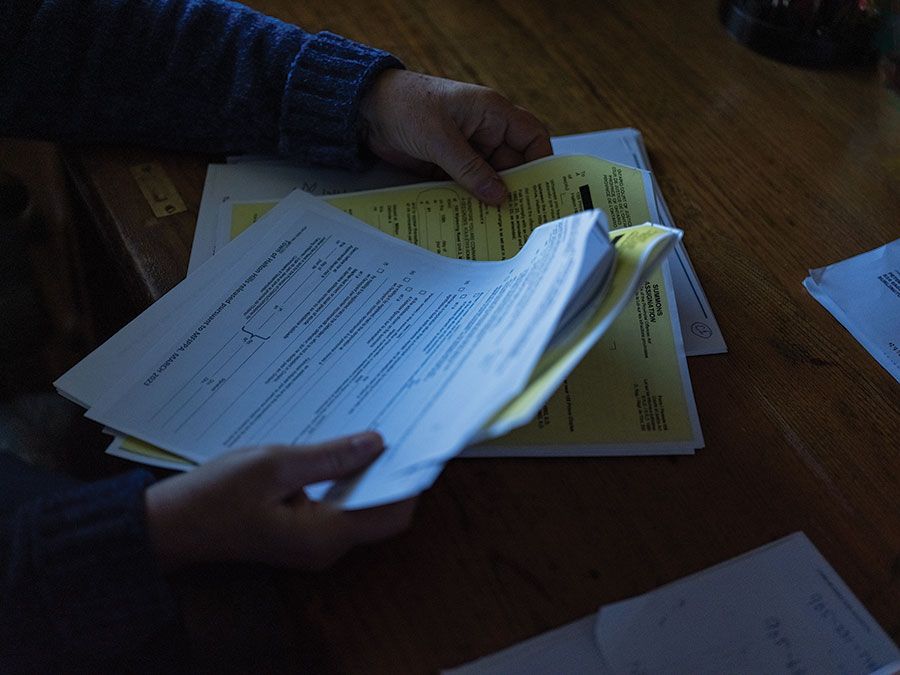
The ministry may be silent on the performance of its certified assessors, but the courts have not been. In 2019, Judge Michael Penny threw out the work of two government-certified assessors after finding both reports were egregious examples of improper influence by feuding family members. The case, similar to the Palichuks’, involved two sisters fighting over who should be power of attorney for their 90-year-old mother. The younger daughter hired an assessor who found her mother was mentally incapable. Less than two months later, the older daughter arranged a second assessment that found the mother was capable.
In his ruling, Penny lambasted both daughters who “prevailed upon their mother to submit to these assessments for the purpose of obtaining ammunition to use in their fight with one another, not for their mother’s benefit.” The judge found each sister “interfered with, and had a hand in drafting, the final assessment reports.”
In the end, the judge did his own assessment. He found the mother, who had dementia, lacked capacity and noted, “While both daughters, I am sure, want the best for their mother, their mother’s interests have absolutely nothing to do with this dispute. This dispute is a power struggle between two siblings with long and abiding resentments towards one another, pure and simple.”
The ruling made it clear any family members fighting over control of an elder’s care and finances should not be involved in any substantive way in assessing their capacity. Rather, the judge specified capacity assessors are bound by duty to provide the courts with objective opinion and insight, free from interference.
As Shulman says, “The courts do not want hired guns – you know, ‘You pay me enough and I’ll say whatever you want to hear.’”
Meanwhile, there’s a growing area of capacity assessments no government body oversees: making or changing a will, signing a contract or giving a gift. Government-certified assessors can evaluate a person’s capacity to make these kinds of decisions, but physicians and lawyers can also weigh in. Shulman, however, says too few professionals – doctors in particular – have been trained to assess capacity; yet, even specialists, from cardiologists to orthopedic surgeons, will offer an opinion.
“This is an important issue with the rising number of cognitive disorders,” he says, but lawyers will ask family doctors for their opinion. “You know, ‘Your patient, Mr. Smith, do you think he was capable of making a will, because it’s in dispute?’
“The typical letter you see on file is from a general practitioner saying, ‘Mr. Smith is compos mentis [of sound mind], he can make legal and financial decisions,’ which is a meaningless opinion, because [the doctor] doesn’t understand that you can’t generalize about capacity. … Doctors get embarrassed and skewered in court for writing those two-line letters of opinion.”
At the same time, “A lot of doctors are afraid of the legal-medical arena. They say, ‘Oh no, I don’t want to go to court. I don’t want to be examined by a barracuda lawyer.’”
Assessing Nina
With gaps in the types of capacity the government system assesses, a shortage of experts and the growing need to determine the mental state of the rapidly aging population, Nathan Spaling, a former social worker turned estates lawyer, founded Capacity Clinic in October 2020 to provide, among other services, “timely access to capacity evaluators.”
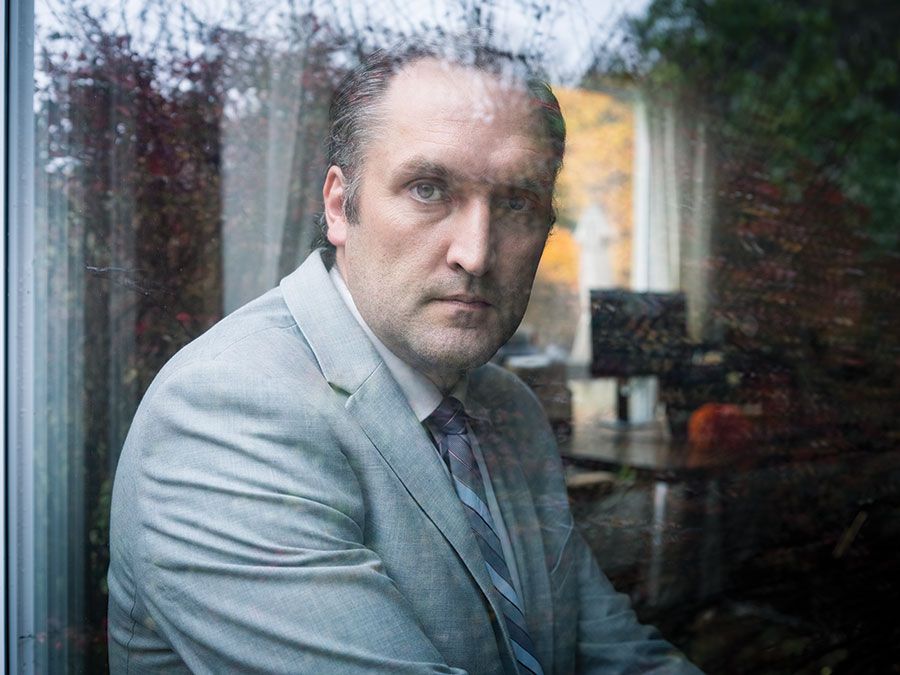
“One of the biggest limitations of capacity assessments I find is that almost everybody who does capacity assessments does it as a part-time business – like, social worker by day, capacity evaluator by weekend, or, you know, doctor by day … and there isn’t this real guiding framework for capacity assessment,” says Spaling.
His company developed a capacity screening app to help lawyers, accountants, bankers, real estate agents and other professionals determine if elderly clients are sound of mind. If the screening tool, dubbed DecisionTracker, identifies concerns, the client can be referred for a full assessment, which can cost anywhere from $1,000 to $5,000. The business model banks on the possibility that not assessing someone’s capacity – before they sell their home, say, or invest in a risky stock – could damage someone’s reputation or result in personal or professional liability.
To launch his company, Spaling asked himself: “‘Who are the courts listening to when it comes to this kind of expert witness testimony for this type of subject matter?’… That’s when I met Dr. Richard Shulman.”
A geriatric psychiatrist at Trillium Hospital in Mississauga, Ont., Richard Shulman (no relation to Kenneth Shulman at Sunnybrook) became medical director of Capacity Clinic, which works with independent capacity evaluators across the country. According to the Palichuk court record, Richard Shulman had appeared in court as a capacity assessment expert three times before Sweatman hired him to assess Nina.
At their first meeting in April 2021, Richard Shulman talked to Nina for 90 minutes. When he interviewed her again less than a month later, his notes, submitted to the court, show Nina had no recollection of meeting him before, nor did she mention making the 2016 will. Richard Shulman told Linda’s lawyer under cross examination he had not seen any other will and he understood the 2020 document was the only will Nina had made since losing her husband.
During her assessment, Nina did not remember if Susan had prevented Linda from entering the house, the park visit or information related to large withdrawals from her bank account.
On the Montreal Cognitive Assessment screening test used to evaluate memory, executive function and verbal fluency – commonly known as MoCA – a score between 26 and 30 indicates normal cognitive ability, while a score between 10 and 17 suggests moderate cognitive impairment. Richard Shulman reported Nina scored 18 out of 30, and his assessment was Nina had mild cognitive impairment due to advanced age. He noted she had not been diagnosed with dementia or Alzheimer’s, and concluded she was capable of managing her own personal care and property, with some assistance.
Ontario Superior Court Justice Roger Chown found Richard Shulman’s conclusion rang true after he reviewed Nina’s transcripts. “Nina had insight,” he wrote in his Nov. 9, 2021, decision, noting she told Richard Shulman: “You got to remember I’m 90 years old, and I can be a little forgetful. And I know I am a bit forgetful. But I try and answer it correctly.”
The judge found the things Nina did forget were “not significant”; for example, Linda’s daughter was an adult, not nine or 10. Crucially, he concluded, Nina “has the required understanding of her main assets … that she was aware that no appraisal of the house had been obtained and was content with this,” because she believed her financial adviser told her she “has sufficient resources to afford her current expenses for the remainder of her life even if she were to live to 110 years old.”
Chown found “one area of weakness” in Richard Shulman’s assessment: It did not probe Nina far enough about the state of the family home. “He does not address Susan’s apparent hoarding. … He did not address whether Nina appreciates that hoarding and lack of maintenance could substantially devalue the Acton property, her largest asset.”
But, the judge said, Nina appreciated the consequences of her decision. “Nina demonstrated full awareness that the effect of her will … was to fully disinherit Linda and to give everything to Susan. She also understood that only two of Susan’s children would be alternate beneficiaries and not Linda’s child or Susan’s estranged child.” His conclusion? “Nina appreciates the social awkwardness of her decision.”
In her affidavit, Nina praised Susan as “exceptional,” because she had helped her for many years and didn’t tell her what to do with her house or money, and criticized Linda as “controlling” for trying to override her wishes. “Linda disagrees with me and thinks I am being told what to do by Susan.”
Nina told the court she believed Linda was well off and Susan was not, and said the same about the two grandchildren she left out. The judge found Nina’s justification was not necessarily reasonable, but it was rational. He also found Nina’s reaction to the “squalid conditions of the Acton house” to be further evidence of her mental capacity.
“[Nina] said that, ‘Susan had a flower shop and gift store [many years before], and she brought a lot of her stuff to the house to sort it out.’ … I see nothing wrong with that.… From my review of the photos, these answers lacked credibility. They were slanted toward Nina’s position in the application. Other answers Nina gave seemed motivated by a desire to paint a picture that Susan was deserving and Linda not deserving. Some positions Nina took regarding Linda appear unfair.”
He went on to write: “However, these failings bolster the conclusion that Nina has capacity, rather than detract from it. She was cagey enough to slant her answers toward the outcome she seeks in this proceeding.”
In the end, Chown decided the case would not go to trial, because it could be a “wasteful exercise.” Since Nina was alive and capable, she had no need for a guardian, and there was no need to consider if Susan had asserted undue influence because Nina had the capacity to change or revoke her 2020 will and POA at any time. “If I allow this matter to proceed to trial to assess whether Nina was subject to undue influence when she [signed the new documents], she could well prepare new ones before trial, or during the trial, and in that case the litigation would be moot,” the judge wrote.
Indeed, Nina acknowledged her will was “not written in stone,” and she might change it in the future “if Linda treated her better.”
The judge ordered Linda to remove her name from the joint bank account and concluded: “The issue Linda seeks to have adjudicated is hypothetical and premature.”
Money Talks
Canadian baby boomers stand to inherit an estimated $1-trillion in the coming years, says CIBC chief economist Benjamin Tal, who first wrote a report on the wealth transfer in 2016. It’s a staggering sum – greater than the annual gross domestic product of Switzerland – but economist Lars Osberg, a professor at Dalhousie University in Halifax, cautions this will not be an equal distribution of wealth. Rather, the bulk of the fortune will be passed down to the heirs of Canada’s few hundred billionaires, while, at the other end of the spectrum, are boomers who will face a “negative inheritance” as they spend their money and time looking after their aging parents.
Much of the wealth flowing to the masses is locked up in real estate, says Osberg, author of more than a dozen books on income and wealth. Houses today are worth about 20 times what people paid for them half a century ago, but extracting the equity means heirs must agree to sell the family home. “That’s when, you know, any sort of failure in past family dynamics comes home to haunt you,” he says. One sibling will say of another: “‘Oh, was it really him who was the favourite all these years?’ And, ‘Didn’t I take care of [mom and dad] more than you did in their old age?’”
Boomers are also facing financial insecurity, worrying about how they will pay for their own care down the road. Unlike their penny-saving parents, some of whom survived a world war or two and the Great Depression, boomers, not generally known for self-denial, spend. Their houses represent most of their savings, Osberg says, while only about 37 per cent of Canadian workers are covered by a registered pension plan. They are also the first generation to age in an era where divorce is common, so their cases can be complicated by claims from ex-spouses.
“There’s a lot of anxiety among people who are 55, 60, 65, 70 as they contemplate, ‘How am I gonna swing it even if I’m living in this house, which I have hopefully paid off?’” They don’t want to sell their homes, leave neighbourhoods where they’ve lived for years, and find a new place, so, with most of their wealth tied up in their houses, there’s not much left over for their kids.
It explains why boomers are currently driving the family-feud litigation bus through Canada, and beyond. In England, for example, a 2024 report from the Law Commission, an independent body that regularly reviews justice system issues, reported the number of will disputes brought before the High Court more than doubled in the first nine months of 2023 compared with 2016. Increases have also been reported in the U.S., Australia and France, where the fate of family vineyards is becoming especially fraught. In Ireland, where University College Dublin research shows a steady rise in family court battles, a 2017 study of 81 nursing homes found more than 10 per cent of staff reported seeing an elderly resident, who appeared to lack capacity, pressured by a visitor, or a visiting solicitor, to make or change a will, or both.
Lawyers who handle family disputes say adults who file court actions often feel their parents treated them unfairly and they want to hear a court say they have been wronged, or they want to challenge a sibling for perceived grievances that may stretch all the way back to childhood.
Boomers also have a culture of standing up for themselves and their rights, and they have the means to do it. “So, devoting $10,000 or $20,000 or even much more than that to retain a lawyer to pursue their claims is not a deterrent,” says Figliomeni, Linda’s lawyer.
Judges, however, are losing patience presiding over dubious sibling squabbles. Last November, an Ontario judge reprimanded a man who, after alleging his sister had manipulated their mentally incapable mother, spent almost $60,000 and four years chasing an inheritance worth a maximum of $85,000. Justice F.L. Myers found the man had “no real evidence” to support his claim “before launching the parties to DEFCON 1.… Forcing a massive expenditure on an estate in an effort to scorch the earth, i.e., destroy what you cannot have yourself, is reprehensible litigation behaviour in my view.”
High Price to Pay
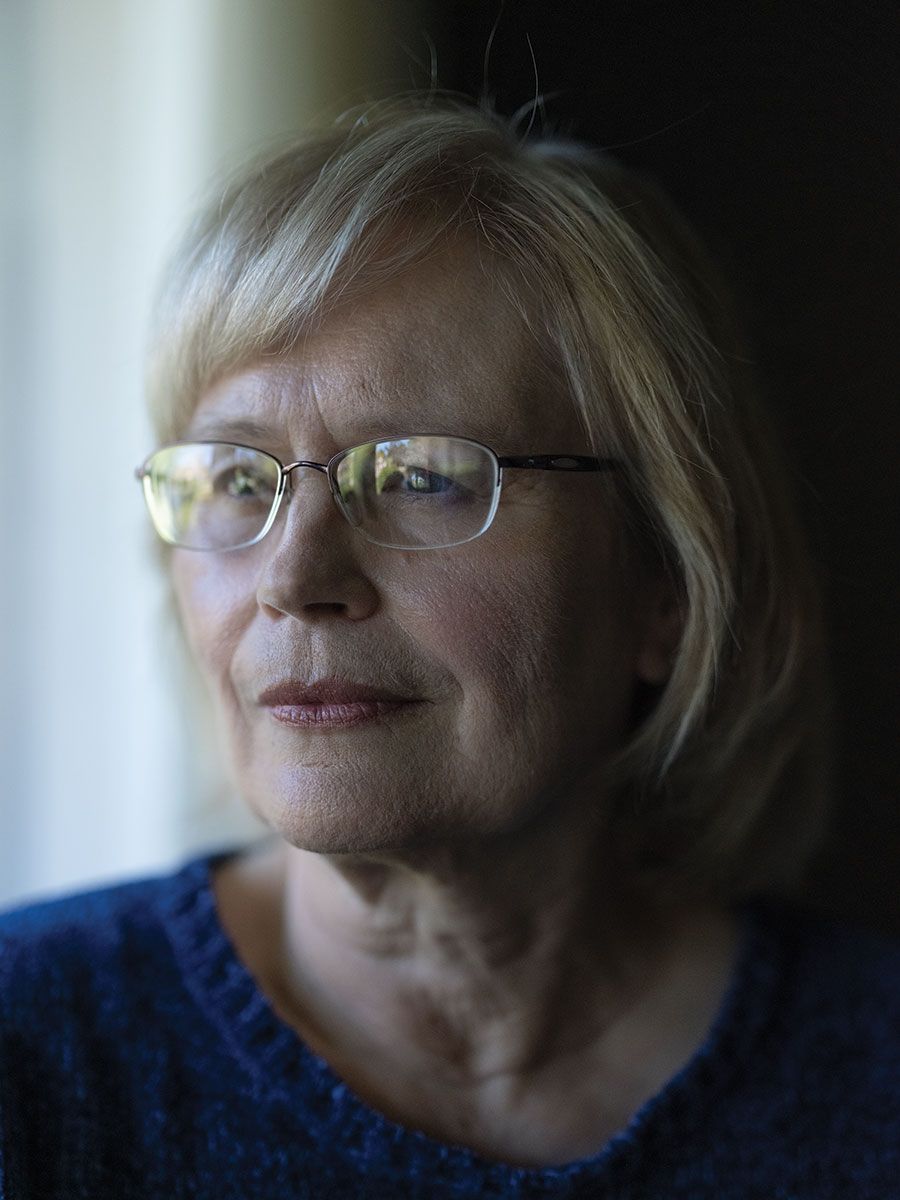
Linda Palichuk was devastated when she heard the judge’s ruling. “I wanted to protect my mother and I failed,” she says. “It felt like the only thing [the court] looked at was the time my mother spent with the geriatric psychiatrist assessing her capacity. They didn’t look at anything else, not how she had been made to live, or the allegations of manipulation and control, nothing.”
Linda and her lawyer appealed the ruling, arguing the judge had erred “by basing his decision entirely on whether Nina has capacity … [and] erred by failing to consider the issue of undue influence and the suspicious circumstances surrounding Nina’s execution” of her new will and powers of attorney.
They also argued Linda should keep her name as a joint holder of her mother’s investment savings account to protect Nina from her sister’s alleged financial misuse and mismanagement. They contended Susan was not suitable to take care of Nina’s property since she’d had difficulty managing her own, and submitted documents showing the Canada Revenue Agency put a lien on Susan’s home after she failed to pay taxes on her flower shop. The Town of Halton Hills also charged Susan for property standard violations after she disregarded repeated municipal orders to fix holes in the walls, eaves and soffits to prevent raccoons and other wildlife from getting inside, among other things. Susan acknowledged she didn’t comply with the orders in her court statement, but didn’t disclose the amount of the fine, or how she covered the costs.
The appeal failed. Justice Gary Trotter’s judgment, on behalf of three Court of Appeal judges, upheld the original decision. It ordered Linda to pay $100,224.11, which covered a portion of her mother’s and sister’s legal fees, including $9,234.35 for Richard Shulman’s capacity assessment and court time, in addition to her own legal bill of about $47,000.
“We are not rich people, and this affected us, financially,” Linda says. “I did plan to retire a few years ago, but I am still working, and hoping that by 2026 there will be enough to get us into a position where we don’t have to worry any longer.”
Sweatman, Nina’s lawyer, was struck by “the vengeance, the aggressiveness of the litigation” in the Palichuk case. “It was a bit like being in the twilight zone, because it didn’t make sense on any level, especially after we did get the independent assessment [finding Nina capable]. You wonder, ‘What are we doing here? Why are we even arguing this, and then we have to go to the court of appeal?’”
Linda says she kept going with the case, because “I did not believe that my mother had capacity, and I was hoping at some point that would become more evident.” She also believed the only way to protect her mother was to get a legal opinion from a judge.
Lawyers who witness the emotional carnage of family legal disputes say there’s a growing sense these cases don’t belong in the courts. “What we really need is … an independent tribunal to mediate and arbitrate these cases,” says Sweatman. “These cases are very, very difficult. I mean, the courts hate them, and they’re very draining on the lawyer and they’re draining on the client and quite often … the parent dies, and the litigation is not over. At least in this case, it’s over for Nina and gave her peace of mind.”
Nina, At Last
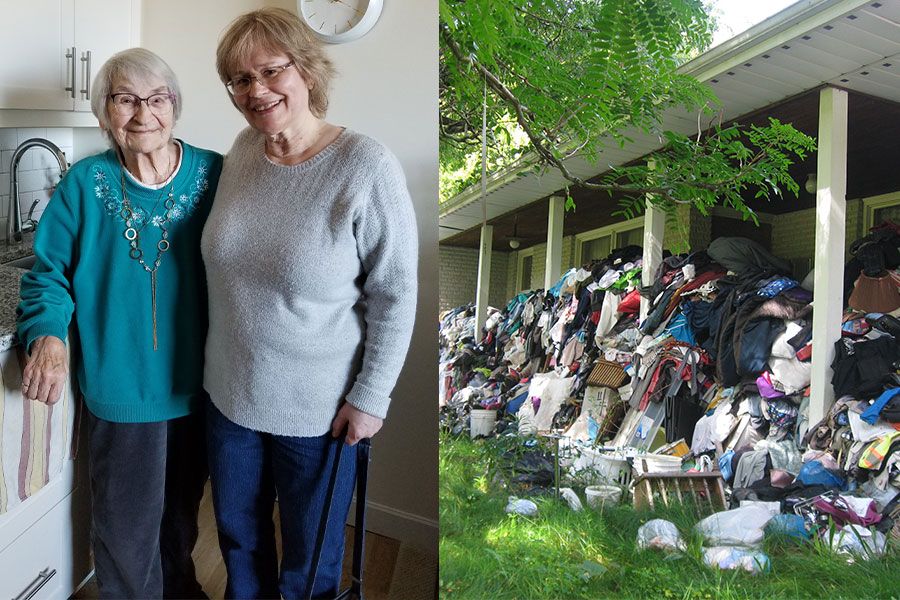
Linda has seen her mother only once since the court case wrapped up in 2021. “Last March, I went, out of the blue, with a friend who knocked on her suite door, in case Susan was there, but she wasn’t. My mom was so happy to see me, she hugged me and said she had missed me. My friend took pictures and videos of us and I told my mom I would come back to see her again the next week.”
The following week when Linda arrived, however, retirement home staff told her Nina had once again barred her from visiting.
In the fall of 2023, Linda heard from neighbours in Acton that someone called town officials to complain about the state of Nina’s house and its yard full of debris. Pictures taken before the clean-up show toys, hampers, small kitchen appliances, furniture, books, binders and shoes scattered across the front lawn and driveway, and around back, clothes piled nearly as high as the eavestroughs. Linda heard the removal “took five or six days and the police were involved.” She doubted her mother knew anything about it.
My attempts to reach Nina for an interview began in the early spring of 2024, but no one answered repeated calls to her phone number at the retirement home. Linda says others have given up trying to reach her mother, including Nina’s close friends Stella, Elfriede and Maria, her sister-in-law Halyna, cousins Velma and Janice, and Linda’s daughter.
“She should be spending time with relatives, enjoying her family,” Linda says. “At her age, I don’t know how much time she has left.”
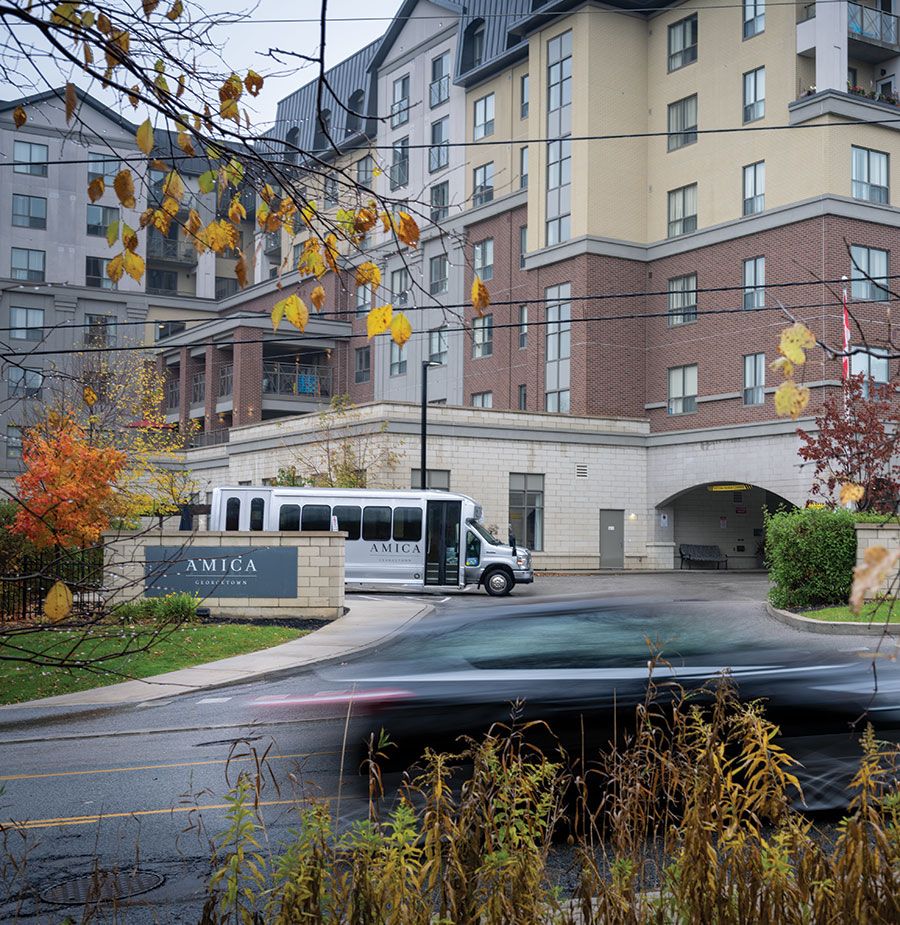
In April 2024, a week after Easter, I drove to the mid-rise where Nina has a suite on one of the upper floors. A blue crepe paper wreath with sparkly eggs hung on her front door, but it was Susan, not Nina, who answered when I knocked that afternoon. Susan said her 93-year-old mother was sleeping and would find it too stressful to discuss the case, anyway. Susan felt the same way, although she did speak off the record in the doorway for nearly two hours. Not once did our voices bring Nina to the door.
After several more weeks of unanswered phone calls, I returned to Georgetown on a sunny October afternoon to try again to ask Nina for her side of the story. This time, I finally spotted the matriarch of the Palichuk family. She was using a walker to make her way through the lobby with a crowd of other residents, all of them just back from an organized boat trip on Lake Ontario. Wearing a bright red coat and plaid cream wool scarf, Nina was bright-eyed and friendly. “I look pretty good for my age, don’t I?” she said, and she did.
Susan, Nina’s constant companion, personal support worker, and, to some extent, her memory, was by her side, gently reminding Nina of her floor number when her mother hesitated in the elevator. Nina wanted to speak inside her suite, but Susan said it was time for supper. When asked about the court case, she offered, “It hurts.
“Linda thought I couldn’t take care of myself, but I could,” Nina said. “I still can.
“I love Linda, but she doesn’t love me. I love Susan and I love Linda.” Then, she added, “Do you have children? What would you do?”
Nina knew there had been an order barring Linda from visiting, but she wasn’t sure if it was still in place. When she looked at Susan for confirmation, her younger daughter said, “You don’t want to see Linda, do you? Do you want to see Linda?”
“No,” Nina replied.
She wanted to think about giving an interview, but when I visited Nina two weeks later to find out what she’d decided, she didn’t recognize me and rolled right past me with her walker into the dining hall for supper with Susan. When I asked Nina if she recalled meeting me, she shook her head and didn’t utter a word. Susan, however, told me her mother had nothing to say.
Now, Linda tries to hold on to the good times she shared with her mother: lunch dates, long talks on the phone and, when she was younger, how Nina taught her to knit and make cabbage rolls and perogies. “She’s a funny, friendly person,” she says. “I miss her a lot.” Expecting the inevitable, Linda has resorted to regularly checking funeral home websites in Acton and Georgetown, searching for her mother’s obituary. “I don’t know how else I would know.”
On a recent visit to the Palichuk acreage in Acton, there were no signs of life. A canopy of weeds hid the path to the front door, which was flanked by a broken planter and a barnboard snowman. A trail of garbage sat in front of the garage, and an old grey Chevy, missing a licence plate, was parked beside the driveway. But the front-yard pond, dotted with lily pads, was glistening in the fall sun, a tangible reminder of the family that enjoyed the seasons here together, once upon a time.
WATCH: Libby Znaimer and theZoomer panel tackle abuse of guardianship and predatory marriage, and provide tips to protect your loved ones from rising cases of elder abuse.
A version of this article appeared in the Dec 2024/Jan 2025 issue with the headline ‘A Perfect Storm,’ p. 36.