Few series in the history of television have been as comprehensively influential as Miami Vice, which debuted with minor fanfare 40 years ago this week on Sept. 16, 1984. And yet the series rolled up its jacket sleeves – literally – and changed pop culture, both in its heyday and for generations to come.
Over just five seasons, producer-cum-filmmaker Michael Mann’s glossy, high-concept cop drama starring Don Johnson, Philip Michael Thomas, and an almost comically stone-faced and taciturn Edward James Olmos – plus a stack of guns, speedboats, and pastel everything – impacted fashion and music, helped revitalize the South Beach area of Miami, cemented the concept of stunt casting and altered the very nature of TV police procedurals.
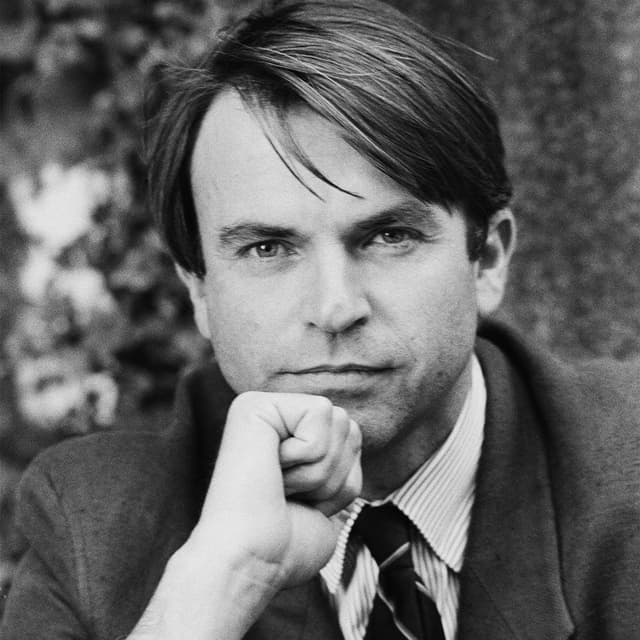
Its bearing on men’s fashion is still felt today, while trivia buffs can spend hours online chasing down obscure clips of myriad actors who used the show as a launchpad to fame far eclipsing the show’s leads, from Liam Neeson to Julia Roberts to Ben Stiller and Viggo Mortensen.
Cheers ran longer, Hill Street Blues was more acclaimed, and Dallas had better ratings. But nothing on prime time in the 1980s beat Miami Vice for cool. It was palpable. Teenage viewers heard the same contemporary music blasting from the series that they heard on the radio – a hugely innovative concept in lockstep with the 1981 launch of MTV.
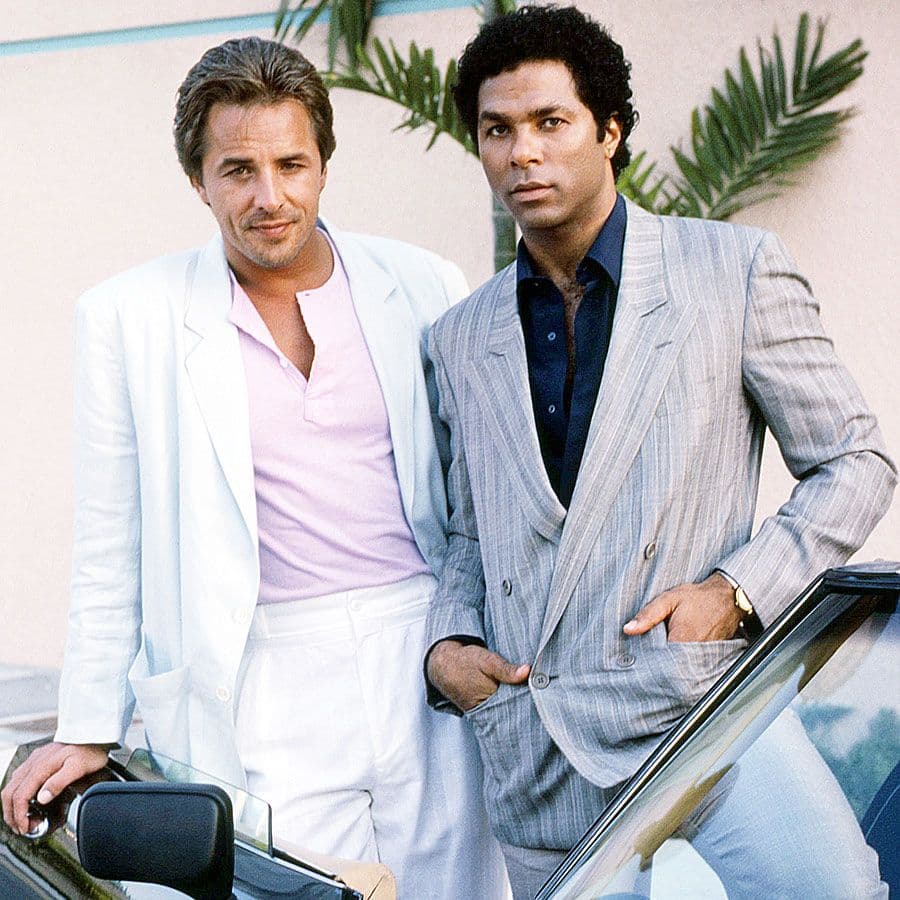
Grownups, meanwhile, were dazzled watching slicker-than-slick Sonny Crockett (Johnson) and Ricardo Tubbs (Thomas) casually wearing Versace and dashing through the mean streets of Miami in a sports car, heading to the houseboat where Crockett – in the saucy words of singer Sheena Easton, who played his second wife on the show – plied his “specialty of taking girls out in that thing and getting them wet.” Hey, it’s Miami Vice, baby.
From 1984 to 89, Miami Vice made staying home on Friday nights a defensible decision. To celebrate the game-changing drama’s 40th anniversary, we’re looking back on some of its benchmark, and most enduring, achievements.
The Clothes
In a recent interview with The Hollywood Reporter, season one costume designer Jodie Tillen observed that Miami Vice, “changed the way men dressed in the world. It gave men permission to wear pastels.” It also gave them permission to wear T-shirts under blazers, loafers without socks, and designers like Hugo Boss.
Like so many aspects of the show, the conceit of the fancy threads was meant to reinforce the illusion that undercover cops Crockett and Tubbs were actually in the same stratosphere, even the same line of work, as the high-flying drug dealers they were busting with the big guns they kept hidden beneath those baggy blazers and loose-fitting pants.

Both Tillen and season two costume designer Bambi Breakstone scoured Europe for their characters’ signature looks, noting that while Crockett’s vibe broadcast his renegade nature, Tubbs’ more buttoned-down aesthetic reflected his New York City roots. But it was Crockett’s look that took.
The Hollywood Reporter points to five red carpet appearances by actors in 2024 that might have been lifted from 1987, rocked by a diverse roster including Sterling K. Brown, Simu Liu, Ryans Reynolds and Gosling, and Sebastian Stan. Who needs a tie when you’ve got a flamingo-pink tee?
Did you know? Miami Vice had a Canadian connection beyond Leonard Cohen in a guest role. One of the show’s many marketing collaborations was with Montreal new wave–inspired clothing label Parachute, also favoured by such 80s tastemakers such as Madonna and David Bowie.

The Music
As television historians have noted, Miami Vice was expensive to create, mostly because visionary producer Michael Mann insisted on very high-quality visuals. As costume designer Tillen revealed to The Hollywood Reporter, “We had a colour palette: no earth tones, no primary, all pastel. Every car colour, every wall that the actors walked in front of, was by design – nothing was by mistake. There was a major coordination between the art department, locations and costume.”
Another huge expense was licensing original music for playback during the show, which has been pegged as high as $10,000 per episode in 1980s money. But it was money well-spent, securing broadcast rights to a jukebox-worthy selection of hits from Depeche Mode, Glenn Frey, Honeymoon Suite (Canada again!), Jackson Browne plus Don Henley, Bette Midler, Peter Gabriel, Tina Turner, Pat Benatar, George Thoroughgood, Foreigner and multiple instances of Phil Collins, a massive pop star at the time. Moreover, the show’s synth-y theme and score by Jan Hammer basically became the decade’s most recognizable background music.
Did you know? Phil Collins’ iconic In the Air Tonight was twice used in Miami Vice, most notably in the 1984 pilot episode, “Brother’s Keeper.” Almost the whole of the song plays as Crockett and Tubbs drive towards a showdown, though that drive is interrupted by a phone call Crockett places to his ex-wife to say goodbye, possibly for the last time.
The Stunt Casting
At the time, the idea of having famous rock stars play bad-asses was novel to say the least. Yet it’s somehow perfectly in sync with the show’s broad use of original contemporary music and the rise of MTV, which suddenly made musicians recognizable to the mainstream. Ergo, Miami Vice cast Frank Zappa as a drug trafficker, Ted Nugent as a thug, and Phil Collins as a con artist all in season two, while Willie Nelson played a cranky retired Texas Ranger in season three and James Brown guest-starred as a cult leader with dubious connections in season four.
And that wasn’t the only wink-nudge casting during the show’s run. In 1987, Melanie Griffith – at the time Johnson’s real-life ex-wife, and soon to be his wife a second time around two years later – was cast as his girlfriend who, unfortunately for an undercover vice cop, turns out to be a madam, leading to the episode’s fabulous title, “By Hooker By Crook.”
Did you know? When that latter episode – one of only four directed by Johnson – first aired, it contained a lovemaking scene between Johnson and Griffith that anyone lucky enough to see knew was happening between two people who’d done that sort of thing before, for real. Deemed too racy for TV, it was subsequently cut, never to resurface, including on DVD release.
It Made South Beach Famous
Miami Vice is widely credited with spearheading the revival of the now-iconic Ocean Drive which, at the time of the series’ filming, was a deteriorating and crime-ridden stretch of hotels and co-ops used primarily as retirement homes. In other words, far from the celebrated and tourist-friendly Art Deco destination it is today. Indeed, as IMDb notes, “Miami tourism officials credit the series for transforming the impression of the city from a retirement community to a fun and exciting place for young people to visit.”
Fittingly, a 40th anniversary Miami Vice reunion weekend slated for the area and attended by much of the crew and cast (though not Johnson, now 74 or Thomas, 75) benefits the Police Officer Assistance Trust of Greater Miami.
Did you know? Some areas of South Beach were so dilapidated that the show’s set designers and production crew had to paint over graffiti and make repairs to buildings before filming. Ironically, Miami city officials initially worried that the word “vice” in the show’s title would reflect poorly on the city’s reputation.

It Changed How We Viewed Cop Shows
Before Miami Vice, nobody thought of cop shows as having a cinematic sheen with high production values and top-drawer cinematography. They were gritty. Cops had worked undercover before, but they hadn’t gone all-in like Crockett and Tubbs, with the clothes and the cars and all the wealth-and-status regalia.
There certainly wasn’t much noise on TV about drug cartels and arms dealers or depictions of the lavish lifestyles they afforded key lieutenants. Perhaps most substantially, on Miami Vice, the good guys weren’t always clearly distinguishable from the bad guys. By permitting ethical ambiguity, the show rewrote the police procedural forever. Forty years later, it’s still a blast to watch, especially when Crockett pulls over that high-performance Ferrari Daytona Spyder to use a coin-operated pay phone.
Did you know? According to IMDb, “Each episode cost around $1.3 million to make, some 30 percent more than most other police series at the time. The series was one of the first to be broadcast in stereophonic sound, new to TV in the 1980s, which brought out the music and sound effects in a way rarely seen at the time.”
RELATED:
Back to the ’80s: How the “Decade of Decadence” Is Winning the Nostalgia Game
Designing ‘Dynasty’: How the Style of the Legendary 1980s Series Embodied the Excess of the Decade