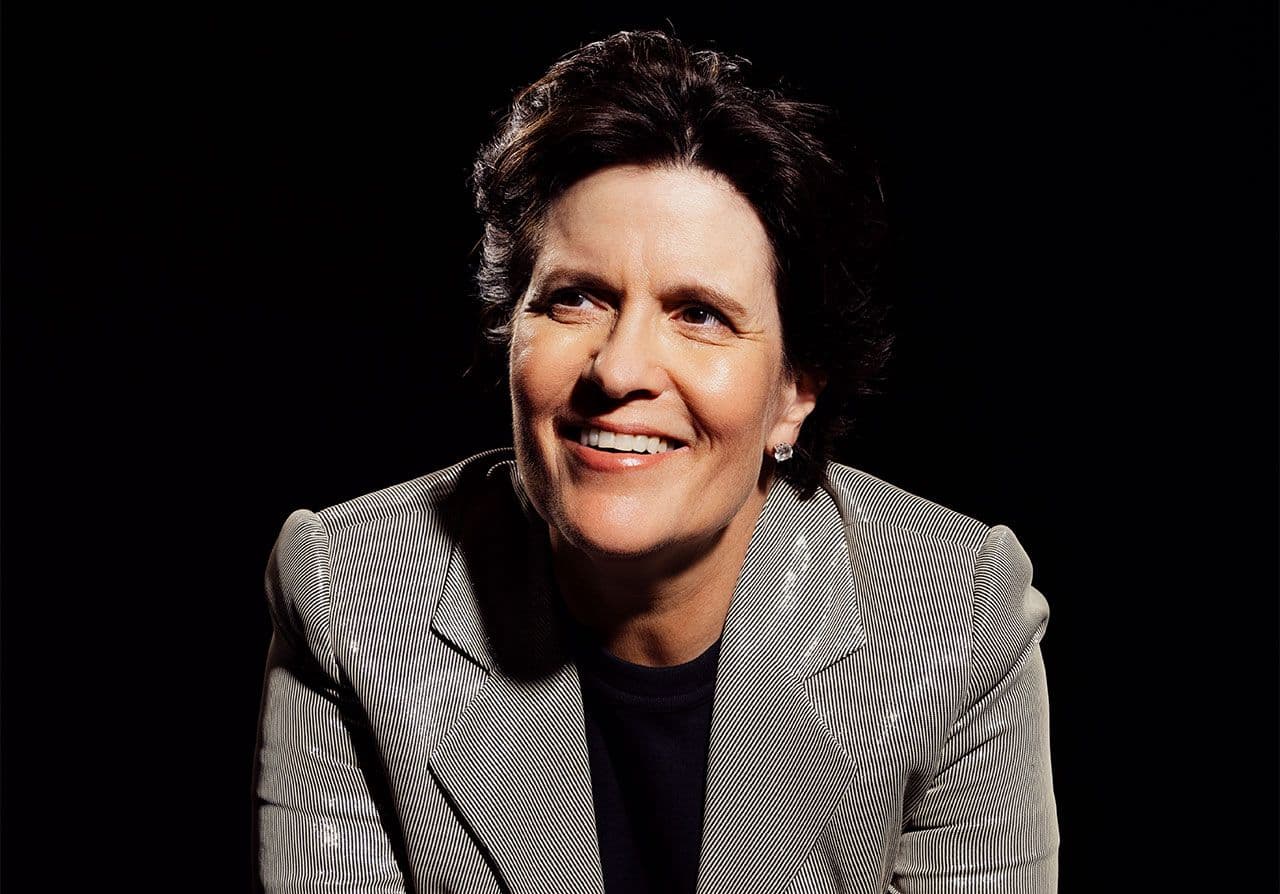
In the early years, when she covered technology for the Washington Post and the Wall Street Journal, Kara Swisher called herself a “working reporter.” At 61, “reportrepreneur” is the term she favours. Celebrity podcast host (Pivot, with NYU professor Scott Galloway; On with Kara Swisher) and all-round badass would also apply. Swisher, who has twice married, regularly reminds her audiences of one additional badge she clearly wears with pride: mom of four children, aged 2, 4, 18 and 21 (two with her first wife, former United States chief technology officer and Google VP Megan Smith, and two with WashPo opinion editor Amanda Katz).
After establishing herself early as Silicon Valley’s reporter-of-record, keeping tech bros and unicorn founders in line, she and her Journal colleague Walt Mossberg launched a series of journalism start-ups. These included the websites Recode and D: All Things Digital and the spin-off live conferences D: All Things Digital and Code, where they conducted on-stage interviews with the who’s who of big tech. Famously, they lined up an unprecedented Bill Gates-Steve Jobs doubleheader and, embarrassingly for Mark Zuckerberg, challenged the Facebook founder so intensely, he sweated through his hoodie.
In her memoir Burn Book: A Tech Love Story, a scorched-earth tell-all, the sardonic, righteous raconteur makes it clear she’s lost that lovin’ feeling, especially for Elon Musk. He’s “curdled into the worst aspects of his personality,” she writes, and believes the way Musk has dealt with X (formerly Twitter) is “one long cry for help from a clearly troubled man” and “one of the saddest developments in her long love story with tech.” I spoke to Swisher about her book, her brand, how big tech is as bad as cigarette manufacturers while the politicians who enable them are even worse and why she calls media mogul Rupert Murdoch – whose News Corp company bought the Wall Street Journal in 2007 – “Uncle Satan.”

Anne O’Hagan: You’re very funny in the book.
Kara Swisher: Thanks. I’ve done a lot of very serious reporting, but a lot of it’s ridiculous, right? So I joke that the book’s mean, but it’s “mean funny.” Kind of Hunter S. Thompson or P.J. O’Rourke – funny and also eviscerating.
AO: What reaction are you expecting?
KS: I don’t know. People say it’s a really good history of the early internet. That was one goal– to say “here’s how it went down.” A lot of our coverage of these people is very cartoonish. They’re like characters. I guess Elon [Musk] is playing the villain right now. He was the hero, but now he’s the villain. Mark [Zuckerburg] was the villain and now he’s still the villain. I wanted to bring them back to humanity. They’re just people. Some of them are just good stories, like the weird party at Google with the ice sculptures and the diapers. I didn’t get to put that in the Wall Street Journal. I mean, I was a beat reporter. But I wanted to capture those fantastic little moments in the ecosystem.
AO: So you built a business and a brand – every working writer’s dream – or more like fantasy …
KS: Yeah, right?!
AO: Are you a serial entrepreneur?
KS: I am. I was never really very happy within the confines of an organization, and having covered this stuff, it was hard not to see where it was going sideways. I got a real taste of it at the Washington Post when the mainstays of their economics – display advertising, classifieds, subscriptions – were cratering. I was like, wow, every single one of your businesses is in trouble because of digital. That really alerted me to think about it in a different way. I was young at the time it was starting, so I was the young person paying attention. And I just kept doing that throughout my career. A lot of reporters get disgruntled about their owners. I just don’t have any time to be mad at Rupert Murdoch. Like, I don’t like him, I’m leaving, I’ll do my own thing. I could go on about how much I don’t like him, but why waste my breath?
AO: Well, you’ve written the definitive chapter on that.
KS: He’s not someone I wanted to work with and I had the choice. A lot of us have much more choice than we think. People don’t take their opportunities when they can. Look, the Journal just laid off a ton of people. They should have seen it coming. The economics are not in line with the revenues. It’s not a charity; it’s a business. I was always aware of that. I never thought they’d protect me. Except for the Grahams [former owners of the Washington Post], maybe, who are lovely people.
AO: So you call Elon Musk an “adult toddler,” which came to mind watching Mark Zuckerberg get scolded like a schoolboy at the Senate Judiciary Online Child Safety hearings in February.
KS: These are the very same politicians who pass no laws, so they should shut the f–k up. It was performative. The funny thing is they go right to social media to post their rants. It’s like saying, “You pollution-spewing factories, how dare you?” Well, I wonder who has the power to do something about it.
AO: It was embarrassing.
KS: It was, but I don’t feel bad for Mark.
AO: You’ve spent years covering these young tech guys. Did it eventually get irritating?
KS: Yeah. Absolutely. Several years ago, I did an interview with Zuckerberg where he said Holocaust deniers don’t mean to lie, which is just ridiculous on its face.
AO: Seriously?
KS: These politicians could have acted right then. Two years later, Zuckerberg finally threw them off the platform. So, two years of antisemitic garbage flowing freely like sewage across Facebook until he decided to do something about it. Again, these regulators have let us down. It’s astonishing: A door blows off Air Alaska and all the planes are grounded immediately. Meanwhile our kids are getting attacked online via pornography or self-esteem or anorexia or misinformation, and we don’t do anything about it. They’re [like] cigarette manufacturers, and we’re just letting them light everybody up. So I blame politicians.

AO: Are you aware of Canada’s attempt to go the way Australia did? Force Meta and Google to pay for using Canadian news online?
KS: The time to get money out of them was a long, long time ago. What they have to do is pass strict privacy laws – the whole world does, especially the U.S. – and update antitrust laws, algorithmic transparency laws. Stop
pontificating and just go for the wallet. These are the most powerful people on the planet. Look at Apple, Amazon and Facebook’s financial results. They’re spectacular, of course, because they’re running everything. They have more money than ever to push back government intervention. And it’s almost too late. But it isn’t with AI.
AO: So about AI, what’s the good, the bad, and the ugly?
KS: I’m a big fan of The Terminator – I watch all those things – so I’m not immune to its attraction. But I do think there’s an opportunity for governments and citizens to get back control of their data by properly regulating it. You know, there are significant copyright laws that we could start to employ. We cannot allow these companies to run everything and if we do it’s our own f–king fault. We just can’t let it become what the internet has become. Like with [the fight with the] media companies: Are you really going to let them [Google and Meta] take everything again? But if we do it right, it could be great. When the iPhone first came out, I didn’t think of Uber, but someone did. That’s creativity. You know, I am a tech optimist in a weird way.
AO: In what way?
KS: We can use technology for good as a tool, or a weapon. There’s only one way you use guns. They’re for killing. That’s their job. But we cannot let unaccountable unelected people – as problematic as our elected officials are – make decisions for society.
AO: And parents?
KS: I think parents need to get much more involved. That was the one part of the hearing I liked, making Mark [Zuckerberg] turn around and face those parents. They held him accountable, made him look at their kids’ pictures. I saw his face. I know him pretty well. I wonder what he did when he went home that night.
AO: Oh, because he has little kids …
KS: Yeah, when I saw his face, I was like, “Huh, that got to him, not the stupid congresspeople.” He could care less about them. It was those parents…. Oh, I have to go!
AO: Okay, thanks Kara. I was kind of nervous about interviewing the Interview Queen.
KS: Oh, I know, but I’m just a mom. I better get going, I’ll be late for [CNN anchor] Chris Wallace.
This interview has been edited for length and clarity. It first appeared in the April-May issue of Zoomer Magazine on p. 20, titled, ‘Book of Revelation.’
Related Reading:
Kara Swisher Takes on the Tech Titans Again
Economics 101: 8 Books About Capitalism
Cory Doctorow Nails Dot-Com Tech and its Fat Cats in ‘The Bezzle’