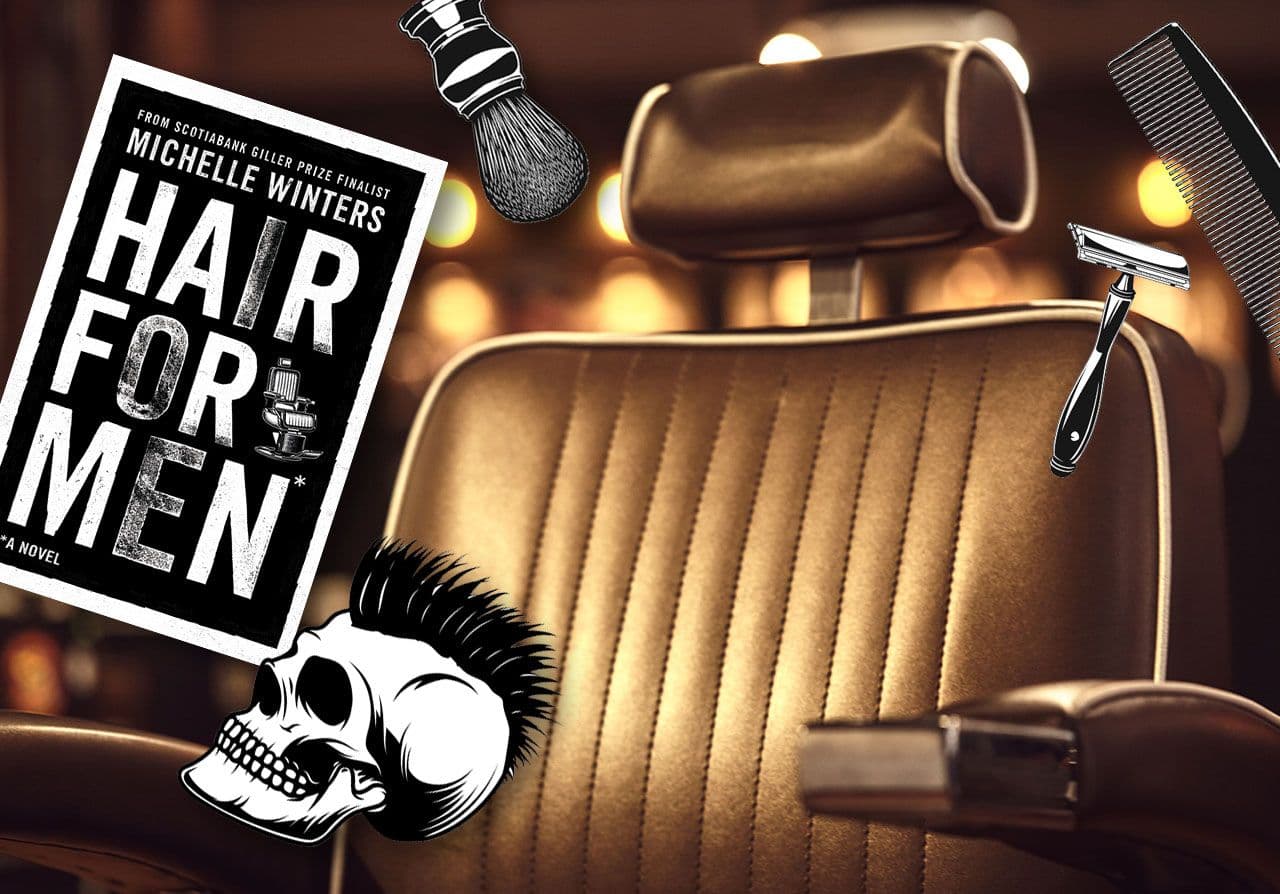
Hair for Men opens with a gruesome scene: The main character, Louise, is throwing weighted bags of body parts into the Atlantic Ocean by moonlight. It turns out to be a bad dream, but the reader wonders why she is haunted by these images. The novel will answer the question, but not before we’re treated to a few twists and turns involving adolescent regrets, hot towel shaves and female anger.
Toronto author Michelle Winters balances love and rage in her second novel, which she has described as the “story of a woman who loves men and also wants to beat them up,” complete with fantasies of violent revenge.
Growing up in 1990s Toronto, Louise, as a young girl, follows her beloved father, a shampoo salesman, on his rounds. Along the way, he tries to steel the innocent girl against the male world she will encounter growing up. And, indeed, in high school she suffers trauma at the hands of a classmate, which sends her into a spiral of shame so strong that she reinvents herself as a straight-edge, hardcore punk who listens to Black Flag and Dayglo Abortions, driving a wedge between herself and her beloved father.

The angsty teen has a “natural anger that is the absolute right of every woman,” Winter writes. Louise doesn’t demonstrate the kind of rebellion shown by female protagonists in Bonnie Garmus’ Lessons in Chemistry or Kirsten Miller’s The Change, but she has a more subversive – yet equally feminist – perspective.
Winters says this was inspired by the #MeToo movement. “I sat watching all these men get cancelled … my head was just spinning,” the writer and painter says in a Zoom interview from her home in Toronto. “I thought, holy cow, this is serious! This is a lot of men!”
A friend had recommended The Will to Change: Men, Masculinity, and Love, a 2004 book by American feminist and social activist bell hooks, who asserted men were unable to express intimacy because the patriarchal culture taught them to repress their emotions. “It just blew things open, in terms of a beautiful possibility,” says Winter. “[I thought] where do we go from here? I bet you anything it’s going to flip a procedural switch and we’re going to have to try something we’ve never done, which is conceivably [men and women] doing it together.”
The answer is Hair for Men, a salon unlike any other in a Mississauga, Ont., industrial park. In her 20s, Louise lands a job there as a hairstylist, and her mentor boss, Constance, introduces her to the idea that men are complex creatures. “The danger for men in particular is in accepting society’s demand that they be only one thing, and so never realizing the full potential of all their glorious moral and emotional complexity,” Constance tells Louise. In this special place, designed like a high-end spa for women complete with private rooms, food and cocktails, men are looking for escape. Louise and her clients develop an unusual connection in this sanctuary, feeling free to express their vulnerability and strengths in open conversations.

There’s also a bouncer – Constance’s boyfriend – who Louise can summon with a bell. As Constance explains, “Sometimes, Louise, people get the wrong idea about what goes on here. You try to innovate, you try to provide something that, when you come right down to it, is essential to us as humans, and certain vulgar assumptions invariably get made.
“If any man asks what services we offer, other than revolutionary cut, shave, and style, you tell him nothing. We do hair. Anyone gives you trouble of any kind, you ring the bell.”
Just when it seems Louise has found kinship and stability, her world is turned upside down. In her late 30s, she flees Toronto to start over at a marina in Saint John, N.B. (where Winters was born and raised). Louise discovers she must eventually confront her past, both literally and figuratively. On the same night of Tragically Hip’s 2016 farewell performance in their hometown of Kingston, Ont., Louise sees a man emerge from the Bay of Fundy, a pivotal moment when she decides to confront her past.
Unlike Louise, Winters spent her summers as an adolescent sailing the Saint John River, painting and “doing stupid things” with her friends, like making up a funny, childish game that two of the characters in Hair for Men play on windy days. Though she left when she was 18, Saint John remains a vivid place in her memories, which makes it easy for her to write about. It’s where she “learned to use imagination.” It’s also one of those places people return to, making it a fitting location for Louise to end up. Winters herself returns often; both her family and her husband’s family live there.
Winters weaves a tale of forgiveness, guilt and the emotional burdens we carry, but Louise is not a younger version of herself, with one exception. “Being an angry girl is the thing she and I share the most,” she says with a grin. She fully admits that, like Louise, she was “a dreadful little teenager,” a punk who liked the idea of upending conventional female beauty ideals. In fact, a driving force for the book was “the value of expressing the rage that comes at the moment, as a girl, that you discover that you’re not as valuable.”
Based on the Tragically Hip imagery that dominates the text, which she has said is “riddled with Easter eggs,” I assumed Winters was a lifelong fan. However, she shunned the band’s music when she was a teen, for being “too mainstream.” The turning point was seeing Gord Downie perform with Toronto musician, artist and filmmaker Sook-Yin Lee at a 2001 arts festival. The show moved her to tears, and she was struck by Downie’s friendly and generous personality.
Hair for Men follows Winters’ debut novel, I Am a Truck, which was shortlisted for the 2017 Giller Prize. Unlike most second books, she found this one easier to write than the first. With the spark of Louise’s character in her mind, the book unfolded from start to finish; even the ending “just revealed itself.”
When I praised Winters’ dialogue, she says her background in theatre – she was a founding member of a production company in New Brunswick, where she wrote two plays – helped her create immersive, readable scenes. For example, as a character breaks down with emotion, he says, “Agad” – not really a word, but a sound people make when they begin to sob. She’s deft at evoking emotion and playing with imagery; in one scene, a character tells Louise something she desperately needs to hear, and “the words danced in the air like colours [she] could touch.”
As for what’s next, Winters has the seed of an idea for another novel, but her priority is painting. She started when she was younger, but “got derailed by theatre,” coming back to it in her 40s. She enrolled in an oils course at the OCAD University in Toronto to learn to paint like the Italian Baroque artist Artemisia Gentileschi, “whose Judith Slaying Holofernes is one of the most wicked, glorious things. … It’s the badness she conveys with all that beauty.”
Winters is having a lot of fun working on a collection of “defiantly joyful women standing among the chaos of their own creating,” including a painting of the late feminist porn icon Candida Royalle spoiling a wedding shoot. “Painting makes me happy,” Winters says. “Writing is where I go when I’m angry.”