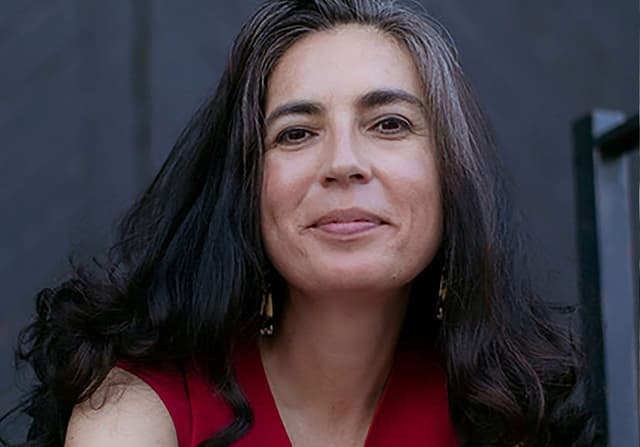
In the 21st century, with Kamala Harris poised to potentially occupy the White House, Taylor Swift’s record-shattering $1-billion revenue from her Eras tour and the #MeToo movement rooted in the cultural firmament, you might think women in the Western world were enjoying gender parity.
But you’d be wrong, as former Globe and Mail columnist and Zoomer contributor Elizabeth Renzetti, 58, makes clear in her expansive new book of essays, What She Said: Conversations About Equality. Look closer, Renzetti argues, and women are still woefully underrepresented in, and underserved by, government, science, health care and law.
In fact, she writes, things are regressing with “a destructive zero-sum game developing,” where men or women are seen to be either winning or losing. Now, “the early men’s right movement … [has] morphed into the online manosphere, fattened on grievances,” while, in the interview, she describes the example of Afghanistan under Taliban rule as “the endpoint of misogyny, the literal silencing of women.” The book also explores the widespread Western practise of using non-disclosure agreements to silence women who might otherwise speak out against sexual harassment or assault.

“In the seven or so years since #MeToo there has been a real backlash against women’s rights around the world. You can look at any number of data points about that,” Renzetti says in a telephone interview from her home in Toronto. “There has been an increase in men’s rights activism, as well as mistrust of and contempt for the goals of feminism. Why aren’t we further along in our hunt for equality? That’s what made me want to write the book.” (Read an excerpt from What She Said here.)
A 2023 poll she cites in the book – where 56 per cent of Canadian men aged 18 to 34 agreed “men make better political leaders than women,” compared to 17 percent of those 55 and older – suggests hard-won, second-wave feminist thinking hasn’t successfully transferred between generations.
While the towering achievements of women such as Harris and Swift signal possibilities, they also symbolize the palpable gender-based resistance, even hatred (see Donald Trump on Swift) women routinely experience when exercising equal rights.
Swift “encapsulates what I have been trying to articulate in this book, because on one hand she is singularly powerful and on the other she is wildly demonized,” Renzetti says. “She is the quintessence of what is happening to a lot of young women around the world.”
Swift is a handy emblem for the disquieting dynamics often surrounding successful women, an idea explored in more depth in the epilogue to What She Said. But the singer is by no means the book’s main thrust, which comprehensively, sometimes heartbreakingly, chronicles everyday Canadian women’s struggle to access health care and make their voices heard in the political arena and in the media in a stubbornly patriarchal system Renzetti says is still designed to restrict them.
That’s especially true for racialized, Indigenous and trans women. “Indigenous women in rural and remote areas are forced to travel at least 200 kilometres to give birth, compared with two per cent of non-Indigenous women in rural areas,” she writes in the chapter titled “Whose Body is It Anyway?,” which surveys gaps in a health care system long skewed toward men in both research and funding. “We are in a strange, uncomfortable space at the moment,” she writes, “where feminism’s goal of equality exists as a commodity, a fashion item, a necessary upheaval in art and culture, but not yet as reality.”
What She Said had its genesis in October 2022 at the Vancouver Writers Fest, where Renzetti was interviewing Canadian-born Eliza Reid – then the First Lady of Iceland – about her book, Secrets of the Sprakkar: Iceland’s Extraordinary Women and How They Are Changing the World. Stephanie Sinclair, head of publishing house McClelland & Stewart, was in the audience, and she approached Renzetti – who wrote extensively about women’s rights during her 30-year career at the Globe – about tackling a similar book about Canadian women.
“I said yes, though I didn’t think it was going to be as cheerful a book as Eliza’s,” laughs Renzetti, who published a book of feminist essays, Shrewed, in 2018, and Bury the Lead in March, the first book in a murder mystery series. “That’s where it started.”
Renzetti unearthed many troubling facts during her research, among them: “Women are less likely to receive CPR [during suspected heart attacks] because strangers are fearful about touching a woman’s chest.” Indigenous women are “sixteen times more likely to be murdered than a white woman in Canada.” Also, in Canada, women hold just 30 percent of the seats in Parliament, five per cent of CEO offices, and earn a tenth of the salary of male athletes.
Most astonishing among her findings was “the extent of intimate partner violence.” In the book, she recounts how, in 2020, she and fellow Globe and Mail journalists Molly Hayes and Tavia Grant began an in-depth investigation into gender-based violence, but soon discovered the topic was grievously underreported, multifaceted and generally “not [viewed] as part of a larger pattern,” even though one woman is killed by her partner every six days in Canada.
“It’s so prevalent that we actually have no idea how prevalent it is,” Renzetti says. “Only 20 percent of partner violence is reported to police and even then, it makes up something like a quarter to a third of calls women make to the police. It’s a huge unacknowledged problem.”
In that vein, Renzetti strikes a personal note by including her late mother Mildred’s story in What She Said. She “encapsulated a lot of what women went through” she writes, noting that despite being bright, her mother was offered two career choices: teacher or nurse. She chose the latter.
“My father was abusive toward her, she had four children and had to work to support us, she was prescribed Valium for a long time by the doctors she worked with,” Renzetti says. “She was downtrodden in a lot of ways, yet she was the most vibrant, funny, loving person. She was an amazing example.”
Renzetti hopes What She Said will find its way into the hands of men. “We have to get away from this idea that these are just women’s issues. These issues affect all humanity,” she says.
“It’s in men’s interest to dismantle the patriarchy. As bell hooks famously said about boys, ‘Patriarchy will not heal them. If that were so they would all be well.’ Hopefully they will see this book as something important for them to read, too.”