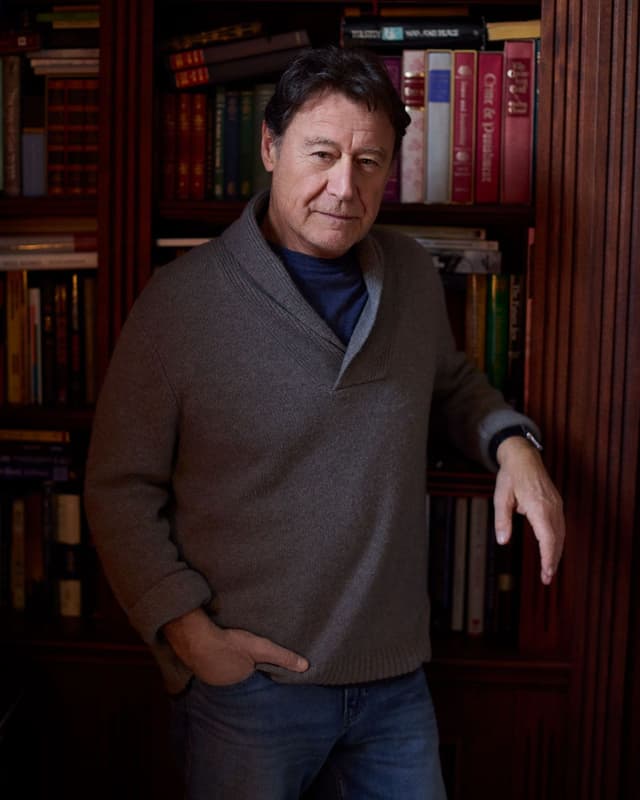
Over a career spanning a half century and 21 movies, Canadian director David Cronenberg has created a number of mad visionaries who conduct outlandish experiments on human flesh, from Jeff Goldblum’s trans-species mutation in The Fly (1988) to Viggo Mortensen harvesting his organs as performance art in Crimes of the Future (2022). But none are as drolly macabre – or resemble their creator as closely – as the protagonist of The Shrouds.
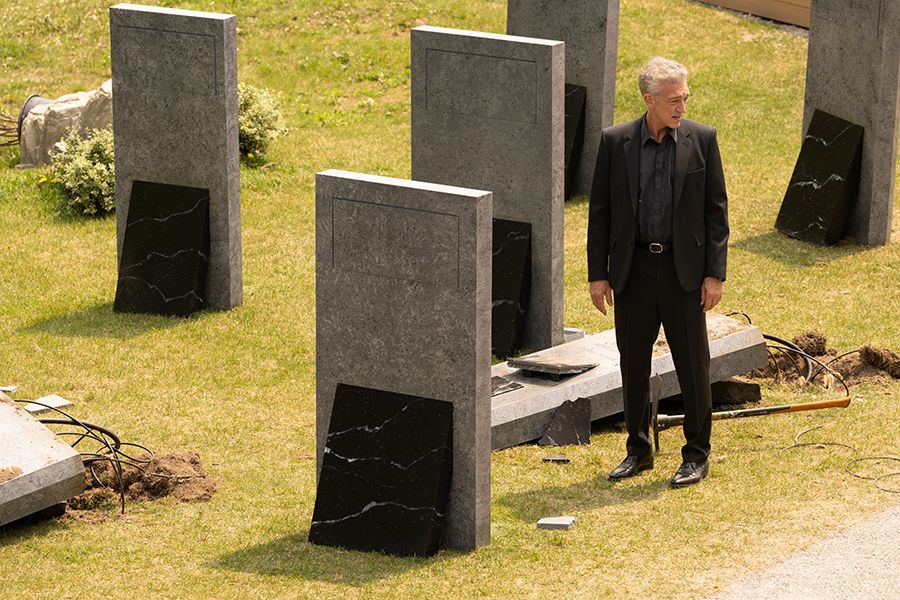
The 82 year old’s latest film, which opens April 25, stars French actor Vincent Cassel, 58, as Karsh, a Toronto entrepreneur who has re-invented the memorial business with GraveTech, a cemetery of video-monitored graves that allow mourners to live-stream the decomposition of their loved ones. Each corpse is enveloped in a 3-D “shroud-cam” that transmits MRI-like images of the remains, which can be viewed via an “encrypted” app, or on touch-screens set into tombstones like the ones on the back of airplane seats.
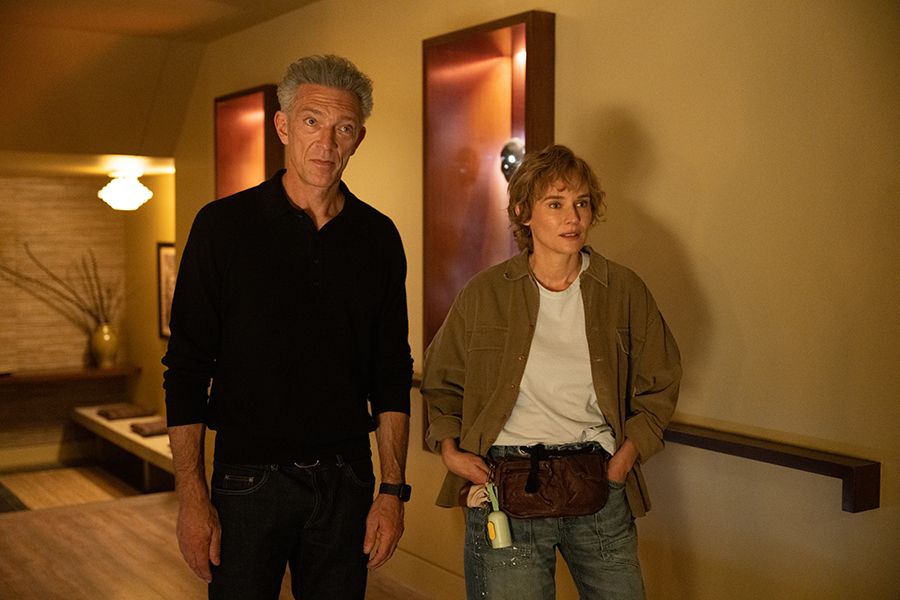
Karsh’s wife, Becca, is among those lying in GraveTech’s cemetery. And four years after her death, given that he’s still routinely “seeing” her, it’s no wonder Karsh is having a hard time rebooting his love life. As he embarks on a fling with the wife of a terminally ill client (Sandrine Holt, 52), he whipsaws between erotic apparitions of Becca and an attraction to her sister – both played by German actress Diane Kruger, 48.
Cronenberg, who lost his wife Carolyn to cancer in 2017, says that The Shrouds was directly inspired by his experience of grappling with her death. It’s a multi-genre invention, an amalgam of conspiracy intrigue, tech satire, perverse romcom and erotic reverie. But beneath its playful maze of a plot there are sombre reflections on love and death that feel quietly confessional and as intimate as anything in the director’s body of work. In a recent video call, I spoke with Cronenberg about how he draws the line between his life and his art.
ZOOMER: It’s been said that The Shrouds is your most personal film, given how it was inspired by Carolyn’s death.
DAVID CRONENBERG: Well, I have never said that this is my most personal movie. Many people have said that about it. And I point out that The Brood (1979) was about a divorce with a little girl in the middle of it, and I had just gone through that [with the end of a seven-year marriage to the director’s first wife Margaret Hinson]. So the first personal movie I made would be The Brood. This would be my second.
Z: How did The Shrouds evolve from the process of mourning your wife?
DC: It begins with a feeling that I have to somehow deal with Carolyn’s death and how it felt to me. And so many of the aperçus by Karsh in the movie are things that I actually felt, but as soon as you start to write the screenplay, it becomes fiction. It’s a very different process than trying to write autobiography. I needed to be freed from that responsibility. And of course, Karsh is a high-tech entrepreneur, he owns a restaurant, he owns a cemetery – I don’t do any of those things. So he’s not me. But I wouldn’t have understood these things Karsh is going through if I hadn’t experienced most of them myself. Very straightforward things like wanting to get into the box with Carolyn when she was being buried because I couldn’t bear to be separated from her. Other things that Karsh says and does are things that I have said and done. But there’s a limit to that. You want the characters to take over and become alive and do and say things that surprise you.
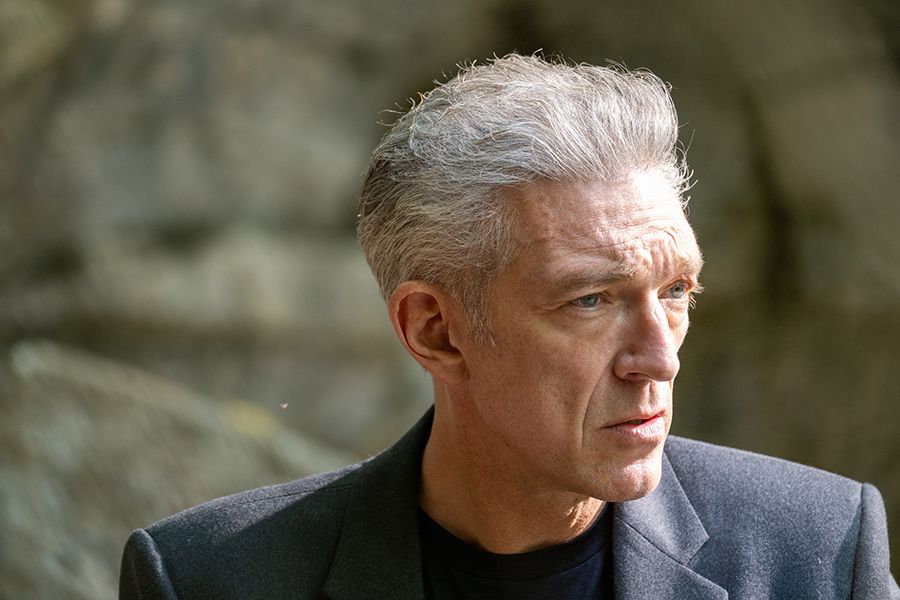
Z: Vincent Cassel is extraordinary as Karsh, and I thought it was uncanny how much he resembles you, from his haircut on down. Was that accidental?
DC: I did not cast Vincent because of his hair. He often shaves his head. And if he had showed up to talk to me about the role with the shaved head, I would have been fine with that. But it’s true that there’s a presence there where, yeah, he does look a bit like me. And the other aspect of it is that, as a good actor, he decided the character was me, and he would base his performance on me. Part of that was that I said, “Look, this is a Toronto story, and your accent should replicate my midtown Toronto accent.” Vincent has known me for many years because this is the third movie we’ve done together. And it’s not just the accent, but also the rhythms of my speech and body language, which were slower. He normally plays tough guys who talk fast.
Z: You’ve worked repeatedly with Jeremy Irons, then Viggo Mortensen, and now Vincent. Do they all become your avatars to some extent?
DC: Yeah. Well, it’s a fusion. It’s no exaggeration to say that I am all my characters. When I’m directing them, it’s like writing them. You have to be them for that moment. So it’s a performance. We’re all acting together.
Z: The dialogue in The Shrouds is riddled with so many ideas and tech talk and plot twists and jokes, you can almost hear the synapses popping. But on the other hand, there are these pools of emotion, the kind of tender, reflective moments that can only come from lived experiences – as when Karsh talks about the impossibility of having sex with his wife after a certain point because she has no immune system and her bones are too fragile. I hope this question is not too intrusive, but was that autobiographical?
DC: Actually, yes. It’s interesting, because I did read all the grief books when I was thinking about doing this movie. I had read Joan Didion’s The Year of Magical Thinking about the death of her husband, and C.S. Lewis, Julian Barnes. And I realized that in each case their grief was not my grief. Joan Didion never mentions her husband’s body or the loss of the body. She misses his voice, his wit, his support. This and that. But from reading that, you would think they never had sex together. I’ll tell this anecdote and you can decide whether to use it or not – about a friend of mine, someone you know, whose beautiful wife had died. He and I were talking about this. And he said that he had a friend who tried to express his empathy and said, “Oh, I understand. My father died three months ago.” And he said, “Well, do you fuck your father? Because if you don’t fuck your father, you have no idea how I feel.” It’s a completely different relationship when your parents die than when the woman that you’ve been making love to for 40 years or something dies. It’s the body. The loss of the body is so compelling. It’s almost impossible to understand it unless you’ve experienced it. All grief is very specific. Some basic notes are going to be the same. But it really depends on the nature of the relationship. And in my case it was very much a physical thing.
Z: And emotion really resides in the body.
DC: Yes. Oh, yes.
Z: In The Shrouds, someone says to Karsh, “Tell me about this body thing –you’ve made a career out of bodies.” I could ask you the same question. Your body of work is about the body.
DC: Every filmmaker makes a career out of bodies. The thing that we photograph most is the human body. The human face. That’s what you light. That’s what you costume. That’s what you put makeup on. So you have to be obsessed with the human body if you’re a moviemaker.
Z: In your films, you’ve invented all these fleshy tech devices that look like art, from the tele-pod in The Fly to the flesh gun in eXistenZ. And now, funeral shrouds that have the sculptural beauty of a chrysalis but function as lens that envelops a decomposing body. Could you imagine this actually happening?
DC: Absolutely. The technology is there.
Z: Would anybody want it to happen?
DC: I would. I absolutely would have done that if I could have.
Z: But how would that body relate to the body that you were in love with?
DC: It would be like you were connected by Instagram. It would not be the same as if you were there in the box. That’s not physically possible. You would die. But there are now AI replicas that you can construct of somebody who’s dead that will talk to you in their voice on a screen that you can manipulate. With people taking videos of each other, there’s enough data to create a spookily accurate replica. Of course, you would not be able to touch and feel and make love to this body and walk around holding hands. So even with AI, there are going to be limits to how much you can resurrect your loved one. And as I think you understand from the film, it’s not enough to make the grief go away. It doesn’t resolve it.
Z: What will happen to your body after your death?
DC: Well, once I had my place on the Walk of Fame, I thought it would be great if I was buried under the sidewalk, which would be plexiglass so that people could look down and see what’s happening to my body. I would have gone for that. But now I have a plot next to Carolyn. So I think that’s where I’m going to end up.
Z: Buried, not cremated?
DC: Yes. I’m a bit of a romantic, and I think of the idea of lovers being buried side by side is pretty good. You know, “The grave’s a fine and private place/But none, I think, do there embrace.” [quoting Andrew Marvell’s poem “To Her Coy Mistress]
Z: In your film, as Karsh restarts his sex life four years after his wife’s death, he says “I didn’t know if I was still sexually viable. I’ve been in a strange, dark place since Becca died.” Do you have a partner now, and have you gone through that experience?
DC: I don’t have a partner now. But I’ve had a couple of partners since Carolyn died, so I have had that experience. And I’m happy to say that at 82, I still seem to be sexually and romantically viable [laughing], despite what the general consensus might or might not be. Honestly, it’s similar to saying to yourself, can I make another movie?
Z: It’s funny. I was just going to ask you that.
DC: It’s the same. Do I have the stamina? Do I have the focus? Have I lost it? Because you can’t tell until you actually try to make a movie, at which point you’re committed, and it could be quite disastrous if you suddenly realize you don’t have it. I felt like I would never make another movie after Carolyn died – the two things seem to be absolutely connected. But eventually, after about five years, I realized I wanted to do that and started to work on Crimes of the Future.
Z: Do you have another movie in the works?
DC: I’ve been talking to Robert Lantos about doing a movie based on my [2014] novel Consumed [a surreal conspiracy thriller about sex, organ trafficking, cannibalism, cancer and Cannes] We’ll see. It wouldn’t be a cheap movie, and the film industry is in total flux.
Z: Aside from creative endeavours, what do you do for fun?
DC: Just life itself is fun for me. I have three kids. I have four grandchildren. That’s a very classic kind of thing. I certainly would be happy to be in love again, romantically. That would be good. But I can live without it.