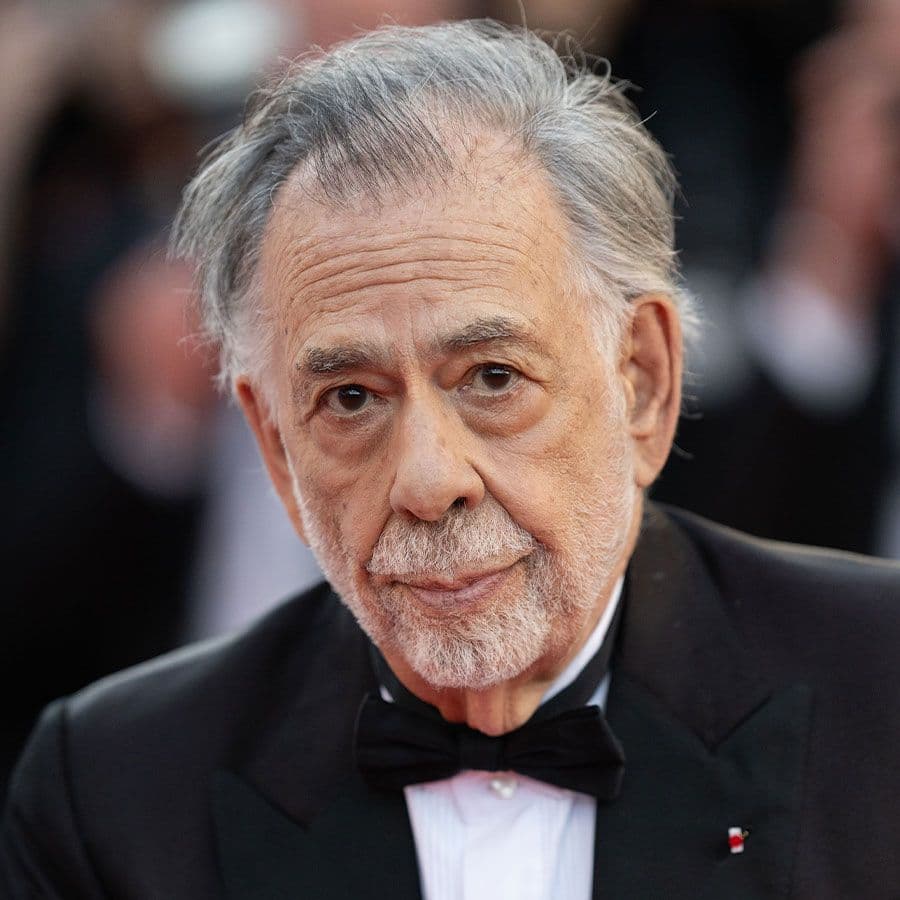
Francis Ford Coppola says he never cared about money. The 85-year-old filmmaker has stared down financial ruin in the past, both on the set of nightmarish war epic Apocalypse Now and his romantic musical One from the Heart. At a press conference in Cannes earlier this year, he explained why staking $120 million of his own cash on Megalopolis left him unfazed the day after it premiered at the fest.
“There are so many people, when they die, they say ‘I wish I had done this and I wish I had done that.’ But when I die, I’m going to say, ‘I got to do this and I got to see my daughter (Sofia Coppola) win an Oscar and I got to make wine and I got to make every movie I wanted to make.’ I’m going to be so busy thinking about all the things that I got to do that when I die I won’t notice it.”
I’m picking up that conversation with Coppola months later over Zoom, before Megalopolis makes its North American premiere at the Toronto International Film Festival. He’s in a Napa Valley bungalow, at his desk. Behind him are memories and trinkets scattered on shelves: screeds, baseballs, photographs and books. I’m struck by the miniature Oscar statue (not sure where his real ones are), as it’s poised not far from a “Certified Fresh” plaque from Rotten Tomatoes. A once-prized marker of cinematic accomplishment is replaced with an imitation, which sits next to a meaningless stamp of approval from a critics aggregator site that the movie industry is now obsessed with appeasing. It’s a chaotic arrangement – about as chaotic as Megalopolis.
Coppola’s sprawling, fascinating and frustrating vision of the future is about the collapse of civilization through the lens of the destruction and attempted rebuild of the fictional New Rome. The movie has been decades in the making; Megalopolis began with ideas Coppola had after Apocalypse Now, which eventually formed into a screenplay draft that the director took a stab at making in the early 2000s. There was a secret reading with prospective cast members like Paul Newman, Robert De Niro, the late Brittany Murphy and Canada’s own Sarah Polley.
But the studios never got behind such an ambitious and perplexing project, then and now, which is why Coppola is footing the bill himself after mortgaging the winery in Napa Valley. That’s where he’s speaking to me from – not just about the film, but his life, career and musings on humanity. Below are edited and condensed excerpts from our conversation.
ZOOMER: You said to me before, and I’m paraphrasing, “as a film critic, don’t tell me what the movie is, tell me what it made you feel. Write about how you experienced it.” It lines up with something else you told me, how Rumble Fish is your favourite among your own films, specifically because kids in [Latin America] really took to it. It sounds like your films are more meaningful to you when they’re reflected back to you, when you hear and are moved by the profound ways in which others have received them.
COPPOLA: That’s art. I thought Rumble Fish was a big flop. It didn’t go over well. It didn’t make very much money. But then I heard that it was seen over and over and over again by those young writers and filmmakers in Latin America which, as you know, became a literary sector in our lifetime. Genius moves around the world. You never know where it’s going to pop up next, whether it’s literature or cinema, because we are all one human family.

ZOOMER: A lot of the challenges you met with while making Megalopolis you’ve dealt with in the past. Your problems with this industry are about as cyclical as the human crisis that you tap into in Megalopolis. But is there anything specific to this new era and the new generation that you found particularly difficult to deal with.
COPPOLA: I think historically, if you look at various fields or activities, when one is coming under its destruction, it begins to behave differently. For example, journalism today is under threat of of extinction. So, you see journalism behave in or in in a desperate way to save itself. Even modern movie business, senses, whether they realize it or not, senses that they’re under danger of destruction. So they look to this notion of streaming and subscriptions and a very aggressive kind of management such as we see in Marvel pictures.
I actually was told by an art director on Megalopolis – when I suggested that we could do a sequence where all the statues fall down with miniatures that would be more theatrical – she said, “Oh, I can’t step on toes. You have to say that idea to the production of designer.” I said, “But, I’m the director. I’m always used to talking to anyone I want. You’re telling me that there’s a structure. I’m not allowed. I’m the director, the producer and the financier. And you’re saying, I can’t go right up to an electrician and say, ‘When he kisses her shake the light.’”
What this tells me is about the movie business is that they’re desperate to survive. The truth of the matter is, the human being has the genius to avoid extinction. But it has to avoid it with creativity.

ZOOMER: Speaking of the challenges when dealing with the new generation, you spoke to Rolling Stone about how you tried to make this movie more inclusive. You were talking about having progressive people in your cast and crew working alongside people who have been cancelled like Jon Voight (Coppola has stated publicly he doesn’t agree with Voight’s far-right politics) and Shia LeBeouf (an alleged abuser). You said you wanted this film not to come across like a didactic woke lecture but a conversation that brings people together. Somehow that quote made it to social media and was reduced to sounding like you’re anti-woke.
COPPOLA: Woke is a label. I originally was very woke. These words are changing. Pretty soon if you say that you love, they’re gonna find that love means something bad. What I was saying in the Rolling Stone [interview] was one thing. And yet it offended someone who felt that I was against woke. These words are labels and they keep changing.
ZOOMER: You refuse to be limited or categorized as just a filmmaker. You are someone who loves life and follows his passions, whether they be filmmaking or these other endeavours, like winemaking. It’s also part of your filmmaking. You’re not following the rules of filmmaking, you’re following your own passions.
COPPOLA: That’s very fair to say.
I’m 85 years old and throughout my life, I was told – at first, by my parents – ‘Oh, be careful about those people.’ ‘Those people don’t like you.’ And ‘It’s dangerous to go to their neighbourhood.’ And I must say that for whatever reason, every time I did go into everyone’s neighbourhood, they always treated me with kindness. It was never true.
In Megalopolis, I had a big Haitian component in the script. I went to a Haitian neighbourhood in Brooklyn. And I had never been treated so nicely in my life. They were so kind to me. You think of Haiti. It was the one country, of course, that had a slave rebellion that succeeded. They’ve never been forgiven for it. Poor Haiti has more trouble today than we care to imagine and it’s because they succeeded to rebel. And yet they’re the nicest people you’ll ever meet.
All human beings are kind and nice and wonderful if you come into contact as your fellow human being.

ZOOMER: In terms of the way you functioned as a filmmaker, pursuing passion rather than success, is that because right out of the gate you made The Godfather? You had nothing to prove because you just won the game. You could do whatever you want after that. And so you chose to pursue your own passions and not be held to anybody else’s standards. Would you say that’s a fair assessment?
COPPOLA: But I don’t think that’s normally because you win the game early on. Tennessee Williams made The Glass Menagerie and A Streetcar Named Desire and spent the rest of his career trying to equal those. I could have spent the whole the rest of my career trying to equal The Godfather. I never even attempted to. I only did The Godfather Part II because they wouldn’t leave me alone when I said I didn’t want to. But in other words, by making a big success when you’re young, you can waste your life trying to do something that equals it. I never attempted to.
Megalopolis is screening at TIFF and opens theatrically September 27. For more from our conversation with Francis Ford Coppola, check out Zoomer’s Oct./Nov. 2024 issue, on newsstands Oct. 7.
RELATED:
TIFF 2024: From Hollywood A-Listers to Homegrown Hits, All the Films We Can’t Wait to See