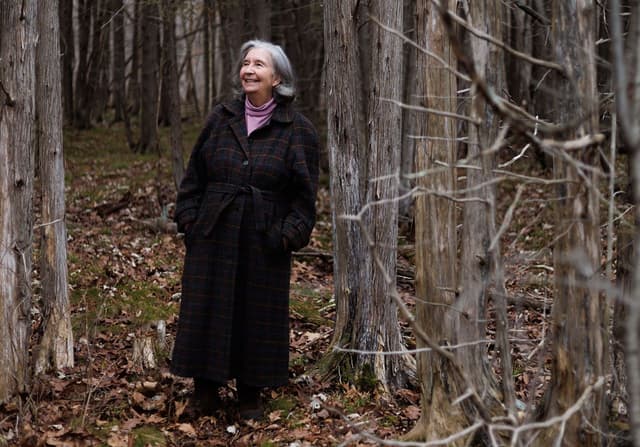
Family secrets can be corrosive or illuminating. Occasionally, they are redemptive. That was the case for Canadian video journalist Roxana Spicer, 70, who painstakingly untangled the closely guarded wartime secrets of her late mother Agnes Spicer for her provocatively titled new non-fiction book, The Traitor’s Daughter.
Among the bombshells Roxana unearthed: Her Russian-born mother served in the Red Army during the Second World War, was captured by Nazis in north-central Ukraine in either late 1942 or early ’43 and was interred in both the Ravensbrück and Auschwitz concentration camps.
At Auschwitz, Agnes endured sexual assaults that resulted in two abortions. She then spent roughly two years working as a slave labourer in Germany while being hunted by the KGB, as all Soviet POWs were. Under brutal Soviet leader Joseph Stalin, they were classified as “traitors” during and after the war.
All of this happened before Agnes’ 24th birthday, Roxana confirms from her home in Toronto. “What child has not wondered who their parents were before they became Mom and Dad,” she says in a recent interview. “Children have a birthright to that story.”
Roxana was uniquely qualified to tell this story, having travelled the globe covering stories as a documentarian, from “remotest Ecuador, the Arabian Desert, and the North Sea,” for major broadcasters including CBC TV and Global TV. These adventures paled compared to the mystery of her mother’s past, which Spicer admits was a lifelong obsession.

Initially, she intended to make a documentary, but her search ultimately pivoted to a book, in which she subjected whatever she found to a “thorough and rigorous journalistic lens.” Her research spanned decades and included 12 self-financed fact-finding trips to Russia and three to Germany, among other locales, including Auschwitz in Poland.
Equal parts memoir, biography and a deep historical dive into the Second World War, The Traitor’s Daughter paints Agnes – born Agnei Rosa Nicolaievna Butorina in November 1922, “in sub-arctic darkness, some sixteen hundred kilometers east of Moscow” – as an iron-willed firecracker who survived through a combination of wits, grit and luck, abetted by the German language she had studied.
At one point, after Agnes was purchased by a farmer, along with three cows and seven pigs, she was one of the foreign slaves known as “Ostarbeiterinnen.” As Spicer writes, Nazi slaves were “as familiar on German streets, factories, churches, or farmers’ fields as bomb craters or swastika flags. Most were Soviet. The story of Hitler’s 13.5 million slaves remained outside the Culture of Remembrance [the German policy of acknowledging Nazi war crimes].”
After the war ended in 1945, Agnes met Jack Pfeil, a German-speaking Canadian soldier. They married in the Netherlands and moved to Canada, where, in the summer of 1947 in Saskatchewan, Pfeil drowned; he was only 27. A classmate of Pfeil’s offered the distraught widow a job as a cook in a hotel in the tiny town of Netherhill, Sask., population 80, where Agnes then met a local man named Eric Spicer. The couple married, had three children and raised Roxana, her twin brother Victor and their older brother Harold in an idyllic rural setting earmarked by the family’s roadside gas station, and a diner run by Agnes.

But charismatic, otherwise forthright Agnes could never outrun her past. Roxana remembered her mother playing LPs of the Red Army Choir late at night as she threw back cocktails, reminiscing about her youth. Young Roxana would come downstairs and absorb snippets of memories. However, Agnes strenuously resisted more detailed questioning for years.
That imperative became urgent after Agnes’ 84th birthday in 2006 (she died in 2009), when “she spontaneously declared that everybody has the right to know who their predecessors were,” says Roxana. Finally, a green light. “I felt such enormous relief hearing her say those words on camera,” says Roxana, who often filmed conversations with her mother. “Mom knew how important it was for me to understand her life story.”
Agnes concealed her identity by changing her name multiple times in captivity to protect her family in Russia from reprisals for her “traitorous” capture, which made tracking down surviving wartime documentation more difficult. In Traitor’s Daughter, Spicer gives stark context to Agnes’ extraordinary struggles. “Stalin had deployed a million Red Army women,” she writes. “There were as many Russian women on the Eastern Front as the combined forces of Canadian troops on the ground, air and sea. There had to be something written about [those women]. I tried over the years, but I found nothing.”
What Spicer did find via exhaustive archival research, multiple interviews with historians and interviews with her relatives in Russia – including Agnes’ late sister Nela (likewise disinclined to revisit an agonizing past) – was proof that Agnes’ astonishing survival story was real, “even though she never thought anyone would ever believe it.”
“When she was captured by the Nazis [as an active-duty Red Army soldier], she was assumed to be a Jew because her name was Rosa, which was pretty much a death sentence,” Spicer explains. “A Nazi interrogator pulled out a knife and said, ‘Let’s see if your blood is red.’ My mother replied in flawless German, ‘I’ll be goddamn if I let anyone tell me I’m not Russian.’ The nerve to do that caught the soldier off-guard and she got to live another day,” she says. “That story, which I remembered from junior high school and really stuck with me, suggested she had lived through trauma she hadn’t described.”

Another piece to Agnes’ puzzle was the numeric tattoo on her left arm, which she hid under long sleeves even in summer. Though detailed prisoner records were destroyed by the Nazis toward the end of the war, an interview with famed historian and human rights advocate Irina Scherbakova confirmed that only those interred at Auschwitz had been tattooed. Further, as Spicer was near to finishing the book, her brother Harold – initially skeptical of his sister’s mission – went into their father’s Kodak slide collection from the 1950s, weeding out pictures of Agnes without sleeves. Spicer had the pictures analyzed by a veteran archivist at The Shapell Center Holocaust museum and repository in Bowie, Maryland.
“We only had the first two numbers of a five-number tattoo, but they definitively placed her in Auschwitz for a three-week period in late February of 1943,” Spicer says. Which raised the question: Why was Agnes so reticent about her incredible (some might say heroic) past, even from the safe distance of her post-war Prairie home, where she dutifully raised three kids who adored her?
“She was suffering from PTSD,” Spicer says. “Knowing Mom, she probably would have scoffed at that diagnosis. For her it was very simple: If you pack trauma deep into your memory, it’s not there to haunt you. Of course, it came out in other ways.” Like Agnes’ nighttime habit of exiting their house and howling at the moon. “Our house was bordered by Highway 7 on one side and wheat fields on the other,” Spicer recalls. “Imagine some trucker driving by on the highway and hearing her howling.
“I wish Mom was alive to see the outpouring of interest in her and how she survived those terribly dark days,” says Spicer, who hopes her book might be adapted into a feature film one day. “I really hope the book resonates with young women, that they can connect with the story of Agnes Spicer and find a role model to tap into.”