Most books are filed by genre. Though End Times Fascism and the Fight for the Living World doubtless appears in the nonfiction, bestseller and new release sections of local shops, don’t be surprised if this authoritative – and hair-raising – indictment of the contemporary political far-right by Canadian authors and activists Naomi Klein and Astra Taylor is also shelved by savvy clerks under politics, self-help, New Age and even horror.
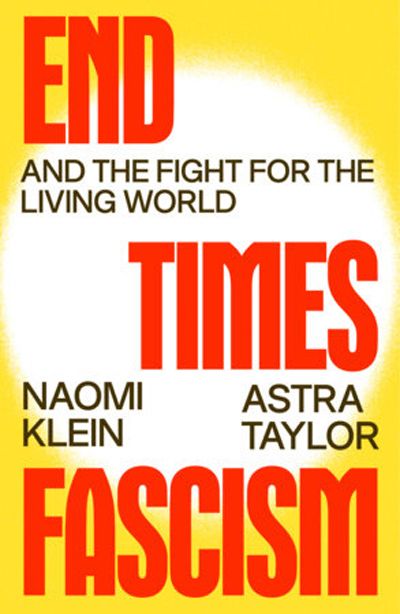
At its core, the book charts how three ostensibly unrelated but politically influential groups operating mainly in the United States – religious fundamentalists, Silicon Valley titans and ethno-nationalists – are united in their belief that the end of the world is nigh. In their view, only a chosen few, namely them, will survive and thrive on the other side. Since the early 20th century, fascism has been described in terms of far-right authoritarianism with dictatorial leaders and ultranationalist political ideologies like Hitler and Mussolini’s. But Klein reframes the meaning for these modern times. “We describe fascism as capitalism’s worst mood,” author Klein told Prospect magazine. “Its threat response. It emerges and surges in Europe after the Russian Revolution, when there is a real threat to capitalism, and fascism protects it. That is happening now, but at the expense of the Earth.”
As End Times Fascism makes clear, these groups are “racing toward a different but related apocalyptic dream, sutured together in common cause.” The book describes tech bros who covet elaborate bunkers and space colonies to escape the earthly ravages of their unregulated AI and accompanying data centres. Western xenophobes scheme to shut borders on pesky climate refugees suffering environmental ruin not of their making. Fundamentalists want to scrub the world of secular “evil.”
Most alarmingly, the authors contend, these groups have the ear of self-aggrandizing leaders, opportunistically enriching themselves while ensuring that “public anger” for their own economic and policy failures is “directed downward at the vulnerable rather than upward at the system itself and its most privileged stewards and beneficiaries.” This is a textbook fascist tactic previously and most infamously deployed by Italy’s Benito Mussolini in the decades after WWI, whose paramilitary “Blackshirts” targeted minority groups as both muscle-flex and diversionary ploy. However, “what is new is how little else is on offer” to a general populace induced to abide unsettling policies. Prosperity for all, Klein and Taylor maintain, will not be forthcoming. “This absence,” the authors write, “is end times fascism’s greatest weakness.”

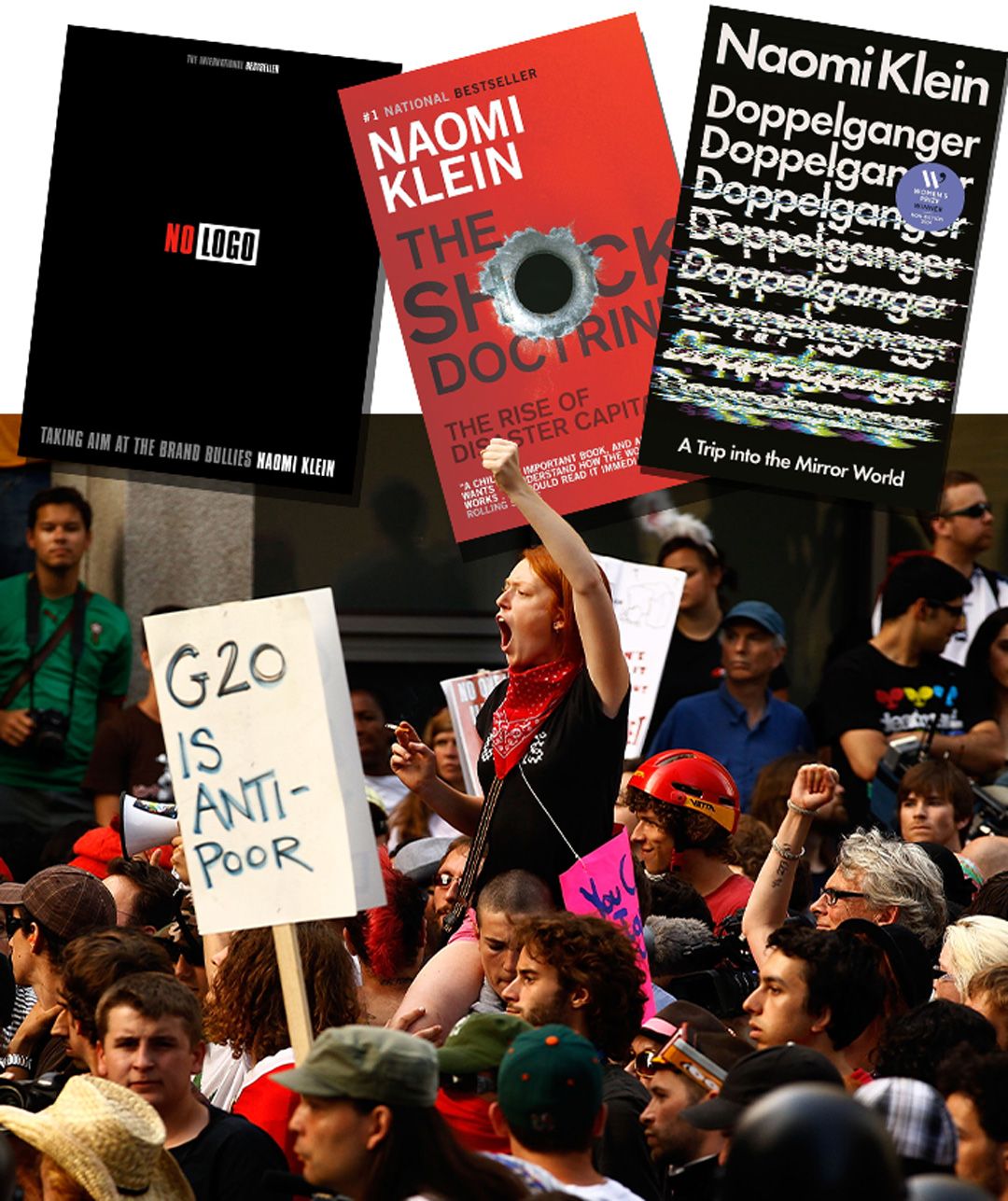
Klein, 56, and Taylor, 47, are uniquely qualified to offer up these explanations. Both have vociferously advocated for the left for decades. Klein’s nine critically acclaimed and award-winning bestsellers include the totemic No Logo from 1999 as well as 2007’s The Shock Doctrine and 2023’s Doppelganger. She is married to former journalist Avi Lewis, now federal leader of the NDP, Canada’s democratic socialist party. Her late father-in-law Stephen Lewis, to whom the book is dedicated, was an esteemed politician, diplomat, and tireless human rights and social justice activist.
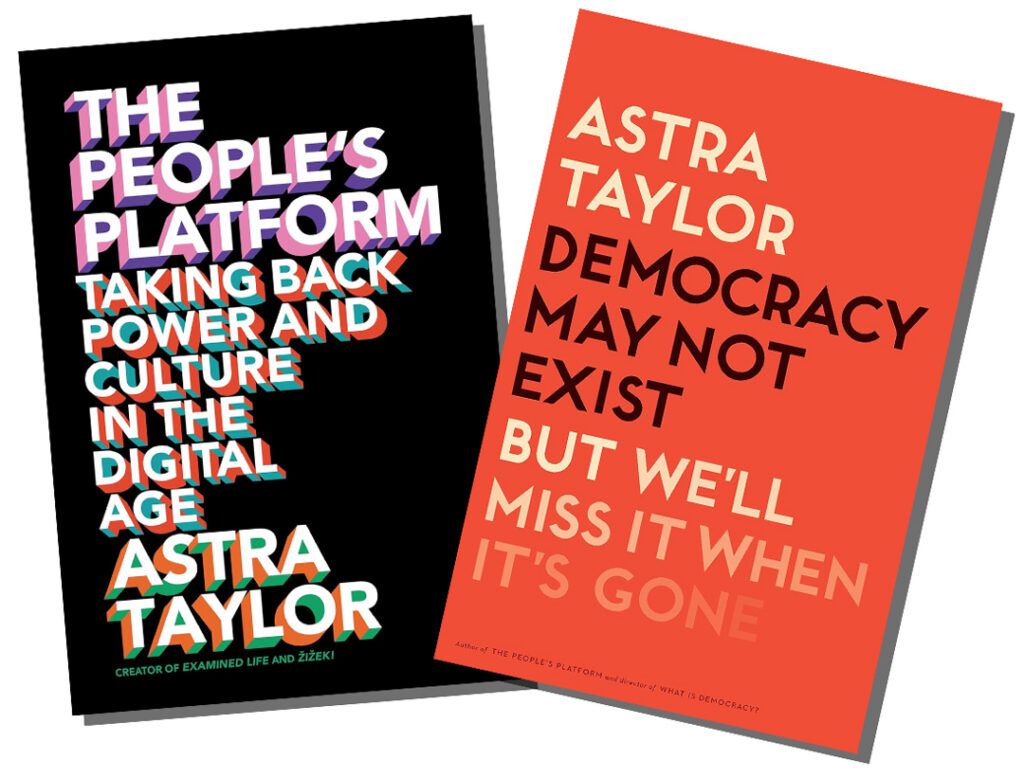
Author and documentarian Taylor, meanwhile, co-founded the Debt Collective, a union of sorts aiming to galvanize Americans facing crushing debt to challenge predatory financial systems through collective action such as debt strikes, legal claims and public advocacy campaigns. Her previous books include 2014’s The People’s Platform: Taking Back Power and Culture in the Digital Age and 2019’s Democracy May Not Exist, but We’ll Miss It When It’s Gone.
Despite this book’s bleak but scrupulously documented portrait of our precarious current world and those jiggling its political levers, Klein and Taylor insist it provides a coherent roadmap to resistance. It also engenders a very human – spiritual even – sense of urgency about saving our home planet from catastrophic environmental degradation.
“End times fascism is contested and vulnerable, and as a result, it can still be defeated,” they write. “However, if we wait until this violent and nihilistic project has colonized every part of the right before we confront it directly, it will indeed be too late.”
Zoomer spoke by phone with Klein and Taylor from Toronto.
Zoomer: How did you two first converge on the idea of authoring this book together?
Naomi Klein: We had been doing some work together after Trump was re-elected, trying to make sense of what was different about the second term. We were both quite focused on the exodus of billionaires to off-world paradises and the extent to which they were adapting to climate breakdown. It seemed more radical. We wrote an essay together for The Guardian in April 2024 called The Rise of End Times Fascism, and we were approached by publishers about expanding it into a book. At first, we didn’t think we wanted to do that because it would be too depressing [Laughs] but at a certain point, Astra said, “I am already down the rabbit hole with this. We might as well do something productive with it.” That was very convincing to me. There’s no way this book could have happened with either of us on our own. We really wanted it to come out quickly as an intervention before the U.S. midterm elections. That really fuelled a divide-and-conquer strategy to make that possible.
Z: Did you have any reservations about authoring such an inflammatory work? We hear about American judges getting death threats for criticizing the current administration …
NK: We are not on the very front lines. There are many people who are under siege from the forces we are describing, from millions in Gaza to those being kidnapped by ICE or the brave neighbours we profile who are rising up in the U.S. There are some incredibly courageous people who refuse to be cowed. That said, the things we were writing about felt more visceral. We both have been writing about the right for a long time in different ways. It’s very inspiring to track the resistance and to write about it and meet with people on the front lines, whether they’re fighting data centres or detention centres. Courage is contagious; it’s a phrase for a reason. Organizing is always risky but there is safety in numbers. Part of our hope with this book is to build those numbers up even higher.
Astra Taylor: I think both of us are probably targets anyway. We have spent a lifetime on the record criticizing these folks. It seemed better to just try and fight them. We see safety in solidarity, not silence.

Z: You write, “This book is an attempt to chart this new territory, to outline what we call the politics of end times fascism.” Is it fair to call it a manifesto?
AT: I think of manifestos as strictly political texts. I do think we wanted to do something that is politically rousing, but that has a spiritual component. So maybe it’s a manifesto of rage against the fascists and love for the living world. I’m not sure what the word is for that kind of text, but it’s what we were aspiring to.
Z: You mentioned in jest that you were worried the book might be depressing. Was there concern that a cogent amalgamation of these stranger-than-fiction facts and arguments might make lay readers feel more hopeless, that they could never meaningfully counter the efforts of these politically connected billionaires?
NK: We sensed that people were feeling that way already. Trump is a chaos agent, and he’s very good at keeping people destabilized. And we are in an information environment where the infinite scroll does a poor job of making sense of events. We are inundated with contradictory messages. And so, the mere act of reading a text that is organized and puts things into context should, if we do our job, make people feel calmer. It’s not within our power to make these times not frightening. Listening to tech oligarchs talking about the end of the world already has people pretty freaked out.
AT: A woman came up to us last night and said, “It’s such a relief to come to your event and hear you name what I am seeing and acknowledge what I am feeling.” There is a sense of camaraderie in facing reality. We are hearing that from readers who come to our talks.
Z: You contend that Trump is the glue holding these seemingly disparate “end times” groups together. Will the end of his second term rupture this coalition or is the proverbial ideological well already poisoned? Could a successor like [New York Mayor] Zohran Mamdani, who you praise in the book, really induce meaningful change?
AT: There are many possible scenarios. The point of the book is not just to describe and analyze the contemporary far right but to highlight their weaknesses, conflicts and failures and where we think we can defeat them. This isn’t just a blueprint of the type of hypothetical future we want. It’s a blueprint of how the weird amalgamation we call “end times fascism” is constructed. People need to come together in an organized fashion to build the political power that enables potential political leaders to enact meaningful policies and address the crises that are feeding the far right today.
NK: And Trump is not the only one cobbling together this coalition, though he is the most visible because the U.S. has the wealthiest individuals and most powerful corporations. This is a global phenomenon and all victories against it will be temporary unless we really are addressing the underlying drivers, which are economic insecurity, a sense that elites are not in your corner, that things are not going to get better and so you really just need to protect you and yours. Even in Canada, before people rallied around Mark Carney, it looked like we were going to have a conservative government that probably would have been quite aligned with Trump. We caution against any sense of false separation. These forces are at work in Canada, and this could happen here.
Z: Permit me a woo-woo question but could there be a gender aspect to conquering end times fascism?
NK: We love woo-woo questions!
AT: The religious fundamentalists, tech accelerationists and ethno-nationalists have lots of differences, but they are really united in their disgusting sexism. I see this as a boldly feminist book even if it doesn’t articulate itself in a conventionally feminist way. Things that are seen as feminist that are being denigrated by the right – like empathy and vulnerability – make us human beings. We think life itself needs to be reclaimed. End times fascism is about separation from the Earth but also separation from oneself, cutting out the vulnerable and empathetic parts of yourself. If that’s woo-woo, then so be it.
NK: In the book we call these groups “traitors to creation.” We don’t mean it as traitors to a flag or a nation. We mean it as a fundamental breaking with the duties of being alive. We have a duty to protect life and nature and the living world. Part of the reason we wanted to write together was to give each other more courage to speak in that register, which isn’t the traditional register of the political analyst writing about economics. But when we are talking about the economy and the environment, we are talking about life.
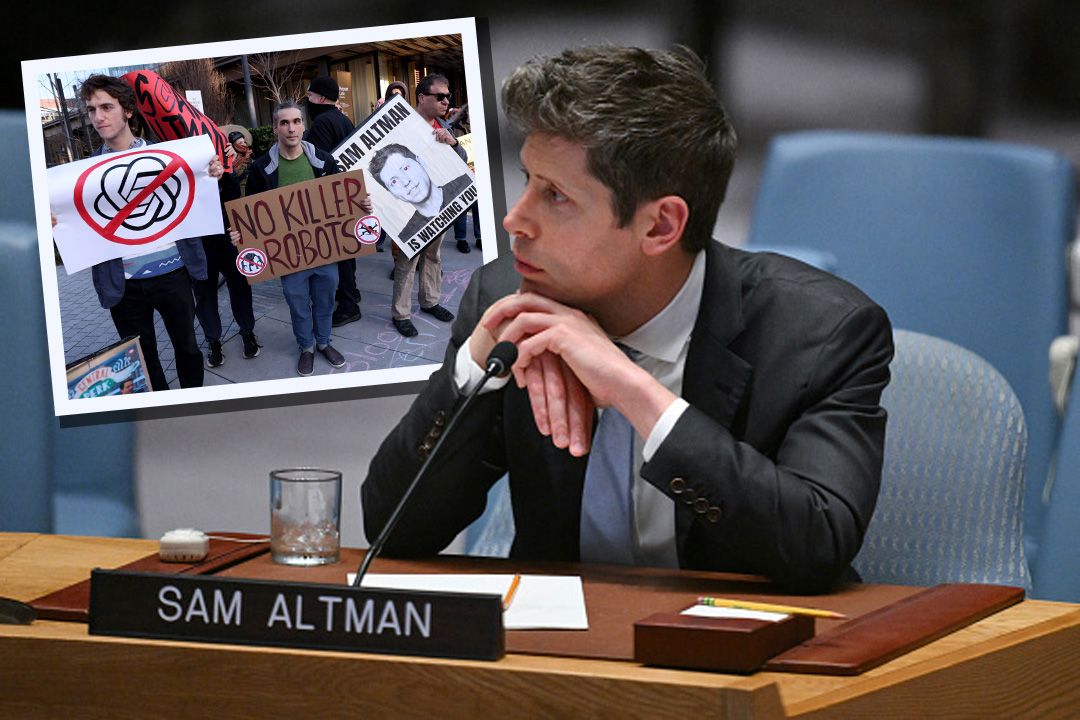
People have described this as a surprisingly spiritual book. It’s a condemnation of fascism, but it’s also an attempt to awaken a deep love for all that is sacred in this world. And compared to what people like [OpenAI CEO] Sam Altman are saying about conjuring a digital god with their AI … I mean, these guys are out there. Comparatively, we are positively down to earth. [Laughs]
Z: What will success look like for you with this book?
NK: We want our book to be useful. Success is providing people who are doing great work with some tools that make their organizing clearer and more appealing and lightens the load a little bit. We have heard from organizers and unions on the ground that the book is doing that work. Being number two on the New York Times bestseller list also doesn’t hurt.