
There’s the Oscar, and a photo of him with Salman Rushdie – another with Courtney Love – and endless images of men in singlets. A framed 1981 Time magazine image, where he’s sitting on the trunk of a car with a “GARP” vanity plate, has faded with age. But then, a blown-up Barneys New York fashion ad from the same decade, featuring him and his then-teenage sons, is as crisp as the day it was shot. In John Irving’s Toronto writing studio, every inch of wall space is filled with memories of the decades he’s spent writing, wrestling and raising a family. At the giant L-shaped desk, there’s a laptop and a few small stacks of books that include Moby-Dick, Great Expectations and The Diary of Anne Frank, all of which are bursting with multicoloured tabs. And there’s a copy of his own 2009 novel, The Last Night in Twisted River, which doesn’t have any tabs but it does have a great first line: “The young Canadian, who could not have been more than 15, had hesitated too long.”
Tucked in between the books is a CD of Canadian folk legends Ian & Sylvia. “I love them,” Irving tells me during our tour of the room. “That’s my period of music.” It’s got him thinking about some of his other favourites. “It wasn’t that long ago that Paul Simon was in town,” he recalls. “We’re old friends, you know, old ’60s ratfuck political complainers. We went out to lunch a day or two before his show. And as we were saying goodbye, I knew I’d see him on stage, but I wouldn’t see him again privately. And it was a knee-jerk at the same time, we pointed at each other from across the room and we both said, ‘Still crazy after all these years.’”
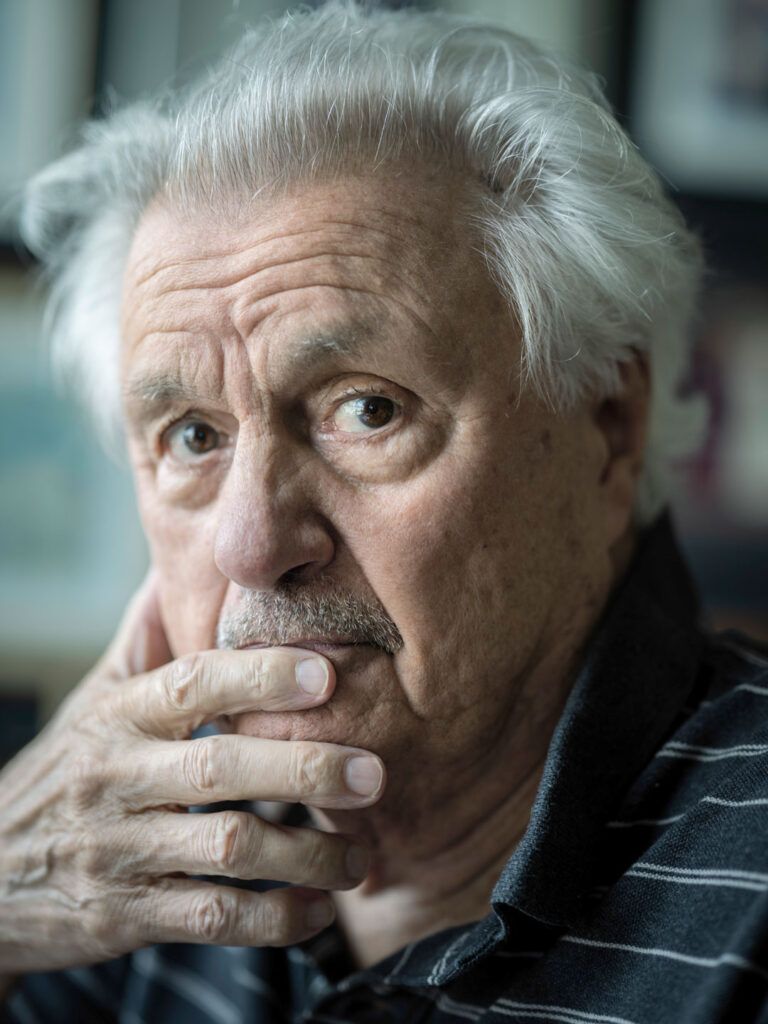
I don’t know 83-year-old Irving well enough to judge his sanity. But his books have always been the best kind of crazy, filled with unforgettable characters, bizarre accidents and deaths, prophetic incidents and bold social commentary. There are endless recurring subjects, including bears, wrestlers (and a bear wrestler), writers, sex workers, lost limbs (see also: tattoos, circumcision, mutilation and castration), absent parents, stepfathers, references to the works of Charles Dickens and Herman Melville, and settings in New England, Vienna and Canada – and this is by no means an exhaustive list of well-trod motifs. As fans know, many of these touchstones correspond to Irving’s own biography: he grew up in New Hampshire, didn’t know his biological father, adored his stepfather and the works of 19th-century authors, studied abroad in Vienna and wrestled (as well as coached and refereed the sport) for most of his life. And even though he has been explaining for decades how he blends truth and fiction in his writing, he happily does it again while we’re sitting at a what would be a dining room table if it wasn’t filled with many, many editions and translations of his books: “There are those novels of mine which are almost entirely autobiographically based; but then from that basis, I add in things that never happened to me. The sort of grounding work is autobiographical, but after that, it ain’t.” Fair enough.
In his latest novel, Queen Esther, the story revolves around young New Hampshirite Jimmy Winslow (which is Irving’s mother’s maiden name), who doesn’t know his father, wants to be a writer, is a wrestler and spends a college year in Vienna in 1963. There are no bears, but we are introduced to an affectionate German Shepherd called Hard Rain, named after what Bob Dylan tells us is a-gonna fall. In fact, Robert Zimmerman’s music is part of the background noise of this, Irving’s 16th novel, which could be referred to short-handedly as his Jewish book, the way The Cider House Rules is called his abortion one, A Prayer for Owen Meany is his Vietnam one and In One Person is his AIDs novel – except that nothing about Irving’s writing and his epic tales can be distilled to a one-word descriptor.
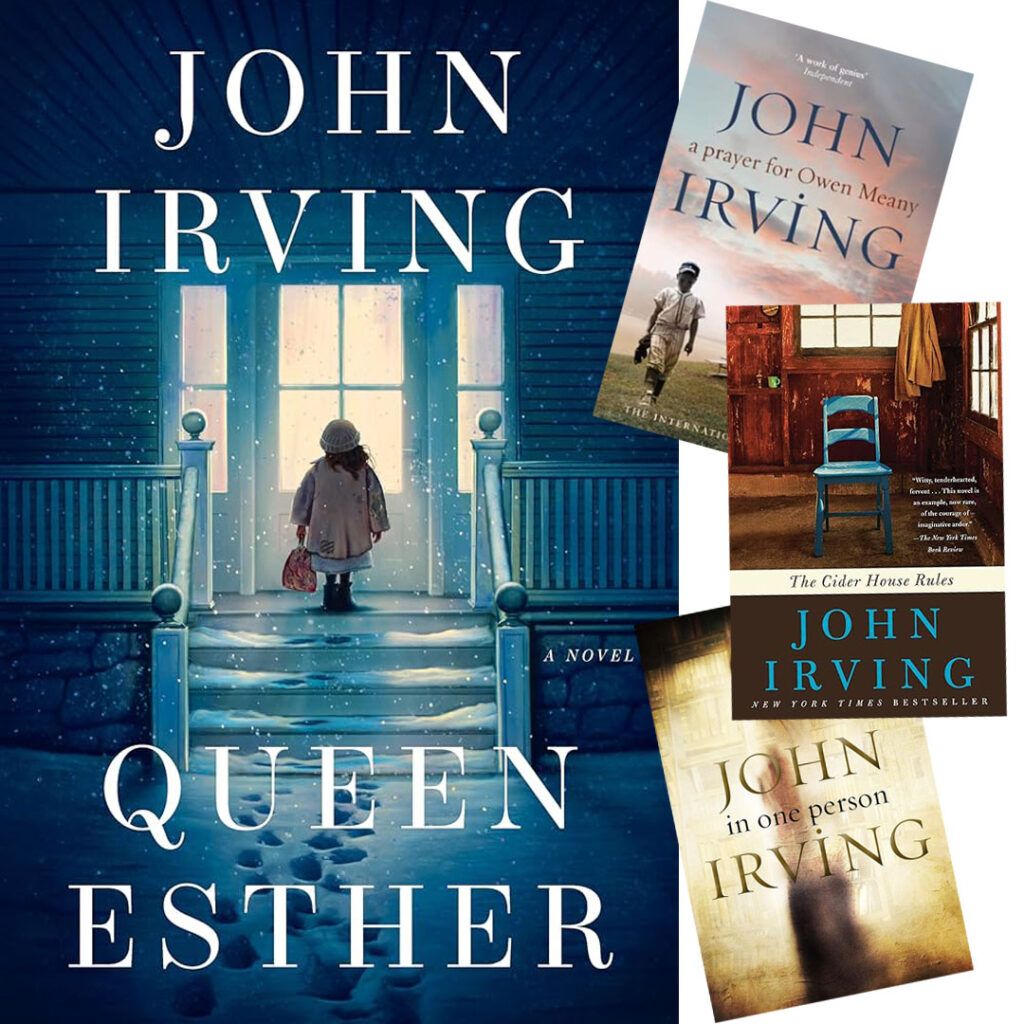
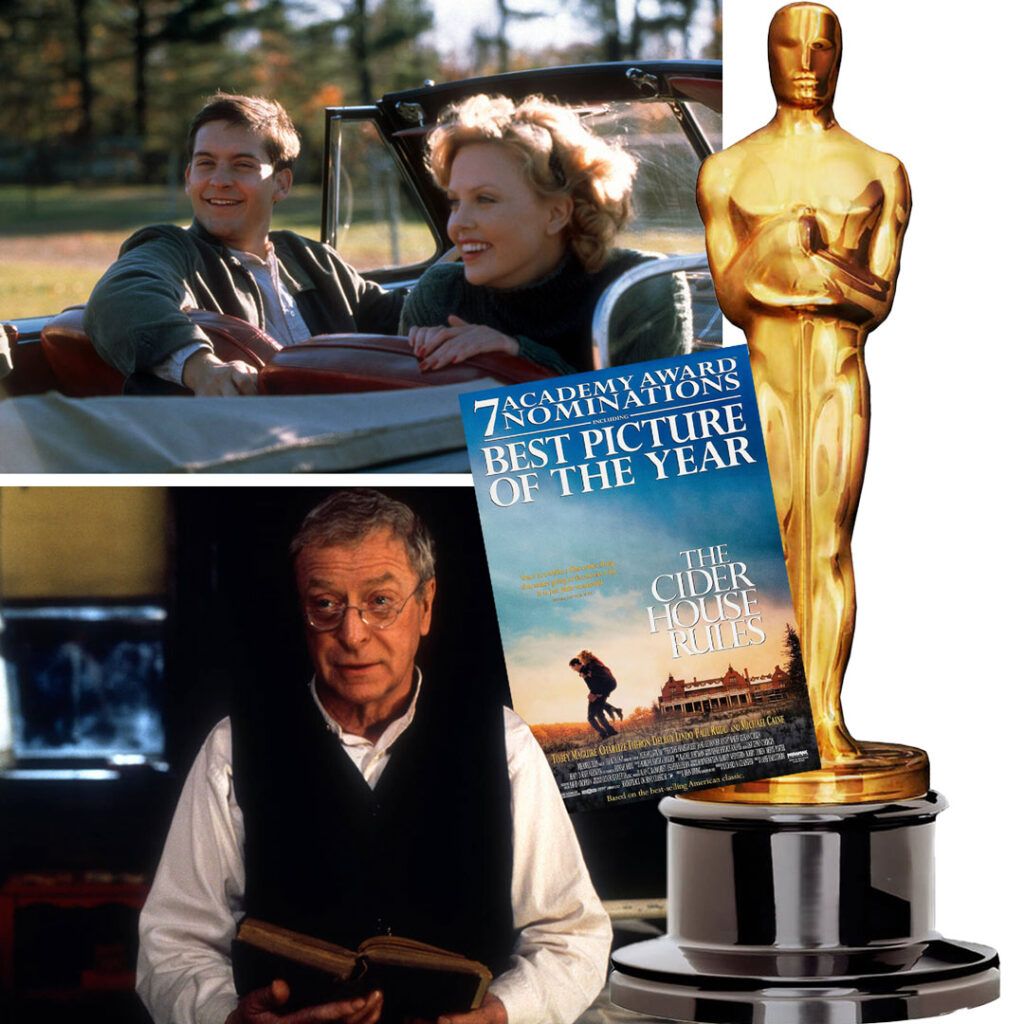
In Vienna in the 1960s, says Irving, “I had this Jewish American roommate, Eric Ross, who looked after me and who opened my eyes to the antisemitism that was still apparent. We remained friends forever. He read all my books, but it pains me that [he died] and never got to read this one.” In the novel, Jimmy – who embodies “a truthful exaggeration of my unawareness at the time,” says Irving – also witnesses the oppressive society and intractable antisemitism of post-war Austria. In an interconnected, albeit earlier storyline, readers follow the titular character, Esther, who was born in Austria and ends up losing both of her parents in the family’s immigration to the U.S. in 1908 – one to illness, the other to an antisemitic attack soon after they arrive in New England. Esther, then a parentless three-year-old, is brought to St. Cloud’s orphanage and put under the protection of Dr. Wilbur Larch, making this novel somewhat of a prequel to The Cider House Rules (the 1985 novel that Irving turned into a script, winning the best adapted screenplay Oscar in 2000).
When Esther is a teenager, she becomes the nanny for the non-Jewish, philanthropic Winslow family in the years before Jimmy is born. She eventually moves back to Europe, becoming a mysterious figure in the creation of the state of Israel, likely working with the Israel Defense Forces and Mossad, fulfilling a destiny similar to that of her namesake in the Old Testament story: Esther was a Persian queen who saved her people from destruction by revealing her secret Jewish identity to her husband, King Ahasuerus. “My entire trajectory for this character,” says Irving, “is that she should be the embodiment of the Queen Esther she’s named for. By the time she’s dumped at the orphanage, her life has already been shaped by antisemitism. And having been denied the Jewish childhood she should have had, I wanted to create the most compelling reason to be a Zionist that, in my imagination, someone might have: that is to say that ‘it’s not going to happen to me anymore.’ This kid, whose Jewish life was taken from her, is on a mission to get it back.”
It’s hard to imagine this historical novel landing at a more timely moment – even though Irving started writing it long before the events of October 7, 2023. Unknowingly, he began his research on his first trip to Israel in 1981, when he was attending the Jerusalem International Book Fair, meeting with publishers, translators and visiting with German-speaking residents. “If you were a visitor to Israel in the ’80s, there were many concentration camp survivors who were still alive. And if you spoke German, even badly, they wanted you to go spend some time with them because they missed speaking the language. They knew it was not a happy language for the Israelis to hear. These people, many of whom were Ashkenazic Jews from Europe, were super-educated, super-trained and were often teaching in a kibbutz [in Yiddish], but they were lonely. And so I was solicited to go speak to some of these people in German.”
When he decided to write Queen Esther, he looked back at his notes from that first trip. “I was not taking notes for a novel I never knew I would write,” he explains. “But I was writing down what people said to me, because I was learning so many things that were new and perplexing, and in many ways, ominous.” Once he decided to tackle the history of that particular part of the world in a novel, his plan was to write a nearly finished version of the last chapter – which takes place in Israel in 1981 – and send it to his friends there so they could read it for accuracy. And then he would return to Israel and discuss the chapter with them – plus he wanted to refresh his visual memory of everywhere he walked and everything he saw in 1981. “These friends were on my case in 2023, saying, ‘You know, the situation on the ground isn’t very stable, you better come now.’ But of course, everything takes a little longer than you think.” He did make it back there in 2024, telling the Times of Israel, “I feel it’s all the more important given what’s happening and the eternal conflict,” and his speech at the Mishkenot Sha’ananim Cultural & Conference Center was met with thunderous applause when he said, “I’m pro-Israel, pro-Jewish and I’m for you. That may not necessarily mean that I’m in favour of your present leader.”
“I seem to have chosen a model that is not only already unpopular with everyone, but this may doom me to obscurity”
He has sharp words for his own country’s current leader as well. Only 13 years ago, Irving told Time magazine that he could never move away from the U.S. full-time: “No matter how much for personal reasons I might be tempted not to live here, I’m an American writer, and I’m not sure that I would be as in touch with my subject if I lived somewhere else.” But in 2015, he and his wife, Janet Turnbull Irving (who was John’s Canadian publisher and is now his agent), sold their monstrous Vermont home, settling permanently in their Toronto condo – where they had been regularly living four months out of every year. “I never imagined when I became a full-time resident here and then a Canadian citizen [he took his oath in 2019, and kept his U.S. citizenship as well] that I would be put in a position to be on Canada’s side, that I would ever feel as estranged from my birth country as this hideous authoritarian in the White House has made me feel. In nine months, he has made a democracy I love and remember into a hateful fascist autocracy. And the degree to which this moron has alienated his long-standing allies is one of the first indications that he doesn’t really know what he’s doing. But the heck with him. We don’t have to talk about him.”
With that, I suggest we discuss Dickens instead, motioning to Great Expectations, which features prominently in both Queen Esther, The Cider House Rules and many of Irving’s other books. I ask if he rereads it every time he goes to write a new novel. “With Great Expectations and with Moby-Dick, I get trapped over and over again,” he says. “I don’t intend to reread them. I go looking for a passage that I much admire, but I don’t know if I’ve remembered it exactly. And so I want to check myself. I remember the scene, I remember the chapter, I remember the character and I go looking. And I think I’m going to get away with just reading that scene that I went looking for, and then I’m back again and the whole thing happens – I can’t count how many times I’ve reread Great Expectations or huge parts of Moby-Dick.”
There was a time when he was certain his love of 19th-century authors – and his desire to write like them – would make him a lost cause. “I was 15 when I first read Great Expectations, and I thought, ‘Well, this is the book. I want to be a writer if I can do it like this,’” he says. “At that age, though, it seemed unwise. The few of my friends who were reading novels willingly – and there were very few of them – all despised the ones they’d been coerced to read in school, such as Dickens.
“I seem to have chosen a model that is not only already unpopular with everyone, but this may doom me to obscurity,” he remembers thinking. “But if I was expected to embrace the canon of the great American novel at the time – this is the ’50s and ’60s, so Hemingway, Faulkner, Fitzgerald – I would have done something else for a living. That wouldn’t have compelled me to be a writer.” He did, however, have an affinity with American writer Kurt Vonnegut and became a student and mentee of the Slaughterhouse-Five author at the Iowa Writers’ Workshop in the mid-’60s.
While he doesn’t speak of it as often – or maybe he just doesn’t get asked about it – Irving was also inspired by the women writers of the Victorian era. At the St. Cloud’s orphanage of Cider House Rules and Queen Esther, the boys are read Great Expectations as well as Dickens’s David Copperfield at bedtime, and the girls hear Jane Eyre by Charlotte Brontë. As Dr. Larch says about these books with parentless protagonists, “What in hell else would you read to an orphan?” In Queen Esther, a writer friend of Jimmy’s is likened to George Eliot for her way of writing about the “state of marriage and the status of women.” I ask Irving what he thought of Eliot’s masterpiece, Middlemarch, which comes up in Queen Esther when Jimmy’s grandfather gives two town hall talks about the novel early in the book. “Well, what writer could not identify with Dorothea,” Irving tells me. “Middlemarch is a wonderful one. The only thing that ever offended me about the Victorian period, that caused me distress even as a teenager – and it was because of my mother’s extreme, ahead-of-the-curve feminism – was to think how the Brontë sisters, whom I most admired, and Marianne Evans [George Eliot’s real name] all had to choose male pseudonyms. I felt a great indignation, especially in the case of Charlotte Brontë because Jane Eyre herself is such a model of pushing back against the social restraints of her time. I thought, “How could you have done this? You know, screw Currer Bell.”
Throughout his career, he’s searched out other writers, both older and younger, who are also enamoured with the books of that time. That’s how he became friends with literary icon Robertson Davies, whom Irving calls Canada’s Dickens. Irving gives more than three pages of his 148-page autobiography to Davies – while Davies himself once gave a 14-page speech entitled Why I Do Not Intend To Write An Autobiography. Irving describes in this 1996 memoir, The Imaginary Girlfriend, which is mainly about wrestling and writing (in that order), how he was introduced to Davies’s work in high school – years before the publication of the Canadian’s most famous book, Fifth Business. Then, in 1981, Davies reviewed Irving’s novel The Hotel New Hampshire for The Washington Post. “It was such a likeable and mischievous review, and by then I had read everything of his,” writes Irving, “that I eventually journeyed to Toronto for the sole purpose of having lunch with him.” Six years later, at Irving’s Toronto wedding to Turnbull, Davies read from the Bible. “My two sons from my first marriage, Colin and Brendan, were the best men,” writes Irving, who also has a daughter with Turnbull. “They had not met Rob before the wedding, and Brendan – he was 17 at the time – didn’t see Professor Davies, in his magnificent white beard, approach the pulpit. Brendan looked up and, suddenly, there was this big man with a big beard and a bigger voice. Colin, who was 22, told me that Brendan looked as if he’d seen a ghost. But Brendan, who was not overly familiar with churches of any kind, had had a different thought. Brendan was quite certain that Professor Davies was God.”
WE FIND OURSELVES BACK AT THIS DESK. Irving has already mentioned that he’s working on a new book, but there are no signs of any physical pages – and he’s famous for handwriting out his books in long-form. “I had to go back to a keyboard,” he says with a sigh. “So many of my fingers were broken backward in my 20 years of wrestling that they’ve led to numerous flexor tendon surgeries. And my hand surgeon said, ‘You’re going to have to stop writing because you’re not going to be able to hold something for six or seven hours a day in this position. Your fingers will lose the dexterity and the strength.’” I’m curious about the phrase “go back to a keyboard” as I thought Irving had always written by hand. “My mom taught me to type when I was 13 years old, which was a great help at school,” he says. But he explains that when he wrote his first novel on a typewriter, he made too many mistakes, with his mind racing so fast. “That’s when I remembered that, when I was living in Vienna, I took my old Underwood typewriter to be repaired. They fixed it, but it came back with a German keyboard. So not only were the letters of the alphabet in different places – that would be bad enough – but what the fuck are you going to do with all those umlauts? So until I got back to the U.S., I had to write by hand. And I found that slowing down was good for me.”
His fingers aren’t the only victims of his wrestling years. Pointing to a black-and-white framed photo of a handsome young man, he says, “That’s me when I still had a straight nose, before I had my nose fixed. I actually used to have, if not a Roman nose, certainly more of a nose than I ended up with. It got broken in a bad way, and they had to take a bone out and put plastic in. And when they do that, your nose goes [makes a deflating sound]. I’m kind of over it now. But there were a number of years I just missed my old nose. Then, I finally grew up and thought, ‘Well I’ll just put my high school graduation picture up and look at it.’”
That grad photo hangs near two group shots that are very much essential to his life story. First, he motions to one of a couple and child smiling and enjoying themselves at an outdoor celebration. “That little boy is me at my mother’s wedding to my stepfather, who legally adopted me. That’s the day I became an Irving,” he says. Up until then, John had lived with his single mother, Frances (Frankie), and his grandparents. He recalls being surrounded by “models of strength,” referring to his mom, grandmother and the mother of his closest childhood friend. “There were these verbally quick, well-spoken, supremely confident, good-looking women just running everything,” he told The Times in 2009, which certainly fits with many of his fictional female characters, including the four-daughter Winslow family in Queen Esther. John was six when they moved in with Colin Irving, who was a history teacher at the Phillips Exeter Academy in New Hampshire, the prep school that John would end up attending. Colin was one of the first readers of all of John’s books, until he died this past January at 100 years old. “I told him many times,” John says, “that the reason all the stepfathers in my novels are heroes was because he was mine. And I named my first kid after him. He was a great guy.”

Next, Irving looks toward a photo of a group of air force men, pointing to the handsomest one in the middle. “That’s Captain John Wallace Blunt. That’s my birth father. That’s who I was named after. I was John Wallace Blunt, Jr., until I became John Irving.” He recounts the story of how his biological father wrote home from the war ending his relationship with Frankie – who was pregnant with John at the time – but saying that he’d like to be a part of his child’s life. Frankie denied that access and told her son nothing about his father, hence all the missing dads in Irving’s books. John only found out these details in 1981 when Frankie passed on a stack of letters from Blunt. Irving has said he doesn’t judge her decision: “I wasn’t standing in her shoes in the 1940s in a small town.” Earlier in his life, there were times when he could have tracked Blunt down on his own with info from members of his mother’s family. ”If I had been unhappy with my mother or my stepfather, I think the quest to find my missing father would have become crucial,” he told the New York Times. It wasn’t until Irving was featured on CBS’s Sunday Morning in 2001 that a half-brother figured out the connection and reached out. “Since then, I’ve met all these siblings that I never knew I had,” Irving tells me. “And we’re very close.”
Ever the gentleman, Irving offers to walk me to the subway after our interview. He throws on a plaid flannel shirt over his blue short-sleeved polo, which he wears with worn jeans and purple ASICS sneakers, noting that he “always looks a bit scruffy.” As we walk, he’s musing about what he’ll get his daughter Eva (a transgender writer-director-actress who appeared on The Pitt) for her birthday, and, at my request, he finishes up a couple of off-the-record, stranger-than-fiction stories about long-ago run-ins with the law – charming and hilarious until our very last moment together. When we part at a traffic light, I watch the man who gave us Garp, Owen Meany, Homer Wells, Queen Esther and so many more memorable characters make his way, completely unnoticed, through the streets of Toronto – still crazy after all these years.