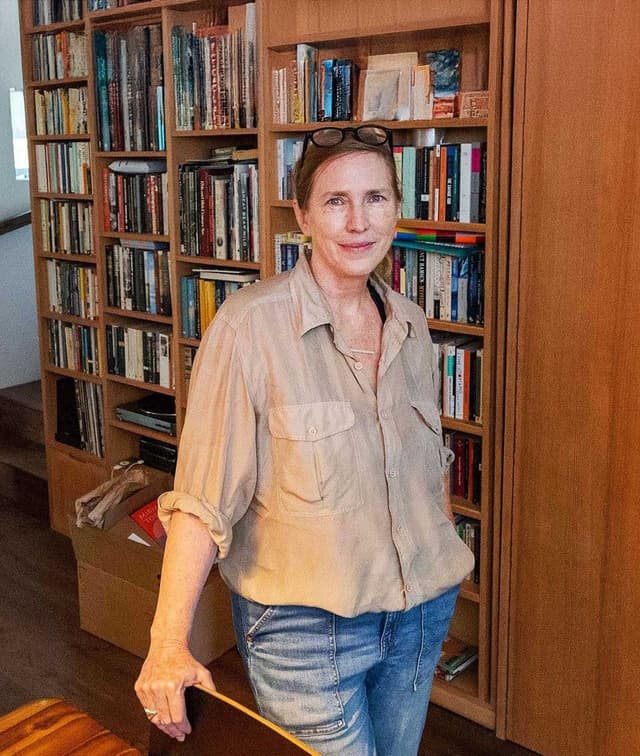
In 2020, Craig Brown was struggling to find a subject for his next biography. He wanted to apply his “mosaic” technique, which ditches a traditional chronological narrative for a profile built from reminiscences, lists and other vignettes, as he’d done with his 2020 bestseller, 150 Glimpses of the Beatles. He just needed to find a subject as universally famous as the Fab Four.
“It struck me that the only person at that level of fame was the Queen, and, of course, she’d had it for much, much longer,” the author and humourist tells Zoomer from his home in the literary neighbourhood of Bloomsbury in London. Her fame outlives her 2022 death and, in much of the world, Elizabeth II is still known simply as the Queen.
The result is Q: A Voyage Around the Queen, a fascinating and funny, insightful and irreverent examination of a woman who maintained an elusive and inscrutable persona despite nearly a century in the spotlight. “The fact that she had all this reserve in her own character meant that people could reflect off her whatever they thought of their own images. They could see in her whatever they wanted to see,” explains Brown, a columnist for the Daily Mail and the satirical magazine Private Eye. “I wanted it to be as much on the Queen as her effect on the rest of the world and the way she inhabited people’s minds, the way people dreamt about her, the way they reacted to her funeral.”

The book’s unconventional format makes it more perceptive than most traditional biographies. Brown’s deep research resulted in lists of all shapes and sorts, including a tangled family tree of the 14 generations of Queen’s beloved ankle-biting corgis (“Like the Corleone clan, their disposition towards violence stayed in their genes from one generation to the next,” he writes) and a list of VIPs, ranging from Sylvia Plath to Rob Halford of Judas Priest, who described Elizabeth as “radiant.”
There’s also a brief history of royal rumours, including the one about Princess Margaret being born deaf with webbed feet, and the prices that royal photographs and tchotchkes have fetched at auction. “The different ways that light reflects on all these different angles builds up into a portrait of her, and equally a portrait of everyone who thought of her and everyone alive during that time,” Brown says.
“The Queen took her fame as a given,” he writes in Q. “It was part of her, something she had to live with, like a birthmark.” It was also stultifyingly repetitive; during her lifetime, she spoke to an estimated four million people. “After you’ve spoken to one million, you might get a little tired,” the author notes. Her small stock of generalized questions and answers included the resolutely neutral response, “how interesting.” By delving into these brief interactions, Brown discovered why so many people can’t remember what she said to them: according to royal protocol, the Queen asked the questions, meaning she wasn’t doing most of the talking – they were.
The author was surprised by two personality traits in particular: her ruthlessness and her kindness. In 1988, her trainer, Dick Hern, had major heart surgery. Though other horse owners stuck with Hern, the Queen fired him. “She basically stabbed him, which was terribly unpopular in the racing world,” Brown says. She eventually changed her mind, but the consensus in that closed world was “too little, too late.” That same brutal streak came to the fore in how quickly she excised Prince Andrew and Prince Harry from the roster of working royals when she perceived their decisions – Andrew’s disastrous interview over his relationship with Jeffrey Epstein and Harry’s desire to mix commercial ventures with royal duties – as threats to the monarchy.

In contrast, the Queen could also be extraordinarily compassionate. One example Brown uses in Q occurred in 1979 when she invited two young grandchildren of Lord Louis Mountbatten (Prince Philip’s uncle) to Balmoral after he was killed by an IRA bomb, which also killed their brother and seriously injured their parents. “She had the air of a mother duck gathering in lost young,” one of the children, Timothy Knatchbull, later recounted. “She was in almost unstoppable mothering mode and I loved it.”
Brown calls this her “quiet kindness,” much like the support she offered princes Harry and William after Diana died in Paris in 1997. “You could see that her prime duty was not as monarch but as grandmother. She was sheltering them,” believes Brown.
Because she was on the throne for 70 years, Q can’t help but examine how the monarchy itself has changed and evolved on her watch. In a chapter titled “From Mystery to Celebrity in 13 Steps,” Brown singles out the damage caused by the 1987 TV show, It’s a Royal Knockout, which he calls “a masterpiece of awfulness.” Produced by 23-year-old Prince Edward, it featured the Windsors – including Princess Anne, Prince Andrew and his wife, Sarah – dressed in medieval costumes and taking part in silly games with a mob of celebrities, including Tom Jones, John Travolta and John Cleese.
“It was as if they were not taking being royal seriously and they had to dramatize it and send it up in a way,” the author says. They came across as “third rate celebs rather than first rate royals.” The vapid kitsch of that TV show profoundly altered the image of the royals in Britain. “The minute you don’t take it seriously, the whole fabric falls apart,” Brown says. “It is a kind of conjurer’s trick and you don’t want to see behind the curtain.”
Meanwhile, the Queen herself was famous for giving little away. When asked for a story that exemplifies Elizabeth II, Brown pauses, then recounts an incident involving Russian President Vladimir Putin during his 2003 state visit. At Buckingham Palace, the guide dog of then-Home Secretary David Blunkett began barking when she saw the Russian. The next time Blunkett saw the Queen, he apologized for his dog’s bad manners. “Dogs have interesting instincts, don’t they?” she responded. On the surface, it was an utterly banal response, yet, as Brown notes: “It conveys what she wanted to say – ‘Yes, the dog sensed that Putin had a creepy character and he was reacting to the character’ – so she could both say and not say what she meant.”
Her enigmatic nature defies description. She broke nearly every royal record, yet few truly knew her, and that’s why unusual biographies like Brown’s strike a chord with the public. The head of state of more than a dozen countries lived so long – born in 1926, the year traffic lights were invented, she died in 2022, the year the James Webb space telescope took the clearest images of our universe – that it’s inevitable authors and readers see what they want in her life, experiences and relationships. As the Queen said, after her grandson Harry and his wife Meghan Markle harshly criticized his family to Oprah Winfrey: “Recollections may vary.”