Home base: Dublin, Ireland
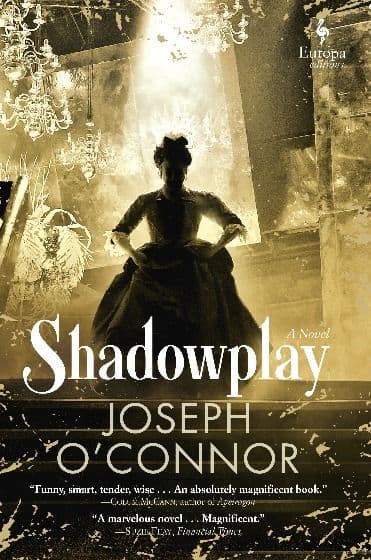
Author’s Take: “A complicated love affair featuring Dracula creator Bram Stoker.”
Favourite Line: “Some nights, she is a wall of dust moving slowly across Piccadilly, causing passers-by to marvel and to rub at their clothes; others, she is a tolling from St. Mary le Strand that exhumes a long-buried memory of broken love.”
Review: Shadowplay grew out of a BBC radio play about the friendship between writer Bram Stoker and his employer, the actor and theatre owner Henry Irving. The novel expands the story to include Ellen Terry, at the time the highest-paid actress in England (and legendary beauty). Her presence helps form a sort of bizarre love triangle – or square, if you count Stoker’s long-suffering wife Florence.
The story spans decades, from his marriage and transition from amateur Dublin theatre critic to general manger of Irving’s Lyceum in the West End, through his struggle as a failed writer to his impoverished twilight years in a nursing home. (Dracula was a flop in Stoker’s day and only became a cultural phenomenon and financial success a decade after the author’s 1912 death, thanks to a silent film called Nosferatu and the copyright diligence of his widow.)
It takes a few chapters to fall in with the novel’s particular rhythm. The prose is gleaming and lyrical, but O’Connor mischievously layers a send-up of Gothic tropes within his earnest exploration of love – and the nature of creativity, ambition and failure. Once you settle in, however, the smell of greasepaint and tallow candles mingle seamlessly with the extant letters, diary entries, and musings of theatre ghost Mina and the slippery notion of a second self.
The latter comes through in the detailed portrait of the acting craft and milieu: in some descriptive passages I felt as dazzled as the audience must have been with Irving’s state-of-the-art illusions. (He experimented with the latest technologies to create legendary special effects.) Likewise, in the Jack the Ripper period, the gripping atmosphere of fear and morbid fascination during Stoker’s episodes of sleeplessness as he wandered the city permeate the pages like sulphurous London smog. There are playful Easter eggs that acknowledge Stoker’s greatest creation (a stagehand named Harker, for example), but the suggestion of how much of Irving’s personality was borrowed to create Count Dracula and what homoerotic elements came from the writer’s own repressed sexuality are more subtle, and poetic.
O’Connor’s novel was published in North America over the summer, but knowing it was a spooky literary gothic, I saved it for the dark autumn days. Once started, I was torn between greedily devouring and slowly savouring it to make the many virtuoso passages last. – Nathalie Atkinson