JODI ECHAKOWITZ
Thornhill, Ont. an entrepreneurial public relations CEO at a tech-focused agency
THE SITUATION
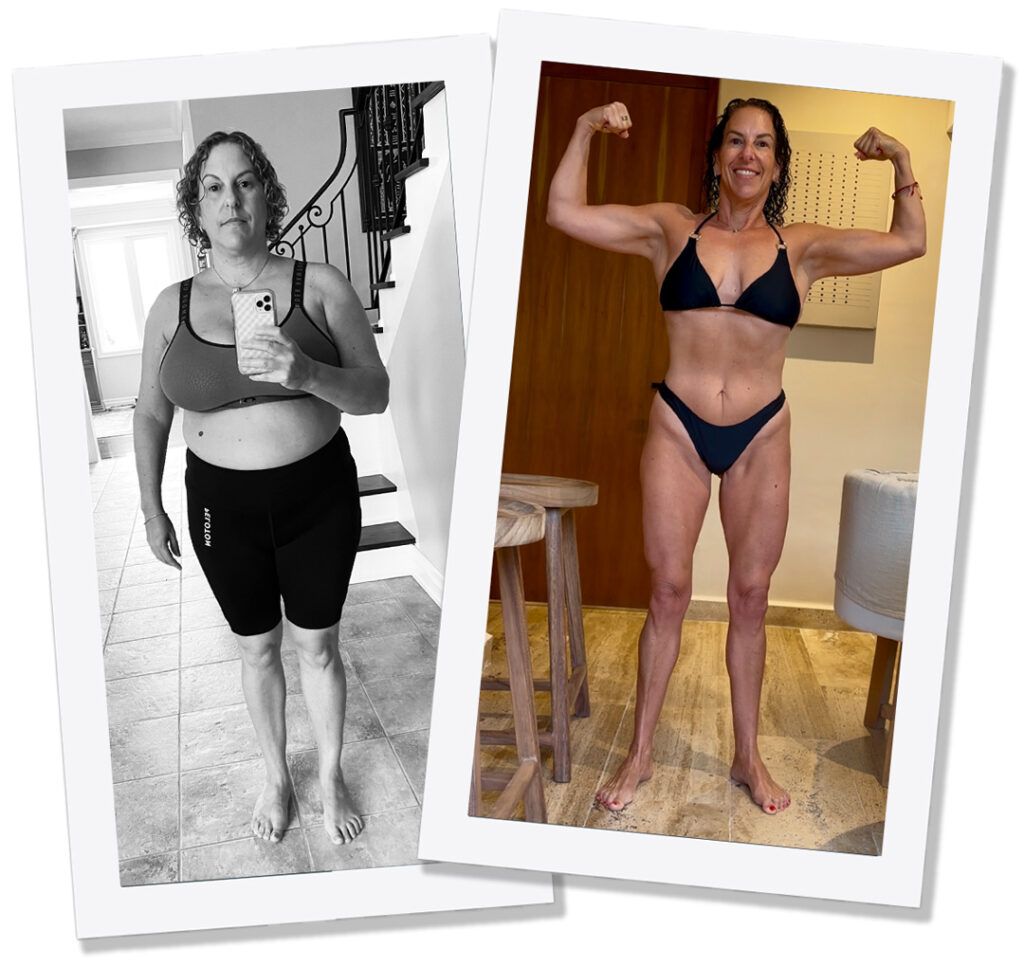
Throughout my adult life, I was a professional yo-yo dieter and had never been able to maintain a healthy weight. By late 2019 and at 5’3”, I weighed 175 pounds, 15 pounds heavier than when I was at full-term pregnancy with my kids. I was out of breath walking up the stairs, uncomfortable in my own skin and sleeping poorly.
Then, in early 2020, I realized I really had a problem. I had already been in perimenopause for a few years and had been struggling with the usual symptoms – hot flashes, night sweats, brain fog. But I got to a point where my brain fog was so bad, I was concerned I had early onset Alzheimer’s. I couldn’t remember the names of my best friend, people on my team at work and clients. I recall going into the kitchen one day and not remembering what the fridge was called. I called my doctor and asked her to test me for early-onset Alzheimer’s. She did a thorough examination, including going through preliminary cognitive testing for Alzheimer’s.
It turns out my cognition was fine, but my recall was very poor. She never said anything about my weight, but she did ask me about my nutrition. And I came clean to her, telling her how poorly I had been eating. What she said to me translated into “garbage in, garbage out.” She asked me if I can get my nutrition in check. Of course, I interpreted that as having to lose weight, not necessarily eating healthy.
So, I decided to go back on a weight-loss program for the umpteenth time, but it didn’t work. I told myself and everyone else I was doing the right things and used every excuse in the book as to why it wasn’t moving the needle – including some of the things we are always told about women in midlife, like hormones, cortisol and perimenopause. Looking back, I was lying to myself. I was still eating junk food and not following the program exactly.
THE PIVOT
I knew I needed to drop weight, but it wasn’t the weight itself that was the problem; it was the symptoms I was experiencing – no energy, exhausted all the time, out of breath walking up the stairs, sleeping poorly and, of course, major brain fog. One of the first things I did was start working with a coach focused on nutrition, strength training and mindset. At the beginning, my coach had me eat five meals a day, every two to three hours, based on the macros assigned to me. While I was eating a mix of protein, carbs and fats, the key was to prioritize protein, which is something I hardly ate before I started my health journey.
THE FIX
While it was challenging for the first few months to wake up and do my workouts daily – I had five days of strength training and two active recovery days – I still did it. I made a promise to myself to get healthy, and I showed up for myself every day. I also started with 10 minutes of cardio daily and eventually built up over time to 45 minutes of cardio four times a week and 60 minutes of cardio three times a week. I was required to walk 10,000 steps per day (excluding any steps taken during cardio). I was also intentional about the food I was eating – no junk, just good nutritious food. It took me just over nine months to drop 55 pounds, but the biggest change in me is my mindset.
CURRENT STATE OF BEING
I finally learned to love who I am after a lifetime of self-loathing. Throughout my life I was always unhappy with my body and the way I looked. In fact, I had very poor self-esteem until a few months into my journey. The way I spoke to myself throughout my teens and adult life was awful; I would never have spoken to a friend the way I spoke to myself. While I wanted this transformation to help me get to a healthy weight, more importantly, I needed help to figure out how to maintain it – something I had never been able to do. I was sick of yo-yo dieting and wanted to change my life. And I had no idea that this was the case, but maintaining my weight came down to mindset (who knew!) – particularly around identifying my upper limit and the reason why I would self-sabotage every time I felt good about myself. The inner athlete in me also emerged during this journey, and by about four months in, I started identifying as an athlete. Today, I feel stronger, more resilient, and more at peace than I ever have.
MY MANTRA
One day at a time.
LESSONS LEARNED
I worked with a coach whose program combines nutrition, strength training and mindset in a way that’s completely tailored to women. I had no idea that at my age it would be possible to build muscle. But here I am. It’s mind-blowing when I see photos of the muscles in my back, legs and shoulders. I think so many of us look at women who are lean and strong and think, “I can never do that.” But the reality is that even those women who are lean and strong started somewhere. The key is to embrace a beginner’s mindset. And believe that anything is possible. For example, when I first started doing hip thrusts in January 2022, I was using a 20-pound dumbbell. But three-and-a-half years into my journey, I’ve hip thrusted 302 pounds (on a barbell) for 12 reps. On that point, 11 months into my journey I decided I wanted to progress to “big girl” weights and learn how to use a barbell. As I train from my home gym, I added a squat rack to my gym and learned how to squat, sumo deadlift and bench press using a barbell. I’ve sumo deadlifted as much as 211.5 pounds for six reps. I’ve squatted 145 pounds for eight reps. And I’ve bench pressed 108 pounds for seven reps. I never thought that any of this would be possible.
BODY, MIND, SPIRIT
I have never been this healthy, this strong or had this much muscle on my body than I do now. It’s so incredible to know that everything I’ve achieved since starting my transformation is because of the hard work I’ve put into my journey. As my coach likes to say, “built, not bought.” Plus, there is something kind of empowering to know that I’m three years post-menopausal and yet I’ve shattered every myth that I have ever read or been told about women in menopause. We are not broken. We are very capable. We just have to be willing to show up for ourselves.
ZOOMER Rx INTEL
You can find a list of approved personal trainers from the Canadian Society for Exercise Physiology (CSEP) here